
AWS Certified Advanced Networking Specialty Interactive Course
The AWS Certified Advanced Networking - Specialty interactive course offers in-depth tutorials and targeted exercises to help you master advanced networking concepts on AWS, making it an ideal resource for effective exam preparation.
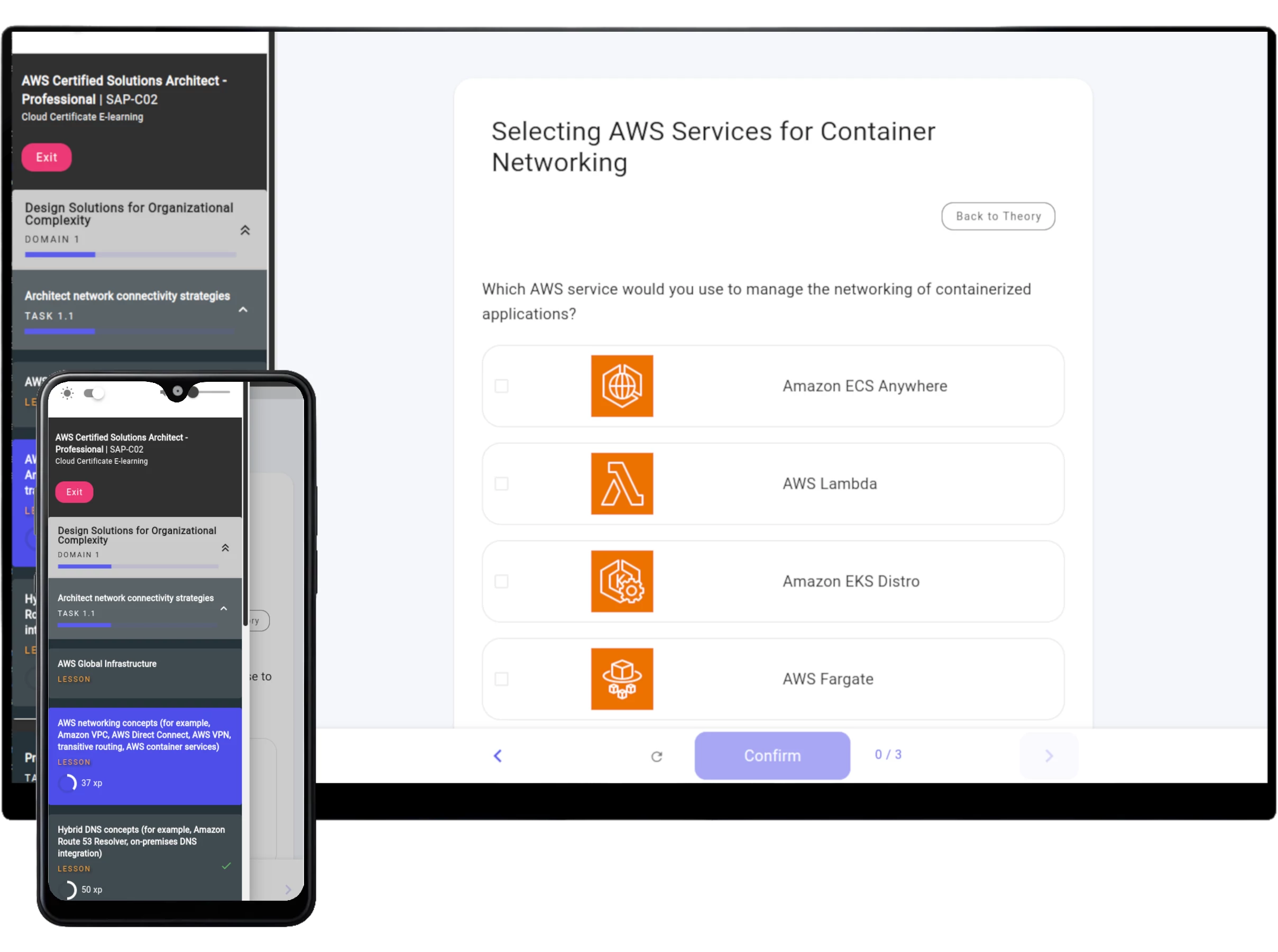
Course scope
The course follows the official ANS-C01 exam guide and covers all 4 domains and 16 tasks. Open a domain to see its lessons.
Design patterns for the usage of content distribution networks
In this stage, we will introduce the concept of Content Distribution Networks (CDNs) and their importance in modern web applications. We will specifically focus on Amazon CloudFront, an AWS service that provides a high-performance CDN for delivering content with low latency and high transfer speeds. You will gain an understanding of how CDNs work, the benefits they offer, and how they can be integrated with various AWS services.
Design patterns for global traffic management
In this lesson, we will explore design patterns for effective global traffic management with a particular focus on AWS services such as AWS Global Accelerator. We will cover principles, use cases, and examples to understand how global traffic can be managed efficiently and reliably to provide low-latency access to users worldwide.
Integration patterns for content distribution networks and global traffic management with other services
This lesson will explore the integration patterns involving Content Distribution Networks (CDNs) and global traffic management with various AWS services. CDNs help in delivering content quickly and efficiently to users around the globe, while global traffic management ensures the optimal distribution of network traffic. Understanding how to integrate these components efficiently with AWS services such as Elastic Load Balancing (ELB) and Amazon API Gateway is crucial for network optimization and performance improvement.
Evaluating requirements of global inbound and outbound traffic from the internet to design an appropriate content distribution solution
In this lesson, we will be delving into the intricacies involved in designing an appropriate content distribution solution by evaluating the requirements for both global inbound and outbound traffic from the internet. This is crucial for the AWS Certified Advanced Networking - Specialty exam. Understanding these requirements allows you to optimize content delivery, improve performance, enhance security, and manage costs effectively.
DNS protocol
The Domain Name System (DNS) is an essential component of the Internet, translating human-readable domain names into IP addresses. This lesson will cover various elements of DNS including DNS records, Time to Live (TTL), DNS Security Extensions (DNSSEC), DNS delegation, and zones. Understanding these components is crucial for the AWS Certified Advanced Networking - Specialty exam.
DNS logging and monitoring
In this lesson, we will explore the concepts of DNS logging and monitoring within the AWS environment, crucial for network security and performance. We'll go over various AWS services and features that facilitate DNS logging and monitoring, understand the importance of monitoring DNS queries, and learn how to effectively use these tools to maintain a secure and efficient network.
Amazon Route 53 features
Amazon Route 53 is a scalable DNS and domain name registration service designed to route end-user requests to internet-based applications effectively and reliably. This stage will provide an overview of Route 53's main features and their applications.
Integration of Route 53 with other AWS networking services
In this lesson, you will learn about how Amazon Route 53 can be integrated with various AWS networking services such as Amazon VPC. Route 53 is a scalable and highly available Domain Name System (DNS) web service designed to route end-user requests to infrastructure running in AWS. By the end of this lesson, you will have a thorough understanding of how Route 53 interacts with other AWS services to provide seamless network integration and reliability.
Integration of Route 53 with hybrid, multi-account, and multi-Region options
Amazon Route 53 is a scalable Domain Name System (DNS) web service designed to route end-user requests. It helps in managing domain names, creating DNS zones, and integrating with other AWS services. In this lesson, we will explore the integration of Route 53 with hybrid architectures, multi-account setups, and multi-region deployments. This tutorial will help you understand how to effectively use Route 53 for advanced networking configurations.
Domain registration
In this lesson, we'll explore the process and best practices for domain registration, especially in the context of Amazon Web Services (AWS). You'll learn about the importance of domain registration, the steps involved, and how AWS services play a crucial role in managing your domain names effectively.
Using Route 53 public hosted zones
Amazon Route 53 is a highly available and scalable Domain Name System (DNS) web service. The service is designed to provide an extremely reliable and cost-effective way for developers and businesses to route end users to internet applications. This lesson will cover the key concepts and configurations required to set up and manage Route 53 public hosted zones, which are used to manage domain names that are accessible over the internet.
Using Route 53 private hosted zones
In this lesson, we will explore AWS Route 53 private hosted zones, which are used to manage DNS within a Virtual Private Cloud (VPC). We'll cover the basic concepts, configuration steps, and best practices for using private hosted zones. By the end of this lesson, you should have a solid understanding of how to leverage private hosted zones in a secure and efficient manner.
Using Route 53 Resolver endpoints in hybrid and AWS architectures
In this introductory lesson, we'll explore the concepts and fundamentals of Route 53 Resolver endpoints. These endpoints play a crucial role in facilitating DNS resolution in hybrid and AWS environments. Understanding their function is important for managing seamless domain name resolution across different architectures. This lesson will help you get familiar with the basics before we dive deeper into specific use cases and configurations in subsequent stages.
Using Route 53 for global traffic management
In this lesson, we will explore how to use Amazon Route 53 for global traffic management. Route 53 is a scalable domain name system (DNS) web service that provides features to route end-user requests to different endpoints based on various criteria. This lesson will prepare you for using Route 53 effectively in your AWS networking tasks, particularly in a global context.
Creating and managing domain registrations
In this introductory stage, we'll discuss what domain registrations are and why they are important for your networking needs. We'll outline the goals of this lesson, which is to walk you through the process of creating and managing domain registrations using AWS Route 53. You'll learn how to register new domains, manage DNS settings, and transfer domains between AWS and other registrars.
How load balancing works at layer 3, layer 4, and layer 7 of the OSI model
In this lesson, we will explore how load balancing works at different layers of the OSI model: Layer 3 (Network Layer), Layer 4 (Transport Layer), and Layer 7 (Application Layer). You'll gain a thorough understanding of how load balancers distribute traffic across servers in a network to ensure optimal performance, reliability, and redundancy. We will cover theoretical concepts combined with practical exercises to reinforce your learning.
Different types of load balancers and how they meet requirements for network design, high availability, and security
In this lesson, we will explore different types of load balancers and how they are used in network design, high availability, and security. Load balancers are crucial for distributing incoming network traffic across multiple servers to ensure no single server bears too much load. This helps in optimizing resource use, maximizing throughput, minimizing response time, and avoiding overload of any single resource. We will specifically focus on AWS load balancers and their role in achieving these network design goals.
Connectivity patterns that apply to load balancing based on the use case
Load balancers are essential components in ensuring application reliability and availability by distributing incoming traffic across multiple targets. In AWS, load balancers come in various types, each suited for different use cases. This lesson will cover the connectivity patterns that apply to load balancing, focusing on internal and external load balancers.
Scaling factors for load balancers
In this lesson, we will explore the concept of scaling factors for load balancers in the context of AWS. Load balancers play a critical role in distributing traffic across multiple servers to ensure high availability and reliability. Understanding how to scale load balancers appropriately is essential for managing a resilient and efficient network. We'll cover the various factors that influence scaling decisions, AWS services involved, and best practices.
Integrations of load balancers and other AWS services
In this lesson, we will explore the various AWS services that can be integrated with load balancers, including AWS Global Accelerator, CloudFront, AWS WAF, Route 53, Amazon EKS, and AWS Certificate Manager. Understanding these integrations is crucial for achieving optimal performance, security, and reliability in your cloud infrastructure.
Configuration options for load balancers
In this lesson, we will explore various configuration options available for load balancers in AWS. Understanding these options is crucial for optimizing the performance, availability, and security of your applications. We will cover proxy protocol, cross-zone load balancing, session affinity (sticky sessions), and different routing algorithms. Let's get started!
Configuration options for load balancer target groups
In this lesson, we will explore the various configuration options available for load balancer target groups in AWS. Understanding these configurations is crucial for anyone pursuing the AWS Certified Advanced Networking - Specialty exam. We will cover different types of target groups such as TCP, GENEVE, IP, and instance-based configurations. By the end of this lesson, you should have a comprehensive understanding of how to configure and utilize these target group types effectively.
AWS Load Balancer Controller for Kubernetes clusters
This stage introduces the concept of AWS Load Balancer Controller for Kubernetes clusters. The AWS Load Balancer Controller integrates with the Elastic Kubernetes Service (EKS) to manage AWS Network Load Balancers (NLBs) and Application Load Balancers (ALBs). In this lesson, you will learn about its architecture, installation, configuration, and common use cases.
Considerations for encryption and authentication with load balancers
In this lesson, we will explore the key considerations for handling encryption and authentication when using load balancers in AWS. We will cover two primary strategies: TLS termination and TLS passthrough. Understanding these techniques is crucial for securing data in transit and optimizing load balancer performance.
Selecting an appropriate load balancer based on the use case
In this lesson, we will explore the intricacies of selecting the appropriate load balancer for various scenarios in AWS. AWS provides different types of load balancers, each suited for specific use cases. Understanding the differences and selecting the correct balancer can significantly impact the performance, availability, and cost-effectiveness of your applications.
Integrating auto scaling with load balancing solutions
In this lesson, we will delve into the integration of Auto Scaling with Load Balancing solutions in AWS. Understanding these two concepts and how they work together is essential for maintaining high availability, fault tolerance, and effective resource management in cloud environments. Auto Scaling helps you automatically adjust the number of instances in your deployment based on demand, while Load Balancing distributes incoming network traffic across multiple instances to ensure no single instance is overloaded.
Integrating load balancers with existing application deployments
In this lesson, we will cover the integration of load balancers with existing application deployments on AWS. Load balancers efficiently distribute incoming application traffic across multiple targets, such as Amazon EC2 instances, in multiple availability zones. We will discuss the different types of load balancers available in AWS, the process of integrating them with your applications, and the best practices to follow.
Amazon CloudWatch metrics, agents, logs, alarms, dashboards, and insights in AWS architectures to provide visibility
Amazon CloudWatch is a comprehensive monitoring service that provides data and actionable insights for AWS, hybrid, and on-premises applications and infrastructure. With CloudWatch, you can collect monitoring and operational data in the form of logs, metrics, and events, then visualize your applications' health and performance from a central dashboard. This lesson is designed to cover key concepts you need to understand for the AWS Certified Advanced Networking - Specialty exam.
AWS Transit Gateway Network Manager in architectures to provide visibility
This lesson will guide you through AWS Transit Gateway Network Manager (TGW-NM), a feature that allows you to manage and monitor your global network from a single pane of glass. You'll learn key concepts, capabilities, and how to implement it in your AWS architecture to ensure optimal performance and visibility. By the end of this lesson, you should have a solid understanding of Transit Gateway Network Manager and how it can be utilized for advanced networking scenarios.
VPC Reachability Analyzer in architectures to provide visibility
Amazon Virtual Private Cloud (VPC) Reachability Analyzer is a highly useful tool that provides comprehensive reachability analysis for your AWS VPCs. It helps identify configuration issues that might hinder network communication between resources in the VPC. Understanding VPC Reachability Analyzer is crucial for the AWS Certified Advanced Networking - Specialty exam. This introduction will set the stage for delving deeper into its functionalities and applications.
Flow logs and traffic mirroring in architectures to provide visibility
In modern cloud environments, visibility into network traffic is essential for security, troubleshooting, and performance management. AWS provides two powerful tools for this purpose: Flow Logs and Traffic Mirroring. Flow Logs capture information about the IP traffic going to and from network interfaces in your VPC. Traffic Mirroring, on the other hand, allows you to capture and inspect network traffic at the packet level. This lesson will explore these tools in detail and outline their importance in advanced networking architectures.
Access logging
In this lesson, we will cover how access logging works in the context of AWS networking services, with a particular focus on load balancers and Amazon CloudFront. Access logs are essential in understanding and auditing the traffic that passes through your applications and services. By enabling logging, you can monitor traffic patterns, troubleshoot issues, and ensure compliance with organizational policies.
Identifying the logging and monitoring requirements
This lesson will cover the various aspects of logging and monitoring that are important for the AWS Certified Advanced Networking - Specialty exam. Understanding these concepts is critical for anyone responsible for managing and securing an AWS environment. This will involve understanding AWS services designed for logging and monitoring, their configurations, and best practices.
Recommending appropriate metrics to provide visibility of the network status
In this lesson, we will explore the key network metrics essential for providing visibility into the network status within an AWS environment. These metrics will help in monitoring, diagnosing, and optimizing your AWS network infrastructure. Understanding these metrics is crucial for candidates preparing for the AWS Certified Advanced Networking - Specialty exam.
Capturing baseline network performance
Understanding your network's baseline performance is crucial for identifying issues and planning for future growth. Baseline performance captures the standard operational level of your network, encompassing metrics such as latency, throughput, and error rates. This lesson will guide you through the process of accurately capturing and interpreting your network’s baseline performance within the context of AWS, to help you prepare for the AWS Certified Advanced Networking - Specialty exam.
Routing fundamentals
In this lesson on routing fundamentals, we will explore the core concepts of routing within networking. We will delve into different types of routing such as static and dynamic routing, and focus on the Border Gateway Protocol (BGP), which is crucial for the AWS Certified Advanced Networking - Specialty exam. The lesson will comprise of detailed explanations followed by challenging exercises to test and reinforce your understanding.
Layer 1 and layer 2 concepts for physical interconnects
In this lesson, we will explore the foundational concepts of networking that encompass both Layer 1 (Physical Layer) and Layer 2 (Data Link Layer) of the OSI model. Understanding these layers is crucial for designing and managing network infrastructures, especially in cloud environments like AWS. We will delve into concepts such as VLANs, Link Aggregation Groups (LAGs), optical interconnects, and configurations like jumbo frames. By the end of this lesson, you should have a solid grasp of how these components work and how they apply within AWS architecture.
Encapsulation and encryption technologies
In this lesson, we will delve into the mechanisms of network encapsulation and encryption, specifically focusing on technologies like Generic Routing Encapsulation (GRE) and IPsec. Understanding these technologies is crucial for ensuring the security and efficiency of network communications in AWS and other environments.
Resource sharing across AWS accounts
In this lesson, we're going to explore the mechanisms and best practices for resource sharing across AWS accounts. This includes looking at AWS services that facilitate cross-account access, understanding IAM roles and policies, and practical scenarios where resource sharing is beneficial. Let's dive in to understand how AWS enables seamless resource sharing while maintaining security and compliance.
Overlay networks
In this lesson, we will explore overlay networks. An overlay network is a virtual network built on top of an existing network. These networks enable additional functionalities and efficiencies, such as easier scaling, better utilization of resources, and enhanced security. Mostly used in cloud environments, such as AWS, overlay networks facilitate features like Virtual Private Clouds (VPCs) and software-defined networking (SDN). By the end of this lesson, you'll have a deeper understanding of how overlay networks function and how they can be applied.
Identifying the requirements for hybrid connectivity
In this lesson, we will explore the requirements for establishing hybrid connectivity in AWS. We will cover topics such as Virtual Private Network (VPN) connections, AWS Direct Connect, and other necessary configurations and services. This foundational knowledge is crucial for passing the AWS Certified Advanced Networking - Specialty exam. Understanding these requirements will allow you to design and implement secure, reliable, and scalable network connections between your on-premises environment and AWS.
Designing a redundant hybrid connectivity model with AWS services
In this lesson, we'll explore designing redundant hybrid connectivity models using AWS services such as AWS Direct Connect and AWS Site-to-Site VPN. Redundant hybrid connectivity ensures high availability and resiliency of your network by combining direct physical connections and encrypted internet-based VPNs. The aim of this lesson is to provide you with theoretical knowledge as well as practical exercises to prepare you for the AWS Certified Advanced Networking - Specialty exam.
Designing BGP routing with BGP attributes to influence the traffic flows based on the desired traffic patterns
In this lesson, we will delve into the design of BGP routing with a focus on utilizing BGP attributes to influence traffic flows. We will explore how to configure settings for load sharing and active/passive paths using different BGP attributes. By the end of the lesson, you will be able to effectively design BGP routing to manage traffic patterns in AWS environments.
Designing for integration of a software-defined wide area network with AWS
In this lesson, we'll discuss the principles and best practices for integrating a Software-Defined Wide Area Network (SD-WAN) with Amazon Web Services (AWS). SD-WAN is crucial for optimizing and securing network communication across a wide geographical area, allowing enterprises to make the most of their AWS cloud infrastructure. We will cover various integration methods including AWS Transit Gateway Connect and overlay networks.
Different connectivity patterns and use cases
In this lesson, we will delve into different AWS connectivity patterns such as VPC Peering, Transit Gateway, and AWS PrivateLink. We will examine their use cases, benefits, and limitations. Understanding these patterns is critical for effectively designing network architectures on AWS.
Capabilities and advantages of VPC sharing
Virtual Private Cloud (VPC) sharing allows multiple AWS accounts to share a single VPC, leading to more efficient resource management. This is particularly useful in large organizations where different departments maintain separate AWS accounts but still need to share underlying infrastructure. Understanding the capabilities and advantages of VPC sharing in AWS is critical for optimizing network design and cost management in complex environments.
IP subnets and solutions accounting for IP address overlaps
In this lesson, we will explore the concept of IP subnets, which is essential for efficient network management, particularly in large and complex environments. Understanding subnetting will help network administrators divide larger networks into smaller, manageable segments, improving performance and security. This lesson also includes how to deal with IP address overlaps, a common issue in network management.
Connecting multiple VPCs by using the most appropriate services based on requirements
Connecting multiple Virtual Private Clouds (VPCs) within AWS provides significant flexibility for managing network resources. This lesson will cover various options such as VPC Peering, Transit Gateway, and PrivateLink, which are critical for achieving efficient and secure inter-VPC communications. Understanding when and how to use each service based on network design requirements is crucial for ensuring optimal performance and security.
Using VPC sharing in a multi-account setup
This lesson will guide you through the process of using VPC sharing in a multi-account environment. VPC sharing allows multiple AWS accounts within the same organization to share Virtual Private Cloud (VPC) resources for greater efficiency and cost savings. Understanding the benefits, prerequisites, and setup process is crucial for efficiently managing network infrastructure across different accounts.
Managing IP overlaps by using different available services and options
In cloud environments, managing IP overlaps is crucial to ensure seamless communication and to prevent conflicts between different networks. AWS offers several tools and services to help manage these overlaps, including NAT, PrivateLink, and Transit Gateway routing. This lesson will delve into each of these services, explaining their use cases, benefits, and how they help in managing IP overlaps.
Routing protocols
Routing protocols are used by routers to determine the best path for forwarding packets. They enable the sharing of route information between routers and can be broadly classified into two types: static routing and dynamic routing. Static routing is configured manually and is useful for smaller networks or specific use cases. Dynamic routing allows routers to automatically adjust pathways based on current network traffic conditions, which makes it suitable for larger and more complex network architectures. Understanding these routing protocols is crucial for AWS networking.
VPNs
Welcome to the lesson on VPNs, one of the critical components in advanced networking, including their implementation on AWS. This lesson will cover what VPNs are, why they are essential for security, how they can be used to accelerate traffic, and how AWS services facilitate VPN deployment. By the end of this lesson, you will have a comprehensive understanding of VPNs and their applications in cloud networking.
Layer 1 and types of hardware to use
This lesson will cover the fundamental concepts of Layer 1 in the OSI model and various types of hardware used in AWS networking. We'll discuss concepts such as physical cabling, data transmission, colocation facilities, Direct Connect, and the importance of Letter of Authorization (LOA) documents.
Layer 2 and layer 3
In networking, communication is separated into multiple layers to simplify network design and troubleshooting. Layer 2 deals with data link level communications and switching, while Layer 3 is responsible for logical addressing through IP and routing between different networks. Understanding both these layers is crucial for designing robust and scalable network architectures, especially in cloud environments like AWS.
Traffic management and SD-WAN
In this lesson, we will explore the critical concepts of traffic management and Software-Defined Wide Area Network (SD-WAN) within the context of AWS. We will dive deep into the workings and benefits of these technologies, focusing specifically on AWS Transit Gateway Connect. By the end of this lesson, you will have a comprehensive understanding of how to manage network traffic efficiently in AWS and leverage various AWS services to optimize your network infrastructure.
DNS
In this lesson, we will delve into the fundamentals and advanced concepts of DNS (Domain Name System) in the context of AWS. You will learn about various DNS capabilities such as conditional forwarding, hosted zones, and resolvers. Understanding DNS is crucial for network management and architectures in AWS, and it is a significant component of the AWS Certified Advanced Networking - Specialty exam.
Security appliances
In this lesson, we delve into the various security appliances, such as firewalls, that AWS offers to safeguard your infrastructure. Understanding these services and how to effectively implement them is crucial for passing the AWS Certified Advanced Networking - Specialty exam. We will cover key topics such as AWS WAF, AWS Shield, and third-party firewall solutions.
Load balancing
In the world of cloud computing, load balancing plays a crucial role in ensuring high availability and reliability of applications. AWS offers a variety of load balancing services tailored to meet diverse requirements, including Elastic Load Balancing (ELB) which supports multiple types like Application Load Balancer (ALB), Network Load Balancer (NLB), and Classic Load Balancer. This lesson will delve into these types, comparing Layer 4 and Layer 7 load balancing, and exploring reverse proxies and Layer 3 load balancers.
Infrastructure automation
In this lesson, we will delve into infrastructure automation within the AWS ecosystem. Infrastructure automation involves using code to manage and provision the technology infrastructure required to support various computing workloads. This lesson will cover automation tools, strategies, and best practices for automating infrastructure in AWS to support high-perfomance, scalable, and fault-tolerant systems.
AWS Organizations and AWS Resource Access Manager
AWS Organizations is a service that helps you centrally manage and govern your environment as you grow and scale your AWS resources. Using AWS Organizations, you can programmatically create new AWS accounts, allocate resources, group accounts for governance, automate account creation, and apply policies across the organization. AWS Resource Access Manager (RAM) enables you to securely share your AWS resources with any AWS account or within your AWS Organization. With AWS RAM, you can share resources such as Amazon VPC, subnets, AWS Transit Gateway, Amazon Route 53, and more without having to duplicate services or resources in multiple accounts.
Test connectivity
In this lesson, we'll dive into AWS network connectivity testing tools such as the Route Analyzer and Reachability Analyzer. These tools help diagnose and troubleshoot network connectivity issues within your AWS environment by providing insights into routes and reachability.
Networking services of VPCs
In this lesson, we will delve into networking services of Virtual Private Clouds (VPCs) within AWS. VPCs allow you to provision logically isolated sections of the AWS cloud where you can launch AWS resources in a virtual network. This lesson will cover key networking concepts and services such as Internet Gateways, NAT Gateways, Route Tables, VPC Peering, and PrivateLink.
Configuring the physical network requirements for hybrid connectivity solutions
In this lesson, we'll explore how to configure the physical network requirements for hybrid connectivity solutions in AWS. Hybrid connectivity involves integrating on-premises networks with AWS to create a seamless, unified environment. Understanding the physical network requirements is crucial to ensure high availability, security, and performance. We'll cover various connectivity options, including AWS Direct Connect, VPN, and Transit Gateway, and delve into the technical requirements and strategies needed for efficient hybrid network configuration.
Configuring static or dynamic routing protocols to work with hybrid connectivity solutions
In this lesson, we will explore how to configure static and dynamic routing protocols to work with hybrid connectivity solutions in AWS. With hybrid cloud solutions becoming more prominent, understanding how to integrate your on-premises environments with AWS using appropriate routing protocols is essential. We will cover static routing, dynamic routing with protocols such as BGP, and touch on AWS Direct Connect and VPN solutions.
Configuring existing on-premises networks to connect with the AWS Cloud
In this lesson, we will cover the steps and considerations for configuring an existing on-premises network to connect with the AWS Cloud. This is a crucial step for hybrid cloud deployments, ensuring seamless communication and interoperability between on-premises infrastructure and AWS resources. We will look into Direct Connect, VPN integration, and other networking services that facilitate this process.
Configuring existing on-premises name resolution with the AWS Cloud
This lesson covers how to configure existing on-premises name resolution with the AWS Cloud, an essential topic for the AWS Certified Advanced Networking - Specialty exam. You will learn about DNS resolution and integration between on-premises networks and AWS Virtual Private Cloud (VPC). This knowledge is crucial for ensuring seamless operations and connectivity in hybrid environments.
Configuring and implementing load balancing solutions
In this introductory stage, we'll discuss the basics of load balancing, its importance in distributing traffic, and how it improves the availability and scalability of applications. We'll cover AWS's various load-balancing options and give a brief overview of their features and use-cases.
Configuring network monitoring and logging for AWS services
In this lesson, we will cover how to configure network monitoring and logging for various AWS services. Network monitoring and logging are crucial for maintaining the security, compliance, and performance of your AWS infrastructure. We will explore tools and services such as Amazon CloudWatch, VPC Flow Logs, and AWS CloudTrail. By the end of this lesson, you should be able to effectively set up and manage network monitoring and logging capabilities on AWS.
Testing and validating connectivity between environments
In this lesson, we will cover various methods and tools to test and validate connectivity between different environments in AWS. You'll learn about the principles behind network connectivity, how to design and implement tests, and how to troubleshoot common issues. By the end of this lesson, you should be well-prepared to address questions on connectivity testing for the AWS Certified Advanced Networking - Specialty exam.
Inter-VPC and multi-account connectivity
In the AWS ecosystem, connecting multiple VPCs and accounts is critical for creating scalable and robust network architectures. Inter-VPC and multi-account connectivity are foundational elements that allow different networks to communicate securely and efficiently. In this lesson, we will explore various connectivity options such as VPC Peering, Transit Gateway, VPN connections, third-party vendors, SD-WAN, and MPLS. Understanding these options will prepare you for efficient network design and AWS certification.
Private application connectivity
In this lesson, you will learn about private application connectivity in AWS, with a focus on AWS PrivateLink. AWS PrivateLink provides private connectivity between VPCs, AWS services, and your on-premises networks without exposing your data to the internet. We will also cover how to configure and troubleshoot PrivateLink connections.
Methods of expanding AWS networking connectivity
Welcome to the lesson on Methods of expanding AWS networking connectivity for the AWS Certified Advanced Networking - Specialty exam. In this lesson, we'll cover various methods to interconnect your AWS environments including AWS Organizations, AWS Resource Access Manager (RAM), and other relevant services. Understanding these methods will help you optimize network performance, security, and cost-efficiency in your AWS deployments.
Host and service name resolution for applications and clients
In this lesson, we will explore the fundamentals of DNS (Domain Name System) and service name resolution within AWS environments. The DNS is essential for network communications, as it converts human-readable domain names into IP addresses required for locating and interacting with services on the Internet or within a private network.
Infrastructure automation
In this lesson, we will explore infrastructure automation, a pivotal aspect of modern cloud architecture. Specifically, we'll be focusing on how to leverage AWS services for automated infrastructure deployment, monitoring, and scaling. By the end of this lesson, you'll have a solid understanding of various tools and techniques to maintain agile and scalable cloud infrastructure.
Authentication and authorization
In this lesson, we will explore the concepts of authentication and authorization, focusing on protocols and services like SAML and Active Directory. You will learn how these mechanisms work in an AWS environment and how to leverage them to secure and manage network resources effectively.
Security
In this lesson, we will delve into various aspects of AWS security, focusing on Security Groups, Network ACLs, and AWS Network Firewall. We will cover the theoretical background behind these services and follow up with some challenging exercises to test your knowledge. Understanding these topics is crucial for the AWS Certified Advanced Networking - Specialty exam.
Test connectivity
In this lesson, we will explore various AWS tools designed to test and analyze the connectivity of your network. Understanding these tools is crucial for ensuring that your AWS architecture is efficient, secure, and resilient. This lesson covers Route Analyzer and Reachability Analyzer, two essential tools that can help you troubleshoot and optimize your AWS network.
Configuring hybrid connectivity with existing third-party vendor solutions
In this lesson, we will explore how to configure hybrid connectivity using existing third-party vendor solutions in AWS. Hybrid connectivity involves integrating AWS with on-premises and other cloud resources. Understanding how to manage such connectivity is essential for the AWS Certified Advanced Networking - Specialty exam.
Configuring network connectivity architectures by using AWS services in a single-VPC or multi-VPC design
In this lesson, we will explore the process of configuring network connectivity architectures using AWS services in both single-VPC and multi-VPC designs. We'll cover essential topics including DHCP, routing, and security groups. Understanding these concepts is vital for the AWS Certified Advanced Networking - Specialty exam. Let's get started with an overview of Virtual Private Cloud (VPC) and its fundamental components without deep dive exercises for this stage.
Configuring a hub-and-spoke network architecture
Hub-and-spoke network architecture is a common design pattern used in AWS to streamline connectivity, enhance security, and reduce operational complexity. This lesson will cover key concepts and configurations for implementing hub-and-spoke architectures using AWS Transit Gateway and Transit VPC. By the end of this lesson, you will have a solid understanding of how to set up and manage a hub-and-spoke network on AWS. Let's dive in!
Configuring a DNS solution to make hybrid connectivity possible
In this lesson, we will explore how to configure a DNS solution to facilitate hybrid connectivity between on-premises environments and AWS. This is crucial knowledge for the AWS Certified Advanced Networking - Specialty exam as hybrid architectures are common in complex network environments. We will go through DNS configuration, key AWS services involved, and best practices for maintaining a robust and secure hybrid network setup.
Implementing security between network boundaries
In this lesson, we will explore the strategies and best practices for implementing security between network boundaries in AWS. By understanding how to manage network security, you can help ensure that your AWS environment is protected against unauthorized access and data breaches. We will cover AWS services and features such as VPC, Security Groups, and Network ACLs, as well as best practices for securing your network.
Configuring network monitoring and logging by using AWS solutions
In today's advanced networking environments, monitoring and logging are essential for maintaining a secure and efficient infrastructure. AWS offers a comprehensive suite of tools designed for these purposes. Understanding how to configure these tools is crucial for the AWS Certified Advanced Networking - Specialty exam. This lesson will cover various stages, including theory and practical exercises, to provide a well-rounded understanding of AWS network monitoring and logging solutions.
When to use private hosted zones and public hosted zones
In this lesson, we will examine the use cases for private and public hosted zones in Amazon Route 53. Understanding when to employ each type of hosted zone is critical for efficient and secure network management. We will cover theory, provide examples, and include exercises to test your comprehension.
Methods to alter traffic management
In this lesson, we will explore various methods to alter traffic management in AWS environments. By understanding how to leverage AWS services to optimize traffic based on latency, geography, and other factors, you can ensure that your applications are performant and resilient. This lesson will cover theoretical knowledge as well as provide hands-on exercises to solidify your understanding.
DNS delegation and forwarding
DNS delegation and forwarding are critical concepts for effective domain name resolution in a networked environment. These techniques play a significant role in managing DNS queries and enabling the scalability and reliability of network resources. AWS allows comprehensive management of DNS through Route 53 and other services.
Different DNS record types
In this lesson, we will explore the various types of DNS records, including A, AAAA, TXT, pointer records, and alias records. Understanding these different record types is crucial for the AWS Certified Advanced Networking - Specialty exam, as it demonstrates your expertise in managing and optimizing DNS configurations in an AWS environment.
DNSSEC
DNS Security Extensions (DNSSEC) is a critical component for securing the Domain Name System. This stage sets the foundation by explaining the importance of DNSSEC, its role in preventing certain types of attacks such as cache poisoning and man-in-the-middle, and the basic working mechanism of DNSSEC. Understanding DNSSEC is vital for securing AWS resources and ensuring the integrity and authenticity of DNS data.
How to share DNS services between accounts
In this lesson, you will learn how to share DNS services between AWS accounts using AWS RAM. This practice is crucial for organizations that need to maintain separate accounts for different teams or applications but still want to manage their DNS resources centrally.
Requirements and implementation options for outbound and inbound endpoints
In this lesson, we will explore the requirements, and implementation options for outbound and inbound endpoints in AWS. Understanding these concepts is crucial for the AWS Certified Advanced Networking - Specialty exam. This includes grasping how different AWS services can be utilized to manage network traffic, secure your data, and ensure optimal performance.
Configuring DNS zones and conditional forwarding
In this lesson, we will cover the fundamental concepts of DNS zones and conditional forwarding using AWS. You will learn how to manage DNS zones and understand the purpose of conditional forwarding in a cloud environment. We will look at how to configure these components within AWS Route 53 and integrate them with other AWS services to create a robust networking architecture. No prior knowledge of DNS concepts is required, but familiarity with basic AWS services will be helpful.
Configuring traffic management by using DNS solutions
This lesson is designed to familiarize you with configuring traffic management using DNS solutions in AWS. DNS plays a pivotal role in directing internet traffic efficiently and securely to various endpoints. Understanding various AWS services that leverage DNS, such as Route 53, and how they can optimize traffic flows is crucial for Advanced Networking professionals.
Configuring DNS for hybrid networks
Welcome to this lesson on configuring DNS for hybrid networks. In hybrid network setups, integrating DNS across on-premises and cloud environments is a critical task. This lesson will guide you through the necessary steps to configure DNS settings, ensuring seamless connectivity between both environments. We will cover concepts such as private DNS, public DNS, and DNS forwarding.
Configuring appropriate DNS records
The Domain Name System (DNS) is critical in the modern internet infrastructure. Understanding and configuring appropriate DNS records is crucial for network departments, especially within AWS environments. This lesson will provide in-depth knowledge about different types of DNS records and their configuration in AWS, tailored for the AWS Certified Advanced Networking - Specialty exam.
Configuring DNSSEC on Route 53
DNSSEC (Domain Name System Security Extensions) adds an additional layer of security to DNS (Domain Name System) by enabling DNS responses to be authenticated. This ensures that responses to queries have not been tampered with and are from valid sources. In this lesson, we will guide you through configuring DNSSEC on Amazon Route 53, the scalable Domain Name System (DNS) web service provided by AWS.
Configuring DNS within a centralized or distributed network architecture
In this lesson, we will explore how to configure Domain Name System (DNS) within both centralized and distributed network architectures on the AWS platform. Understanding DNS configuration is crucial for ensuring high availability, scalability, and fault tolerance in your network infrastructure. This knowledge is also pivotal when preparing for the AWS Certified Advanced Networking - Specialty exam.
Configuring DNS monitoring and logging on Route 53
In this lesson, we'll discuss the importance of monitoring and logging in the context of DNS services. Then we'll dive into practical steps for configuring DNS monitoring and logging in AWS Route 53, covering various AWS services and tools that aid in comprehensive monitoring and logging. This is critical for the AWS Certified Advanced Networking - Specialty exam as it’s essential to maintain secure and reliable DNS configurations.
Infrastructure as code
Infrastructure as Code (IaC) is the process of managing and provisioning computing infrastructure through machine-readable definition files, rather than physical hardware configuration or interactive configuration tools. In AWS, IaC can be implemented using several tools like AWS CloudFormation, AWS CDK, AWS CLI, AWS SDK, and its APIs. This approach can improve the speed, consistency, and reliability of infrastructure setup and management.
Event-driven network automation
In this lesson, we will explore event-driven network automation within the context of AWS, a vital topic for those preparing for the AWS Certified Advanced Networking - Specialty exam. Event-driven automation allows networks to react to specific events, enhancing the agility and responsiveness of your infrastructure. You will gain an understanding of key concepts, AWS services involved, and practical exercises to solidify your knowledge.
Common problems of using hardcoded instructions in IaC templates when provisioning cloud networking resources
In this lesson, we will explore the common problems associated with using hardcoded instructions in Infrastructure as Code (IaC) templates, specifically focusing on the provisioning of cloud networking resources in AWS. Hardcoding values such as IP addresses, instance IDs, or configuration parameters can lead to inflexibility, increased risk of errors, and maintenance challenges. Understanding these issues is crucial for anyone aiming to pass the AWS Certified Advanced Networking - Specialty exam.
Creating and managing repeatable network configurations
This stage introduces the concept of creating and managing repeatable network configurations using AWS. You will learn about the importance of repeatability in cloud environments, common tools and techniques to achieve this, and how automation and infrastructure as code (IaC) play a vital role. By the end of this lesson, you'll be equipped with the knowledge to implement and manage repeatable network configurations on AWS.
Integrating event-driven networking functions
Event-driven architecture is a design pattern where components of a system communicate and react to events. In AWS, this becomes particularly powerful with the various services available that can help you create efficient and scalable network systems. This lesson will introduce key concepts and dive deep into how you can integrate event-driven networking functions to enhance the performance and manageability of your AWS infrastructure.
Integrating hybrid network automation options with AWS native IaC
In this lesson, we will explore the integration of hybrid network automation options with AWS native Infrastructure as Code (IaC) services. We will discuss various tools and techniques available for automating network operations in a hybrid cloud environment and how they can be seamlessly integrated with AWS services like CloudFormation, Terraform, and AWS SDK. This knowledge is essential for the AWS Certified Advanced Networking – Specialty exam.
Eliminating risk and achieving efficiency in a cloud networking environment while maintaining the lowest possible cost
In this lesson, we will explore strategies to eliminate risk and achieve efficiency in a cloud networking environment while aiming to maintain the lowest possible cost. This is a crucial topic for the AWS Certified Advanced Networking - Specialty exam. We will discuss various AWS services, best practices, and techniques to optimize network performance and security without compromising on budget.
Automating the process of optimizing cloud network resources with IaC
In this lesson, you will learn how to automate the process of optimizing cloud network resources using Infrastructure as Code (IaC) within the AWS ecosystem. This lesson is designed to help you prepare for the AWS Certified Advanced Networking - Specialty exam by providing both theoretical knowledge and practical exercises. Key concepts such as CloudFormation, Terraform, and best practices for network optimization will be covered.
Industry-standard routing protocols that are used in AWS hybrid networks
This lesson introduces you to industry-standard routing protocols used in AWS hybrid networks. We will explore how BGP (Border Gateway Protocol) operates over AWS Direct Connect to create robust and scalable network connections between on-premises environments and AWS cloud. By the end of this lesson, you'll have a solid understanding of these essential networking protocols and be well-prepared for the associated questions on the AWS Certified Advanced Networking - Specialty exam.
Connectivity methods for AWS and hybrid networks
Welcome to the course lesson on Connectivity methods for AWS and hybrid networks. In this lesson, we will explore various connectivity options available within AWS and for hybrid network environments. Some key topics include AWS Direct Connect, Transit Gateway, and Virtual Interfaces (VIFs). By the end of this lesson, you will have a deep understanding of these connectivity methods and how to implement them effectively.
How limits and quotas affect AWS networking services
In AWS, limits and quotas are essential mechanisms that control the usage and allocation of resources. These constraints ensure that the AWS ecosystem remains robust and that resources are fairly allocated among customers. In this lesson, we will explore how different limits and quotas affect AWS networking services, such as bandwidth limits, route limits, and more.
Available private and public access methods for custom services
In this lesson, we will explore the various private and public access methods available for custom services within the AWS ecosystem. We will cover services like AWS PrivateLink, VPC peering, and other network access options. Understanding these methods is critical for implementing secure and efficient networking solutions in AWS.
Available inter-Regional and intra-Regional communication patterns
This lesson aims to provide a comprehensive understanding of the communication patterns available within AWS for both inter-regional and intra-regional networking. You'll learn the concepts, services, and configurations that are essential for the AWS Certified Advanced Networking - Specialty exam. We'll explore theoretical aspects before diving into practical exercises.
Managing routing protocols for AWS and hybrid connectivity options
In this lesson, we will delve into the intricacies of managing routing protocols in AWS, particularly for hybrid connectivity options like AWS Direct Connect and VPN. Routing protocols are critical in ensuring data packets find the most efficient path from source to destination. Whether you're using AWS Direct Connect or VPN for hybrid connectivity, understanding how to manage these protocols is essential for network optimization and security.
Maintaining private access to custom services
Welcome to this lesson on maintaining private access to custom services in AWS. In this lesson, we will delve into two main methods of maintaining secure, private connections to your services: AWS PrivateLink and VPC Peering. By the end of this course, you should have a comprehensive understanding of how to implement and manage these services to ensure secure and private communications within your network.
Using route tables to direct traffic appropriately
Route tables are essential components in network traffic management. They are used to determine the path that network traffic takes on its journey to its destination. In this lesson, you will learn how to use route tables in AWS to direct traffic appropriately, discussing concepts such as automatic propagation and Border Gateway Protocol (BGP).
Setting up private access or public access to AWS services
In this lesson, we will explore how to set up private and public access to AWS services, focusing on Direct Connect and VPN. AWS provides multiple methods to secure your data and resources while ensuring optimal network performance. By mastering these methods, you will enhance your skills in designing and implementing secure and scalable networks on AWS.
Optimizing routing over dynamic and static routing protocols
In this lesson, we will cover the concepts of optimizing routing in the context of dynamic and static routing protocols. This is essential knowledge for the AWS Certified Advanced Networking - Specialty exam. You will learn about summarizing routes, understanding CIDR overlap, and other key optimization strategies. By the end of this lesson, you will have a solid understanding of both theoretical and practical aspects of routing optimization.
Network performance metrics and reachability constraints
In this lesson, you will learn about key network performance metrics and reachability constraints that are vital for optimizing network performance. Understanding these factors will help you design and manage efficient, high-performance networks in AWS. We will cover routing, packet size, latency, throughput, and other important network metrics, as well as tools you can use to measure and optimize these metrics in your AWS environments. Let's get started!
Appropriate logs and metrics to assess network performance and reachability issues
Understanding network performance and reachability is crucial for any AWS Certified Advanced Networking Specialist. In this lesson, we will explore various logs and metrics that can help you assess network performance and identify reachability issues such as packet loss. We will cover AWS services that provide these metrics, how to interpret them, and the best practices for troubleshooting network issues.
Tools to collect and analyze logs and metrics
This lesson introduces the various tools available in AWS for collecting and analyzing logs and metrics. Understanding how to effectively use these tools is crucial for monitoring, troubleshooting, and optimizing network performance, which is essential for the AWS Certified Advanced Networking - Specialty exam.
Tools to analyze routing patterns and issues
In this lesson, we will cover tools and methodologies for analyzing routing patterns and diagnosing routing issues in AWS environments. Understanding how to properly utilize these tools is crucial for ensuring network efficiency and security. We will particularly focus on AWS Reachability Analyzer and AWS Transit Gateway Network Manager.
Analyzing tool output to assess network performance and troubleshoot connectivity
In this lesson, we will explore various tools and logs provided by AWS to assess network performance and troubleshoot connectivity issues. Understanding VPC Flow Logs and Amazon CloudWatch Logs can provide deep insights into your network performance. By the end of this lesson, you should be able to effectively analyze output from these tools to improve your network operations and solve connectivity problems.
Mapping or understanding network topology
In this lesson, we will cover the essentials of mapping and understanding network topology in AWS, with a particular focus on AWS Transit Gateway Network Manager. We'll explore what network topology is, why it is important, and how you can leverage AWS tools to manage and optimize your network. By the end of this lesson, you'll have a solid understanding of different types of network topologies and how to represent them using AWS networking services.
Analyzing packets to identify issues in packet shaping
In this lesson, we will delve into how to analyze packets to identify issues arising from packet shaping, with a specific focus on VPC Traffic Mirroring in AWS. Understanding how to identify and troubleshoot such issues is crucial for network administrators and cloud engineers aiming to maintain optimal performance and security in their AWS environment. By the end of this lesson, you will be proficient in detecting and diagnosing packet shaping problems using various AWS tools and techniques.
Troubleshooting connectivity issues that are caused by network misconfiguration
In this lesson, we will explore how to troubleshoot connectivity issues in AWS environments that are caused by network misconfigurations. These can often be complex to resolve, requiring a good understanding of the various AWS networking services and tools available to you. Our focus will be on identifying common misconfigurations and leveraging tools like the AWS Reachability Analyzer to diagnose and resolve these issues.
Verifying that a network configuration meets network design requirements
In this lesson, we will cover the essentials of verifying that a network configuration meets network design requirements within AWS. Specifically, we will focus on tools such as AWS Reachability Analyzer and how they can assist in ensuring that your network setup aligns with your design specifications. The lesson will include practical exercises to solidify your understanding.
Automating the verification of connectivity intent as a network configuration changes
In this lesson, we will explore the concept of verifying connectivity intent in a network environment as configuration changes. Connectivity intent involves ensuring that the configurations deployed in your network fulfill the intended connectivity objectives. This is particularly crucial in dynamic network environments where configurations frequently change. By automating this verification process using tools such as the AWS Reachability Analyzer, you can improve network reliability and reduce the risk of misconfigurations leading to outages. We'll dive into different aspects of this topic, understand how to set it up, and practice with hands-on exercises.
Troubleshooting packet size mismatches in a VPC to restore network connectivity
In a Virtual Private Cloud (VPC) on AWS, ensuring proper packet sizes is crucial for maintaining optimal network connectivity. Packet size mismatches can lead to fragmentation, increased latency, and network timeouts. This lesson aims to equip you with the knowledge and skills necessary for identifying, diagnosing, and troubleshooting packet size mismatches within a VPC environment.
Situations in which a VPC peer or a transit gateway are appropriate
In this lesson, we will explore the appropriate situations for using VPC Peering and Transit Gateway in an AWS environment. Both VPC Peering and Transit Gateway are powerful tools in the AWS networking suite, each with specific use cases and benefits. Understanding when to use each is crucial for designing and managing robust AWS infrastructures. This knowledge is particularly relevant for the AWS Certified Advanced Networking - Specialty exam.
Different methods to reduce bandwidth utilization
In this lesson, we will explore various methods employed to reduce bandwidth utilization in AWS environments. Understanding these methods is crucial for efficiently managing network resources and ensuring optimal performance. We will cover concepts like unicast vs. multicast, AWS CloudFront, adaptive bitrate streaming, and other techniques.
Cost-effective connectivity options for data transfer between a VPC and on-premises environments
Cost-effective connectivity between Amazon Virtual Private Cloud (VPC) and on-premises environments is crucial for businesses looking to optimize their cloud infrastructure. In this lesson, we will explore various connectivity methods, costs, benefits, and best practices. Understanding these options is essential for anyone preparing for the AWS Certified Advanced Networking - Specialty exam.
Different types of network interfaces on AWS
This stage introduces you to the different types of network interfaces available in AWS. Understanding these interfaces is critical for managing and optimizing cloud resources and for preparing for the AWS Certified Advanced Networking - Specialty exam. We will cover Elastic Network Interfaces (ENIs), Elastic Fabric Adapters (EFAs), and Virtual Private Cloud (VPC) endpoints among others.
High-availability features in Route 53
In this lesson, you will learn about the high-availability features available in Amazon Route 53. We will cover topics such as DNS load balancing, health checks, latency-based routing, and weighted record sets. These features are essential for creating resilient and highly available applications within AWS. By the end of this lesson, you should be able to configure and manage these features effectively to ensure your applications remain available and responsive.
Availability of options from Route 53 that provide reliability
Amazon Route 53 is a scalable and highly available Domain Name System (DNS) web service. It is designed to provide developers and businesses with an extremely reliable and cost-effective way to route end users to internet applications by translating domain names into numeric IP addresses. In this lesson, we will explore the various options available in Route 53 that promote reliability, focusing on how these can be leveraged for optimal performance and dependability.
VPC subnet optimization
This lesson will cover the principles and techniques for optimizing VPC subnets in AWS, which is a key skill for the AWS Certified Advanced Networking - Specialty exam. You will learn about subnet design, IP address management, route table configurations, and use cases for different subnet types. By the end of the lesson, you'll be equipped with the knowledge to create highly efficient and secure subnet architectures.
Frame size optimization for bandwidth across different connection types
In this lesson, we will explore the importance of optimizing frame size for bandwidth efficiency across different connection types in a cloud environment. Frame size, also known as Maximum Transmission Unit (MTU), can significantly affect network performance. Proper optimization ensures maximum data throughput, reduces latency, and minimizes packet loss.
Optimizing for network throughput
In this lesson, we will focus on how to optimize network throughput for applications hosted on AWS. Network throughput is a crucial performance metric that defines the amount of data that can be transmitted over a network in a given period of time. Efficient network throughput ensures lower latency and faster data transfer rates. We'll cover several strategies, tools, and services provided by AWS, which can help you enhance network throughput.
Load balancing and traffic distribution patterns
In this lesson, we will explore the fundamentals of load balancing and traffic distribution patterns in AWS. Load balancing ensures that no single server bears too much demand, distributing incoming traffic across multiple instances. This not only improves application scalability but also ensures high availability and reliability. AWS provides several services to help with load balancing, including Elastic Load Balancing (ELB). Understanding these concepts and how to implement them is vital for the AWS Certified Advanced Networking - Specialty exam.
Selecting the right network interface for the best performance
Selecting the right network interface is crucial for ensuring optimal performance in your AWS environment. This lesson will delve into various network interfaces available on AWS, including Elastic Network Interface (ENI), Elastic Network Adapter (ENA), and Elastic Fabric Adapter (EFA). We will discuss their features, use cases, and the performance benefits they bring to your cloud infrastructure.
Choosing between VPC peering, proxy patterns, or a transit gateway connection based on analysis of the network requirements provided
In this lesson, we'll explore the differences and applications of VPC Peering, Proxy Patterns, and Transit Gateway connections in AWS. Understanding these options is crucial for designing scalable and efficient network architectures. By the end of this lesson, you should be able to choose the appropriate network connection method based on specific requirements.
Implementing a solution on an appropriate network connectivity service to meet network requirements
In this lesson, we will explore various network connectivity options provided by AWS to fulfill different networking requirements. Key services include VPC peering, Transit Gateway, and VPN connections. Each service offers unique features and use cases for connecting your AWS resources securely and efficiently.
Implementing a multicast capability within a VPC and on-premises environments
In this lesson, we will cover the implementation of multicast capabilities within both Virtual Private Cloud (VPC) and on-premises environments using AWS. Multicast is a method of network communication where data transmission is addressed to a group of destination computers simultaneously. It is highly efficient for use cases like video conferencing, live streaming, and other real-time applications. Understanding the fundamentals, configurations, and integration between AWS VPC and on-premises networks is crucial for the AWS Certified Advanced Networking - Specialty exam.
Creating Route 53 public hosted zones and private hosted zones and records to optimize application availability
In this lesson, we will cover the basics of Amazon Route 53, focusing on creating public and private hosted zones, as well as optimizing application availability through DNS entries. By understanding how to differentiate between these hosted zones and how to effectively route traffic across Availability Zones, you can ensure robust and reliable application performance on AWS.
Updating and optimizing subnets for auto scaling configurations to support increased application load
In this lesson, we will cover how to update and optimize subnets for your auto scaling configurations to support increased application loads. Understanding how to correctly configure and manage subnets is crucial in efficiently distributing application traffic and ensuring scalable and reliable performance. This lesson is structured to provide you with theoretical knowledge followed by hands-on exercises to test your understanding.
Updating and optimizing subnets to prevent the depletion of available IP addresses within a VPC
In this lesson, you will learn about managing and optimizing subnets within a Virtual Private Cloud (VPC) on AWS. Effective subnetting prevents the depletion of IP addresses and ensures efficient use of your VPC. We will start by understanding the basics of subnets and CIDRs, and then move on to more advanced topics such as updating subnets and using secondary CIDRs.
Configuring jumbo frame support across connection types
Jumbo frames are Ethernet frames with more than 1500 bytes of payload. They are used to improve network performance by allowing for larger payloads per frame. Configuring jumbo frames is essential in AWS environments to optimize performance and reduce CPU overhead. This lesson will guide you through the steps needed to configure jumbo frame support across various connection types in AWS.
Optimizing network connectivity by using Global Accelerator to improve network performance and application availability
AWS Global Accelerator is a networking service that improves the availability and performance of your applications with a highly available and global static IP address. In this lesson, we will explore how AWS Global Accelerator enhances network performance and application availability, and understand its components, features, and benefits.
Common security threats
In this lesson, we will explore common security threats you might encounter when working with Amazon Web Services (AWS). Understanding these threats is crucial for anyone preparing for the AWS Certified Advanced Networking - Specialty exam. We will cover topics like data breaches, DDoS attacks, insufficient identity and access management, insecure interfaces and APIs, and misconfiguration. This introductory stage will set the foundation for the depth of knowledge you need to ensure secure network architecture in AWS.
Different threat models based on application architecture
In this lesson, we will explore various threat models tailored to different application architectures. Understanding these threat models is crucial for the AWS Certified Advanced Networking - Specialty exam, as it ensures you can design robust and secure network architectures. We will cover traditional n-tier applications, microservices-based applications, serverless applications, and hybrid architectures, explaining the unique threats and mitigation strategies associated with each. Let’s get started by delving into the key principles of threat modeling.
Mechanisms to secure different application flows
In this lesson, we will explore different mechanisms to secure application flows in AWS. Securing the flow of your application in the cloud is crucial to protect data integrity and privacy, ensure compliance, and prevent unauthorized access. We will break down each mechanism, detail its purpose, and discuss best practices for implementation. By the end of this lesson, you should have a solid understanding of how to secure your application flows within AWS.
AWS network architecture that meets security and compliance requirements
In this lesson, we will explore the key concepts and best practices for designing an AWS network architecture that meets stringent security and compliance requirements. The AWS Certified Advanced Networking - Specialty exam will test your understanding of these concepts. This lesson will cover aspects such as Virtual Private Cloud (VPC), subnets, security groups, network ACLs, AWS Identity and Access Management (IAM), and logging and monitoring tools.
Securing inbound traffic flows into AWS
In any cloud infrastructure, securing inbound traffic is paramount for protecting sensitive data and ensuring the integrity and availability of applications. AWS offers several services geared towards enhancing the security of inbound traffic. This lesson will cover key AWS services: AWS Web Application Firewall (WAF), AWS Shield, and AWS Network Firewall, each designed to thwart different types of threats and attacks.
Securing outbound traffic flows from AWS
In this lesson, we will explore various methods to secure outbound traffic flows in AWS. Outbound traffic refers to the data that leaves your AWS resources and heads out to the internet or other external networks. It is crucial to secure this traffic to protect your data and adhere to compliance requirements. We will cover AWS services like Network Firewall, proxies, and Gateway Load Balancers, and discuss best practices for securing outbound traffic.
Securing inter-VPC traffic within an account or across multiple accounts
In this lesson, we will explore how to secure inter-VPC traffic within an AWS account or across multiple accounts. We will cover various AWS security features such as Security Groups, Network ACLs, VPC Endpoint Policies, and more. By the end of this lesson, you will understand how to effectively use these tools to safeguard traffic and ensure compliance with security best practices.
Implementing an AWS network architecture to meet security and compliance requirements
In this lesson, we will cover how to design and implement an AWS network architecture that meets security and compliance requirements. Topics will include dealing with untrusted networks, creating perimeter VPCs, and setting up a three-tier architecture. By the end of this lesson, you should understand the core concepts and be able to apply them to achieve a secure and compliant AWS setup.
Automating security incident reporting and alerting using AWS
This introductory stage aims to provide an overview of automating security incident reporting and alerting processes using AWS. You will learn about various AWS services such as AWS CloudTrail, CloudWatch, and AWS Lambda that help achieve an automated and efficient security incident handling environment.
Developing a threat model and identifying appropriate mitigation strategies for a given network architecture
In this stage, you will gain an understanding of threat modeling and its importance in creating secure network architectures. Threat modeling is the process of identifying potential threats to a system and determining the impact, likelihood, and mitigation strategies for those threats. This process helps in creating robust systems that can withstand various types of attacks and ensure data integrity. The lesson will cover the fundamental concepts, methodologies, and benefits of threat modeling before diving into practical exercises.
Testing compliance with the initial requirements
In this lesson, we will delve into the essential aspects of testing compliance with initial requirements such as failover testing and resiliency on AWS. This is a critical component for the AWS Certified Advanced Networking - Specialty exam. Understanding how to ensure that your cloud architecture meets these requirements is crucial for maintaining high availability and reliability in cloud environments. We will cover several theoretical concepts and practical exercises tailored to test your understanding.
Network monitoring and logging services that are available in AWS
In this lesson, we'll explore various network monitoring and logging services available in AWS. Understanding these services is crucial for maintaining a secure and efficiently operating network infrastructure. We will cover AWS CloudWatch, AWS CloudTrail, VPC Traffic Mirroring, VPC Flow Logs, and Transit Gateway Network Manager, and delve into their functionalities, use cases, and configurations.
Alert mechanisms
This lesson is designed to provide comprehensive knowledge on AWS alert mechanisms, particularly focusing on CloudWatch alarms. You will learn about various types of alerts, their configurations, and best practices. By the end of this lesson, you should be able to effectively set up and manage alerts in AWS to monitor and maintain your cloud infrastructure.
Log creation in different AWS services
In this lesson, we will explore how to create and manage logs in various AWS services. This is an essential skill for the AWS Certified Advanced Networking - Specialty exam. By understanding log creation, you can monitor and troubleshoot your network infrastructure efficiently. We will cover VPC flow logs, load balancer access logs, and CloudFront access logs.
Log delivery mechanisms
In this lesson, we will explore various log delivery mechanisms offered by AWS, such as Amazon Kinesis, Route 53, and CloudWatch. These services are critical for monitoring and analyzing the performance, health, and security of your AWS resources. Understanding their roles and how to configure them effectively is essential for achieving the AWS Certified Advanced Networking - Specialty exam.
Mechanisms to audit network security configurations
Auditing network security configurations in AWS is crucial to ensure your cloud infrastructure is secure and compliant with organizational policies. This lesson will guide you through various mechanisms and tools provided by AWS to audit network security configurations, such as AWS Firewall Manager, AWS Trusted Advisor, and security groups. These tools can help identify security vulnerabilities, optimize configurations, and maintain best practices.
Creating and analyzing a VPC flow log
In this lesson, we will dive into the creation and analysis of VPC Flow Logs. This is a crucial skill for the AWS Certified Advanced Networking - Specialty exam. VPC Flow Logs enable you to capture information about the IP traffic going to and from network interfaces in your VPC. Whether for security analysis, troubleshooting, or optimizing network performance, understanding how to work with VPC Flow Logs is essential.
Creating and analyzing network traffic mirroring
In this lesson, we will delve into the concept of network traffic mirroring in AWS, which is an essential feature for monitoring and analyzing network traffic. We will specifically focus on VPC Traffic Mirroring. This feature allows you to capture and inspect network traffic at the packet level within your Virtual Private Cloud (VPC). We will cover the setup process, use cases, and best practices for leveraging this feature in various scenarios.
Implementing automated alarms by using CloudWatch
Amazon CloudWatch is a monitoring and observability service for AWS cloud resources and the applications you run on AWS. CloudWatch allows you to collect and track metrics, collect and monitor log files, and set alarms. This lesson focuses on implementing automated alarms using CloudWatch, which is critical for maintaining the health and performance of your applications and infrastructure. We will cover key concepts, practical steps, and exercises to strengthen your understanding.
Implementing customized metrics by using CloudWatch
In this lesson, we will explore how to implement customized metrics using AWS CloudWatch. Customized metrics allow you to monitor and set alarms for specific application metrics that are not available through default CloudWatch metrics. This lesson is crucial for the AWS Certified Advanced Networking - Specialty exam as it covers how to create, publish, and use customized metrics in various networking scenarios.
Correlating and analyzing information across single or multiple AWS log sources
In this lesson, we'll explore how to correlate and analyze information across single or multiple AWS log sources. This is a crucial skill for anyone pursuing the AWS Certified Advanced Networking - Specialty exam. You'll learn the theory behind log correlation and analysis, and we'll also present practical exercises to test your understanding.
Implementing log delivery solutions
In modern cloud environments, log delivery is essential for monitoring, troubleshooting, and compliance. AWS offers several services and features that facilitate log delivery. This lesson will cover the implementation of these solutions, key AWS services involved, and best practices for achieving efficient log management.
Implementing a network audit strategy across single or multiple AWS network services and accounts
Welcome to the lesson on implementing a network audit strategy across AWS network services and accounts. In this lesson, you will learn how to conduct audits on various AWS network components such as Firewall Manager, security groups, and network ACLs. We'll cover theoretical concepts and provide hands-on exercises to reinforce your learning.
Network encryption options that are available on AWS
In this lesson, we will explore various network encryption options available on AWS. Understanding these encryption options is crucial for securing data in transit, which is a key aspect of network security. We will discuss benefits, use cases, and configuration tips for these options, helping you prepare for the AWS Certified Advanced Networking - Specialty exam.
VPN connectivity over Direct Connect
In this lesson, we will explore VPN connectivity over AWS Direct Connect. Direct Connect establishes a dedicated network connection from your premises to AWS, providing consistent network performance and reducing data transfer costs. When combined with VPN, it ensures a secure and flexible hybrid architecture.
Encryption methods for data in transit
This stage provides an overview of the importance of encryption for data in transit. Data in transit refers to any data that is actively moving from one location to another, such as across the internet or through a private network. Encrypting data in transit helps protect it from interception, unauthorized access, and other potential cyber threats.
Network encryption under the AWS shared responsibility model
In this lesson, we will explore network encryption within the context of the AWS Shared Responsibility Model. Understanding the shared responsibilities between AWS and the customer is crucial for securing data in transit. We will cover key encryption concepts, AWS services that offer encryption, and best practices for implementing network encryption.
Security methods for DNS communications
DNS security is crucial to ensuring the integrity, authenticity, and confidentiality of domain name resolution processes. This lesson covers key methods like DNSSEC, which adds a layer of protection against various attacks. We will cover how these methods work, their importance, and how to implement them effectively.
Implementing network encryption methods to meet application compliance requirements
In this lesson, we will explore network encryption methods such as IPsec and TLS, which are essential for securing data in transit. Understanding these methods is crucial for ensuring compliance with various application requirements. We will also delve into how to implement these methods in AWS environments to meet the AWS Certified Advanced Networking - Specialty exam standards.
Implementing encryption solutions to secure data in transit
In this lesson, we will explore the various encryption solutions that AWS provides for securing data in transit. This includes using CloudFront, Application Load Balancers, Network Load Balancers, VPN over Direct Connect, AWS managed databases, Amazon S3, custom solutions on Amazon EC2, and Transit Gateway. By the end of this lesson, you should be able to implement these solutions to ensure data is securely transmitted across different AWS services.
Implementing a certificate management solution by using a certificate authority
In this lesson, we'll explore how to implement a certificate management solution by using a certificate authority, such as ACM or AWS Private Certificate Authority (ACM PCA). We'll cover the importance of secure communications, SSL/TLS certificates, and the role of a certificate authority in managing digital certificates. By the end of this lesson, you'll have a practical understanding of deploying and managing certificates in AWS environments.
Implementing secure DNS communications
In this lesson, we will explore the importance of secure DNS communications and how it pertains to your AWS Certified Advanced Networking - Specialty exam. The Domain Name System (DNS) is a critical component of internet infrastructure that translates human-readable domain names to IP addresses. Securing DNS communications is essential to prevent interception, spoofing, or manipulation of DNS queries and responses. We will dive into various techniques and AWS services that can be utilized to achieve secure DNS communications.