
AWS Certified Solutions Architect Professional Interactive Course
Elevate your expertise with our advanced interactive course for the AWS Certified Solutions Architect - Professional exam. Master complex AWS architecture, design scalable solutions, and optimize performance.
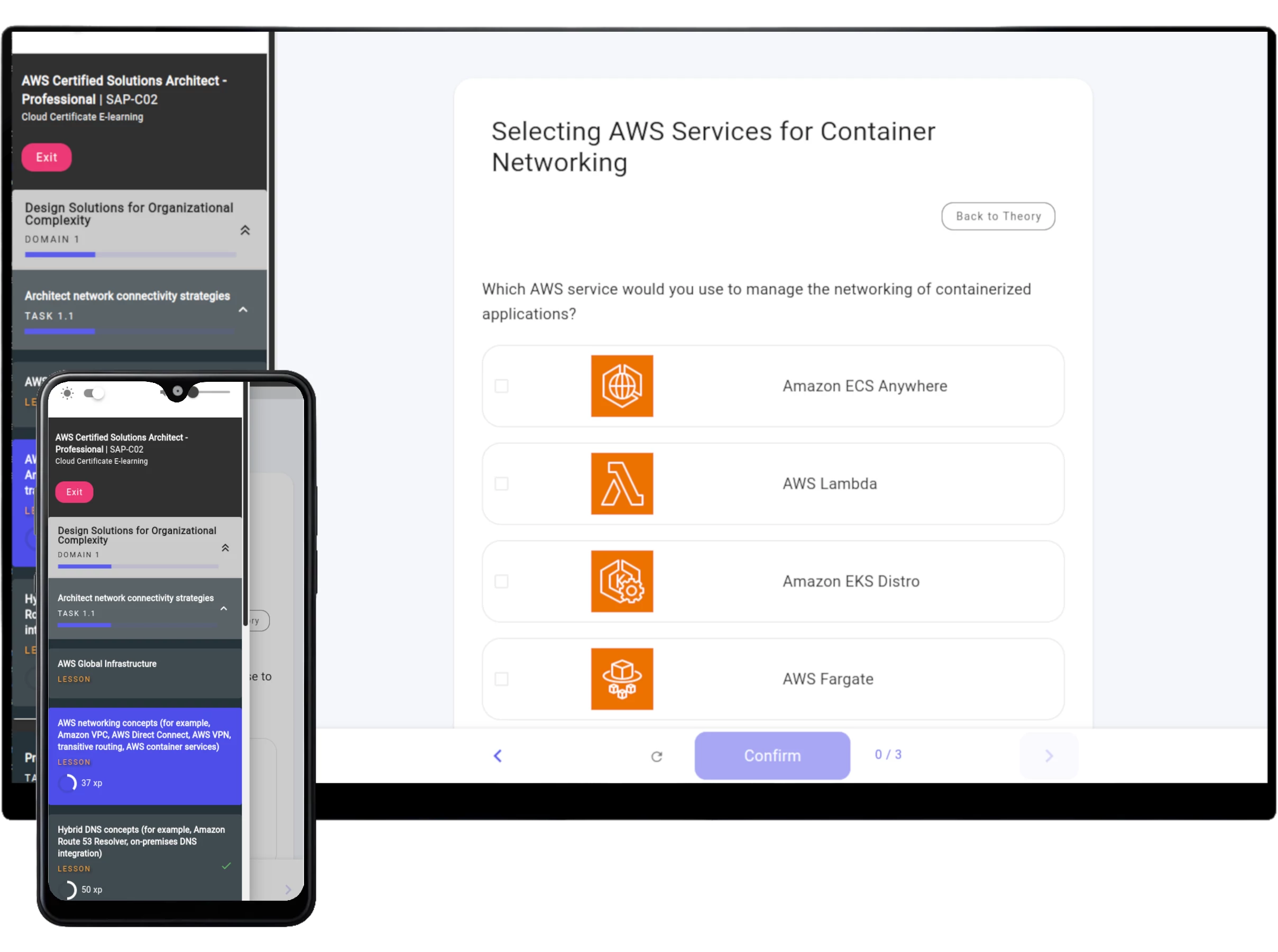
Course scope
The course follows the official SAP-C02 exam guide and covers all 4 domains and 20 tasks. Open a domain to see its lessons.
AWS Global Infrastructure
In this lesson, we will explore the AWS Global Infrastructure which is designed to enable AWS customers to deploy applications and data in a secure, scalable, and highly available manner across the globe. We'll cover concepts such as regions, availability zones, and edge locations.
AWS networking concepts
Welcome to the lesson on AWS Networking concepts. In this lesson, we will cover key topics such as Amazon VPC, AWS Direct Connect, AWS VPN, transitive routing, and AWS container services. These concepts are crucial for designing and deploying scalable, reliable, and secure applications in the AWS cloud. Understanding these topics will help you in achieving the AWS Certified Solutions Architect – Professional certification.
Hybrid DNS concepts
In this lesson, we will delve into the concepts of Hybrid DNS. This includes an understanding of how Amazon Route 53 Resolver works in conjunction with on-premises DNS. Hybrid DNS solutions allow seamless integration between AWS cloud environments and on-premises networks, providing a unified approach to DNS resolution. This is crucial for scenarios where resolution of both AWS-hosted and on-premises domains is necessary.
Network segmentation
Network segmentation is the practice of dividing a larger, overarching network into smaller, more manageable sub-networks or segments. This aids in managing traffic, improving security, and optimizing performance. Within the realm of AWS, this often involves concepts like subnetting, IP addressing, and Virtual Private Clouds (VPCs). In this lesson, we will explore these concepts in detail and how they can be applied in AWS.
Network traffic monitoring
In this lesson, we will dive into the intricacies of network traffic monitoring on AWS. You will learn about various tools and practices that AWS provides for effectively monitoring and analyzing network traffic. By the end of this lesson, you will be able to leverage these tools to maintain optimal performance and security for your AWS deployments.
Evaluating connectivity options for multiple VPCs
In this lesson, you'll learn about various approaches to connect multiple Virtual Private Clouds (VPCs) within AWS. You'll understand the pros and cons of each method, their use cases, and best practices to optimize performance and cost. The lesson will cover AWS Transit Gateway, VPC peering, AWS PrivateLink, and VPN connections. By the end of this lesson, you should be able to choose the best connectivity option for different scenarios.
Evaluating connectivity options for on-premises, co-location, and cloud integration
This lesson will provide an in-depth look at the various connectivity options available for on-premises, co-location, and cloud integration, specifically focusing on AWS services. Understanding the connectivity options is crucial for designing scalable, secure, and efficient architectures that meet business needs on AWS. We will cover topics including Direct Connect, VPN, and Transit Gateway, and explore how they fit into different scenarios.
Selecting AWS Regions and Availability Zones based on network and latency requirements
In this lesson, we will explore the importance of selecting the appropriate AWS Regions and Availability Zones based on network and latency requirements. Understanding these concepts is critical for achieving optimal performance, reliability, and compliance for your applications. This foundational knowledge is crucial for passing the AWS Certified Solutions Architect – Professional exam.
Troubleshooting traffic flows by using AWS tools
In this lesson, you will learn how to troubleshoot traffic flows in AWS environments using various AWS tools. The key tools include AWS CloudWatch, AWS CloudTrail, AWS VPC Flow Logs, and AWS X-Ray. Understanding how to effectively utilize these tools is crucial for ensuring seamless traffic management and resolving issues. We will go through different stages where we'll mix theoretical understanding with practical exercises. By the end, you'll have a solid grasp on diagnosing and fixing traffic flow problems in your applications.
Using service endpoints for service integrations
In this lesson, we will cover the concept of service endpoints in AWS, which are crucial for service integrations. We will discuss their significance, how they work, and the benefits they provide for securing and optimizing network traffic within your AWS environment. By understanding service endpoints, you will be equipped to design and implement robust AWS architectures that leverage these components effectively.
AWS Identity and Access Management and AWS IAM Identity Center
In this lesson, we will explore AWS Identity and Access Management (IAM) and AWS IAM Identity Center, also known as AWS Single Sign-On (SSO). IAM is a service that helps you securely control access to AWS services and resources for your users. AWS IAM Identity Center simplifies access management across multiple AWS accounts by allowing users to sign in to all their accounts in one place using SSO. Understanding these services is crucial for the AWS Certified Solutions Architect – Professional exam.
Route tables, security groups, and network ACLs
In this lesson, we'll dive into the core network components within AWS crucial for the AWS Certified Solutions Architect – Professional exam. We'll cover Route Tables, Security Groups, and Network ACLs, explaining their roles, configurations, and how they interact within a VPC. This foundational understanding is essential for designing secure, scalable, and highly available network architectures on AWS.
Encryption keys and certificate management
In this lesson, we will explore the concepts of encryption keys and certificate management in the context of AWS services. We will delve into AWS Key Management Service (KMS), which is used for creating and controlling encryption keys, and AWS Certificate Manager (ACM), which provision, manages, and deploys SSL/TLS certificates. Understanding how these services work will equip you with the knowledge needed to secure your applications and data in AWS.
AWS security, identity, and compliance tools
In this lesson, we will cover various AWS tools that help in ensuring the security, identity management, and compliance of your AWS environment. These tools include AWS CloudTrail, AWS Identity and Access Management (IAM) Access Analyzer, AWS Security Hub, and Amazon Inspector. By understanding these tools, you'll be better prepared for the AWS Certified Solutions Architect – Professional exam.
Evaluating cross-account access management
Cross-account access in AWS allows an IAM user or role in one AWS account to access resources in another AWS account. It's essential for various scenarios like shared services environments, centralized monitoring, or billing across multiple accounts. This lesson will delve into evaluating and configuring cross-account access management with various tools and strategies in AWS IAM.
Integrating with third-party identity providers
This stage provides an overview of the benefits and necessity of integrating AWS with third-party identity providers (IdPs). You'll understand the key reasons for integration, such as improved security, simplified management, and enhanced user experience, especially in enterprise and multi-cloud environments.
Deploying encryption strategies for data at rest and data in transit
Welcome to our lesson on deploying encryption strategies for data at rest and data in transit in AWS. This lesson will cover key concepts, AWS services, and best practices for protecting your data. Understanding these topics is crucial for the AWS Certified Solutions Architect – Professional exam. Let's get started with an overview of encryption methods and their importance.
Developing a strategy for centralized security event notifications and auditing
In an AWS environment, centralized security event notifications and auditing are critical components for maintaining security and compliance. This lesson aims to provide you with a strategy for setting up and managing centralized security event notifications and auditing in AWS, which is essential for the AWS Certified Solutions Architect – Professional exam.
Recovery time objectives and recovery point objectives
Recovery Time Objectives (RTOs) and Recovery Point Objectives (RPOs) are vital components in disaster recovery and business continuity planning. An RTO is the maximum acceptable amount of time it should take to restore normal operations following an outage or disruption. In contrast, an RPO indicates the maximum acceptable amount of data loss measured in time. Understanding and setting these objectives is crucial for designing resilient AWS architectures.
Disaster recovery strategies
In this lesson, we will explore various disaster recovery strategies available in AWS. We'll dive into concepts such as AWS Elastic Disaster Recovery, pilot light, warm standby, and multi-site. This knowledge is essential for achieving the AWS Certified Solutions Architect – Professional certification. Understanding these strategies will help you design resilient and high-availability systems.
Data backup and restoration
In this lesson, we will explore the best practices and AWS services essential for data backup and restoration. We'll delve into different strategies for ensuring data redundancy, how to set up automated backups, and the processes for restoring data in the event of a failure or data loss. Mastering this topic is crucial for passing the AWS Certified Solutions Architect – Professional exam.
Designing disaster recovery solutions based on RTO and RPO requirements
Disaster recovery (DR) is a critical component of the AWS architecture, designed to ensure business continuity. It focuses on establishing protocols and procedures that will allow an organization to quickly resume mission-critical functions following any disruptive event. Understanding Recovery Time Objective (RTO) and Recovery Point Objective (RPO) is essential in designing effective DR solutions.
Implementing architectures to automatically recover from failure
Welcome to this lesson on implementing architectures to automatically recover from failure, a critical topic for the AWS Certified Solutions Architect – Professional exam. In this lesson, we’ll cover architectural principles, best practices, and specific AWS services designed to help you build resilient systems. Understanding these concepts will allow you to create systems that can withstand and recover from various types of failures, ensuring high availability and reliability.
Developing the optimal architecture by considering scale-up and scale-out options
In this lesson, we will explore how to develop optimal architectures by considering both scale-up and scale-out strategies on AWS. We'll discuss the differences between vertical and horizontal scaling, their use cases, and strategies to implement them effectively within AWS. We'll also cover important AWS services that facilitate these scaling techniques.
Designing an effective backup and restoration strategy
In this lesson, we will explore the fundamentals of creating a robust backup and restoration strategy on AWS. This includes understanding the key AWS services involved, best practices, considerations for data integrity, and automation. A strong backup and restoration plan can safeguard your data and ensure business continuity in the event of data loss or disasters.
AWS Organizations and AWS Control Tower
This lesson aims to provide an in-depth understanding of AWS Organizations and AWS Control Tower, which are essential tools for managing multiple AWS accounts. AWS Organizations allows you to centrally manage and govern your environment as you grow and scale your AWS resources. Meanwhile, AWS Control Tower builds on AWS Organizations to provide an easier way to set up and govern a secure, multi-account AWS environment. This lesson will cover the key features, setup, and best practices for these services.
Multi-account event notifications
Multi-account event notifications in AWS enable centralized monitoring and alerting across multiple AWS accounts. This is crucial for organizations that operate multiple accounts for various purposes such as development, testing, and production. Through centralized event notifications, one can streamline operations, enhance security, and facilitate compliance. This lesson will delve into setting up such notifications using services like AWS CloudWatch, AWS CloudTrail, and AWS SNS, and how to architect solutions for multi-account environments.
AWS resource sharing across environments
This lesson will explore the methods and best practices for sharing AWS resources across different environments. We'll dive into resource sharing scenarios, cross-account access, AWS Resource Access Manager (RAM), and more. Understanding these concepts is critical for the AWS Certified Solutions Architect – Professional exam.
Evaluating the most appropriate account structure for organizational requirements
In this lesson, we will explore the intricacies of evaluating and determining the most appropriate AWS account structure for an organization's requirements. We will delve into various strategies and best practices for managing and organizing accounts effectively, ensuring optimal cost management, security, and compliance. By the end of this lesson, you should be able to recommend the right account structure for different organizational needs.
Recommending a strategy for central logging and event notifications
Central logging and event notifications are crucial components of a robust AWS architecture. They provide a unified mechanism to collect, monitor, and respond to log data and alerts from various AWS services. This can help in troubleshooting, security monitoring, and ensuring compliance with regulatory requirements. In this lesson, we will discuss best practices, AWS services involved, and recommend strategies for implementing central logging and event notifications in AWS.
Developing a multi-account governance model
In this lesson, we will explore the concepts of managing multiple AWS accounts within an organization. Governance becomes more complex as the number of accounts grows, and proper governance ensures security, cost control, and compliance. You will learn about the AWS Organizations service, as well as best practices for structuring your AWS environment.
AWS cost and usage monitoring tools
In this lesson, we will explore various AWS tools that help with cost and usage monitoring. These tools are essential for managing and optimizing your AWS expenditures. They provide insights and recommendations, help in budgeting, and allow for detailed cost analysis.
AWS purchasing options
Welcome to the lesson on AWS purchasing options. In this lesson, we'll cover key AWS purchasing options including Reserved Instances, Savings Plans, and Spot Instances. This will provide you with the knowledge required to make cost-effective and performance-optimized choices when designing solutions in AWS.
AWS rightsizing visibility tools
In this lesson, we will delve into the tools provided by AWS to help you optimize your services and resources. Rightsizing is a critical aspect of cloud cost management. Proper use of monitoring and advisor tools helps you avoid over-provisioning or paying for unused resources. We will focus on tools like AWS Compute Optimizer and Amazon S3 Storage Lens.
Monitoring cost and usage with AWS tools
In this lesson, we'll explore how to monitor and manage your AWS cost and usage using various tools provided by AWS. Understanding how to efficiently monitor costs is critical for optimizing your cloud expenditures and ensuring that resources are used optimally.
Developing an effective tagging strategy that maps costs to business units
Tagging resources in AWS is crucial for a variety of reasons such as cost allocation, resource management, and automation. Understanding how to develop an effective tagging strategy can greatly benefit businesses in terms of tracking costs and managing resources efficiently. This lesson will guide you through creating a tagging strategy that maps costs to business units, a vital skill for AWS Certified Solutions Architect - Professional exam.
Understanding how purchasing options affect cost and performance
As an AWS Certified Solutions Architect Professional, understanding the purchasing options available in AWS is crucial for designing cost-effective and high-performance architectures. This lesson will guide you through various purchasing options, such as On-Demand, Reserved Instances, and Spot Instances, and how they affect both cost and performance.
Infrastructure as code
In this lesson, we will cover the essentials of Infrastructure as Code (IaC), focusing on AWS CloudFormation. Infrastructure as Code is a key practice in DevOps and Cloud Computing that allows you to define and manage infrastructure using configuration files. AWS CloudFormation is a powerful IaC service that enables you to provision, update, and manage AWS resources in an automated and repeatable way. Understanding these concepts is crucial for the AWS Certified Solutions Architect – Professional exam, as it helps you design and scale secure, reliable, and cost-effective systems in the cloud.
Continuous integration and continuous delivery
Continuous Integration (CI) and Continuous Delivery (CD) are practices that enable development teams to deliver code changes more frequently and reliably. CI involves integrating code changes into a shared repository multiple times a day, with each integration verified by automated tests to detect errors early. CD extends this process by ensuring that integrated code is always in a deployable state, allowing for automated deployment to production environments. This lesson will cover the key concepts, AWS services, and best practices necessary for implementing a CI/CD pipeline in AWS.
Change management processes
Understanding the change management process is essential for managing resources and applications effectively in the AWS environment. This lesson focuses on the principles, methodologies, and tools used in change management for AWS Certified Solutions Architect – Professional.
Configuration management tools
Configuration management tools are essential for efficiently managing and maintaining your cloud infrastructure. They help automate tasks such as software installations, configurations, and updates, reducing the need for manual intervention and minimizing the risk of human errors. AWS offers several tools for configuration management, including AWS Systems Manager. In this lesson, we'll explore these tools, their features, and how they fit into a larger AWS architecture.
Determining an application or upgrade path for new services and features
This lesson will cover the steps and considerations necessary for determining the path of applying or upgrading new services and features in AWS. The goal is to understand the systematic approach required for AWS Certified Solutions Architect – Professional exam candidates to make informed decisions. We will explore various practices, analyze decision-making criteria, and assess how these elements come together in planning.
Selecting services to develop deployment strategies and implement appropriate rollback mechanisms
In this lesson, we will explore various deployment strategies and how to implement effective rollback mechanisms using AWS services. This knowledge is critical for maintaining the reliability and availability of your applications while ensuring smooth transitions during application updates. We will cover Blue/Green deployments, Canary deployments, A/B testing, and how to configure automatic rollbacks effectively.
Adopting managed services as needed to reduce infrastructure provisioning and patching overhead
In this lesson, we will explore the advantages of adopting managed services in AWS to reduce overhead caused by infrastructure provisioning and patching. Managed services can offload many routine management tasks, allowing your organization to focus on more strategic endeavors. Understanding which services provide the best return on investment and how to integrate them into your architecture is critical for any AWS Certified Solutions Architect - Professional.
Making advanced technologies accessible by delegating complex development and deployment tasks to AWS
In this lesson, we will explore how AWS can be used to simplify the adoption of advanced technologies by delegating complex development and deployment tasks to the platform. By leveraging AWS services, organizations can focus on building their applications rather than managing infrastructure. This lesson is particularly relevant for those preparing for the AWS Certified Solutions Architect – Professional exam.
AWS Global Infrastructure
In this lesson, we will explore the AWS Global Infrastructure, which is the backbone of AWS services. Understanding the global network setup, regions, availability zones, and edge locations is crucial for architecting robust and highly available applications.
AWS networking concepts
In this lesson, we will dive into the key networking concepts in AWS that are essential for the AWS Certified Solutions Architect – Professional exam. The topics covered include Amazon Route 53, routing methods, and other essential networking services. By the end of this lesson, you should understand how to design, implement, and manage networking in AWS.
RTOs and RPOs
Recovery Time Objectives (RTOs) and Recovery Point Objectives (RPOs) are essential metrics in disaster recovery and business continuity planning. Understanding these concepts helps define the acceptable amount of downtime and data loss during outages or disasters.
Disaster recovery scenarios
Disaster recovery (DR) involves a set of policies and procedures to enable the recovery or continuation of vital technology infrastructures and systems following a natural or human-induced disaster. In AWS, various DR strategies can be implemented ranging from simple backups to full-scale multi-site deployments. This lesson explores common DR strategies such as backup and restore, pilot light, warm standby, and multi-site, explaining the theory behind each method and providing exercises to test your understanding.
Disaster recovery solutions on AWS
Understanding disaster recovery (DR) is crucial for cloud architects. This lesson will delve into various DR solutions available on AWS, their use cases, and how to implement them. Key topics include RPO (Recovery Point Objective), RTO (Recovery Time Objective), and the four DR strategies on AWS: Backup and Restore, Pilot Light, Warm Standby, and Multi-site.
Configuring disaster recovery solutions
In this lesson, we will explore various disaster recovery solutions within AWS. Disaster recovery is a critical component in ensuring your applications and data remain available and intact in the event of failures or disasters. We will examine different strategies such as backup and restore, pilot light, warm standby, and multi-site active-active configurations. Understanding these strategies and how to implement them using AWS services will prepare you for scenarios you may encounter in the AWS Certified Solutions Architect – Professional exam.
Configuring data and database replication
In this lesson, we will cover how to configure data and database replication in AWS. Data replication entails copying data from one location to another to ensure availability, durability, and disaster recovery. Database replication, on the other hand, involves copying database changes from one database to another to maintain consistency and provide failover capability. By the end of this lesson, you will be well-equipped to handle data and database replication scenarios in AWS.
Performing disaster recovery testing
This lesson will cover the essential aspects of performing disaster recovery (DR) testing in an AWS environment. As a certified AWS solutions architect, understanding how to effectively plan and execute DR tests is crucial to ensure business continuity. You will learn about different DR strategies, DR scenarios, and how to utilize AWS services to implement these strategies. By the end of this lesson, you should be well-prepared for questions related to disaster recovery testing on the AWS Certified Solutions Architect – Professional exam.
Architecting a backup solution that is automated, is cost-effective, and supports business continuity across multiple Availability Zones or Regions
In this lesson, we will explore how to architect an automated, cost-effective backup solution that supports business continuity across multiple Availability Zones (AZs) or Regions in AWS. This is an essential topic for the AWS Certified Solutions Architect – Professional exam. Understanding the architecture considerations and best practices will help you ensure data integrity, availability, and durability.
Using processes and components for centralized monitoring to proactively recover from system failures
Centralized monitoring in AWS allows for streamlined oversight of cloud infrastructure. By using various AWS services, you can proactively recover from system failures and ensure the high availability and reliability of your systems. In this lesson, we will explore processes and components essential for implementing centralized monitoring and recovery in AWS.
Designing an architecture that provides application and infrastructure availability in the event of a disruption
In this first stage of our lesson, we introduce the concepts of high availability (HA) and fault tolerance within the context of AWS. AWS provides a powerful set of tools and services that allow architects to design systems that are resilient to failures and disruptions. Key concepts include load balancing, auto-scaling, replication across multiple availability zones (AZs), and rigorous monitoring. Understanding these principles is crucial to ensuring application and infrastructure availability, a critical requirement for many organizations.
IAM
In this lesson, we will explore Identity and Access Management (IAM) in AWS, a critical service for managing permissions and roles in your AWS environment. Understanding IAM is essential for ensuring secure and organized access to AWS resources. This section will cover the basics of IAM, the components involved, and best practices for managing identities and permissions.
Route tables, security groups, and network ACLs
In this lesson, we'll dive into the fundamental components of networking in AWS: Route tables, Security Groups, and Network ACLs. Understanding these components is crucial for designing and implementing secure, efficient, and scalable architectures in the cloud. By the end of this lesson, you'll be well-equipped to manage network traffic within your AWS environment using these essential tools.
Encryption options for data at rest and data in transit
In today's lesson, we will cover various encryption options available for data at rest and data in transit within AWS. Understanding these options is crucial for ensuring data security and compliance in your AWS environment. We will delve into different AWS services that support encryption and the best practices for implementing them.
AWS service endpoints
In this lesson, we will focus on AWS service endpoints, which play a crucial role in accessing AWS services in different regions. Understanding how endpoints work and their configurations is essential for AWS Certified Solutions Architects. We will deep dive into regional and global services, VPC endpoints, endpoint policies, and more.
Credential management services
This stage introduces the fundamentals of credential management services offered by AWS. Credential management involves the creation, rotation, and storage of keys, passwords, and tokens to secure applications and services. AWS provides a variety of tools and services to manage credentials, including AWS Identity and Access Management (IAM), AWS Key Management Service (KMS), AWS Secrets Manager, and AWS Systems Manager Parameter Store. Understanding these services and their best practices is crucial for ensuring secure authorization and authentication in your AWS environment.
AWS managed security services
This lesson provides an overview of AWS Managed Security Services essential for the AWS Certified Solutions Architect – Professional exam. It covers AWS Shield, AWS WAF, Amazon GuardDuty, and AWS Security Hub. These services are vital for securing applications and data on the AWS cloud platform.
Specifying IAM users and IAM roles that adhere to the principle of least privilege access
In this lesson, we will delve into the principles of IAM (Identity and Access Management) users and roles within AWS, focusing on adhering to the principle of least privilege. This principle ensures that IAM users and roles have only the permissions required to perform their tasks, reducing security risks. We will cover best practices, examine the mechanisms for setting appropriate permissions, and explore various scenarios illustrating the application of least privilege.
Specifying inbound and outbound network flows by using security group rules and network ACL rules
In this lesson, we will cover how to specify inbound and outbound network flows using security group rules and network ACL rules. This is essential knowledge for the AWS Certified Solutions Architect – Professional exam. Understanding how to control traffic at both the instance and subnet level is crucial for designing secure and efficient AWS architectures.
Developing attack mitigation strategies for large-scale web applications
With the increasing scale and complexity of web applications, it's essential to develop effective strategies for mitigating various attacks. AWS provides a wide array of tools and services that help in building secure, resilient web applications. This lesson focuses on understanding different threat vectors and implementing mitigation techniques to defend against them specifically in the context of AWS Cloud.
Developing encryption strategies for data at rest and data in transit
In this module, we will cover the essential concepts and strategies for implementing effective encryption for data at rest and data in transit in the AWS cloud. Understanding these principles is critical for passing the AWS Certified Solutions Architect – Professional exam. We will discuss why encryption is necessary, the different AWS services that offer encryption, and best practices.
Specifying service endpoints for service integrations
In this lesson, we will cover how to specify service endpoints for integrating various AWS services. Understanding endpoints helps in configuring applications for optimal performance, security, and reliability. We will look into different types of endpoints, their use cases, and how to effectively configure them in your AWS environment. By mastering this, you'll enhance your proficiency in designing architectures that are robust, secure, and efficient.
Developing strategies for patch management to remain compliant with organizational standards
Patch management is essential for maintaining the security and compliance of your AWS architecture. This lesson covers the best practices, AWS services, and strategies needed to effectively manage patches and stay compliant with organizational standards.
AWS Global Infrastructure
AWS Global Infrastructure is designed to deliver robust and reliable services on a global scale. Understanding its structure and components is essential for designing highly available, fault-tolerant, and resilient architectures. In this lesson, you'll learn about regions, availability zones, edge locations, and the backbone network.
AWS storage services and replication strategies
This lesson covers the various Storage Services AWS offers and the replication strategies available for data durability and high availability. Services such as Amazon S3, Amazon RDS, and Amazon ElastiCache will be explored. By the end of this lesson, you should have a clear understanding of these services and their respective replication methodologies.
Multi-AZ and multi-Region architectures
In this lesson, we will explore the concepts of Multi-AZ (Availability Zone) and Multi-Region architectures in AWS. These architectures enhance the availability, fault tolerance, and disaster recovery of applications. We'll cover the theory and practical applications of both strategies. By the end of this lesson, you'll understand how to design highly available and resilient architectures using AWS services.
Auto scaling policies and events
In this lesson, we will dive into the mechanics of AWS Auto Scaling. We will explore different types of auto-scaling policies, how they function, and the events that trigger these policies. This knowledge is crucial for optimizing the performance, availability, and cost-efficiency of applications running on AWS.
Application integration
In this lesson, we will delve into the core concepts of application integration using AWS services. Key services we'll be exploring include Amazon Simple Notification Service (Amazon SNS), Amazon Simple Queue Service (Amazon SQS), and AWS Step Functions. By understanding these services, you will be able to design robust, scalable, and reliable systems that leverage AWS's cloud capabilities.
Service quotas and limits
In AWS, service quotas (or limits) are the maximum number of resources that you can create for a given Amazon Web Service. These quotas are imposed by AWS to ensure the optimal performance and availability of services. As an AWS Certified Solutions Architect – Professional, it's essential to understand these limits to architect scalable solutions efficiently and avoid service interruptions.
Designing highly available application environments based on business requirements
In this introductory stage, you will learn about the concepts of high availability (HA) and its importance in cloud environments, specifically AWS. High availability refers to the ability of a system to operate continuously without failure for a long time. AWS provides various services and architectures that help achieve HA and align with business requirements. Understanding the basics of HA will set the foundation for designing robust, fault-tolerant systems.
Using advanced techniques to design for failure and ensure seamless system recoverability
In this lesson, we will cover advanced techniques to design AWS solutions for failure and ensure seamless recoverability. By preparing for inevitable failures, you can build robust and reliable systems. This lesson aligns with the AWS Certified Solutions Architect – Professional exam requirements by focusing on best practices for high availability, reliability, and disaster recovery.
Implementing loosely coupled dependencies
The idea of loosely coupled dependencies is to minimize the interconnections between various components of a system. In AWS, this means designing services that interact with each other in a way that does not require them to be tightly linked. This reduces the risk of a single point of failure and allows for more flexibility and scalability. This stage will introduce the concept and its importance in the context of AWS solutions architecture.
Operating and maintaining high-availability architectures
In this lesson, we will dive into the realm of high-availability architectures on AWS. High-availability (HA) architectures are designed to ensure continuous operation, with minimal downtime. This involves using multiple resources and failover mechanisms so that if one component fails, another can take its place without interrupting the application’s operation. This lesson will focus on strategies for creating HA architectures including application and database failovers.
Using AWS managed services for high availability
This lesson provides an in-depth understanding of how to utilize AWS managed services to achieve high availability for your applications. High availability ensures that your services remain available and operational even during partial system failures. Understanding the AWS ecosystem's managed services is crucial for implementing robust, resilient, and highly available architectures, which are key concepts for the AWS Certified Solutions Architect – Professional exam.
Implementing DNS routing policies
In this lesson, we'll delve into the DNS routing policies provided by AWS Route 53, including latency-based routing, geolocation routing, and simple routing. Understanding these policies is essential for optimizing domain name system operations, enhancing user experience, and ensuring optimal application performance. Through a series of stages comprising theory and exercises, you'll master how to implement and manage these routing policies efficiently.
Performance monitoring technologies
In this lesson, we will cover various technologies and services offered by AWS that are essential in monitoring the performance of your applications and infrastructure. Understanding these tools and their functionalities is critical for both ongoing operational management and the successful preparation for the AWS Certified Solutions Architect – Professional exam. Let’s dive in!
Storage options on AWS
This lesson covers the different storage options available on AWS. As an AWS Certified Solutions Architect – Professional, it's crucial to understand the nuances, use cases, and best practices associated with each storage service. We will explore services such as Amazon S3, EBS, EFS, and Glacier, among others. By the end of this lesson, you should be able to identify which storage solution is suitable for various scenarios.
Instance families and use cases
In this lesson, we will explore the different EC2 instance families offered by AWS and their use cases. We will cover general-purpose instances, compute-optimized instances, memory-optimized instances, storage-optimized instances, and accelerated computing instances. Each instance type is designed for specific workloads and understanding these can help you select the most appropriate instance for your application.
Purpose-built databases
In today's world, businesses demand high-performance databases that are tailored to specific workloads. Purpose-built databases are designed to meet the needs of different applications with various data models and structures. AWS offers a wide range of purpose-built databases to address these diverse requirements efficiently.
Designing large-scale application architectures for a variety of access patterns
In this lesson, we will explore the principles and best practices for designing large-scale application architectures on Amazon Web Services (AWS). This lesson is specifically tailored for those preparing for the AWS Certified Solutions Architect – Professional exam. We will cover topics such as scalability, availability, security, and performance optimization, ensuring that your architectural designs can handle a variety of access patterns reliably and efficiently.
Designing an elastic architecture based on business objectives
This lesson will introduce you to designing an elastic architecture on AWS that adapts to changing business objectives. You will learn how to leverage AWS services to create an infrastructure that scales dynamically and efficiently. Key concepts include understanding business requirements, selecting appropriate AWS services, and implementing automated scaling solutions to optimize performance and cost management.
Applying design patterns to meet performance objectives with caching, buffering, and replicas
This lesson will guide you through different design patterns that enhance performance in AWS cloud solutions. We will explore concepts such as caching, buffering, and using replicas to meet various performance objectives. By understanding and applying these patterns, you'll be better equipped to design highly efficient and scalable architectures on AWS.
Developing a process methodology for selecting purpose-built services for required tasks
In this lesson, we'll explore the methodology needed to select the right AWS services tailored to specific tasks. Purpose-built services in AWS are designed to address specific business needs such as data processing, storage, machine learning, and more. Understanding how to choose the most appropriate service will enhance your ability to build robust, scalable, and cost-effective solutions.
Designing a rightsizing strategy
In this lesson, we will explore how to design a rightsizing strategy for AWS environments as part of your preparation for the AWS Certified Solutions Architect – Professional exam. Rightsizing involves optimizing your cloud resources to ensure cost-efficiency and performance. We will break down the concepts and include challenging exercises to cement your understanding.
AWS cost and usage monitoring tools
In this lesson, we will explore various AWS tools and services that help in managing and monitoring AWS costs and usage. Understanding these tools is crucial for the AWS Certified Solutions Architect – Professional exam. We will discuss key tools like Cost Explorer, Trusted Advisor, and AWS Pricing Calculator among others. Let's dive in and learn how each tool contributes to efficient cost management.
Pricing models
Welcome to the lesson on AWS Pricing Models. In this lesson, we will delve deeply into different pricing models offered by AWS, such as Reserved Instances and Savings Plans. Understanding these models is critical for the AWS Certified Solutions Architect – Professional exam, as they help in optimizing costs effectively. We will explore their features, benefits, use-cases, and practical application strategies.
Storage tiering
Storage tiering involves the placement of data in various types of storage mediums based on performance, cost, and access requirements. It's a critical concept in AWS to optimize storage costs and performance while ensuring that the appropriate service levels are met. In this lesson, we will explore AWS services and strategies related to storage tiering, analyze scenarios, and learn how to implement tiered storage solutions.
Data transfer costs
In this lesson, we will delve into the various components that contribute to data transfer costs within AWS. Understanding these costs is crucial for optimizing your cloud architecture and avoiding unexpected expenses. This lesson is designed to prepare you for the AWS Certified Solutions Architect – Professional exam by covering key concepts, terminologies, and practical scenarios related to data transfer costs.
AWS managed service offerings
Welcome to the lesson on AWS Managed Services. In this lesson, we will cover different AWS managed service offerings which are crucial for the AWS Certified Solutions Architect – Professional exam. Understanding these services helps you architect highly available, fault-tolerant, scalable, and cost-effective solutions on AWS.
Identifying opportunities to select and rightsize infrastructure for cost-effective resources
In this lesson, we will focus on identifying opportunities to select and rightsize infrastructure for cost-effective resources within the AWS environment. This topic is crucial for the AWS Certified Solutions Architect – Professional exam. We will explore various aspects such as understanding AWS services, analyzing workloads, and applying cost-management principles.
Identifying appropriate pricing models
In this lesson, we will explore the various pricing models in AWS and how to identify the most appropriate one for a given use case. AWS offers a variety of pricing models tailored to different services and operational needs. Understanding these models is crucial for AWS Certified Solutions Architects, as it helps in optimizing cost and ensuring the efficiency of cloud resources.
Performing data transfer modeling and selecting services to reduce data transfer costs
In this lesson, we'll explore the best practices for performing data transfer modeling and selecting AWS services to reduce data transfer costs. Understanding the intricacies of data transfer charges and how to model them effectively is crucial for creating cost-effective architectures. We’ll also cover the selection of services that can help you minimize data transfer expenses within AWS ecosystem.
Developing a strategy and implementing controls for expenditure and usage awareness
Welcome to the lesson on developing a strategy and implementing controls for expenditure and usage awareness for the AWS Certified Solutions Architect – Professional exam. In this lesson, we will explore how to manage costs and optimize the usage of AWS services. This includes setting budgets, monitoring costs, and using AWS tools to track and manage expenses. Understanding these concepts will help you design cost-effective and efficient solutions on AWS.
Alerting and automatic remediation strategies
In this lesson, we will explore the essential concepts of alerting and automatic remediation in AWS. Understanding these principles is crucial for managing a scalable and resilient cloud infrastructure. We will cover various AWS services involved in monitoring and alerting, and show how to implement automatic remediation strategies to maintain system reliability and performance.
Disaster recovery planning
In this stage, you will get an introduction to Disaster Recovery (DR) Planning. Disaster Recovery in the context of AWS refers to the strategies and services to ensure the quick recovery of critical IT systems. DR planning is crucial for minimizing downtime and data loss during a disaster situation. In this lesson, you will learn about different DR strategies, key AWS services involved, and how to create an effective DR plan.
Monitoring and logging solutions
In this lesson, we'll be diving into the monitoring and logging capabilities of Amazon CloudWatch, an essential service for maintaining the health and performance of your applications on AWS. We'll cover foundational concepts, practical applications, and configuration steps necessary for leveraging CloudWatch to its fullest potential. By the end of this lesson, you should have a solid understanding of how to set up monitoring and logging using Amazon CloudWatch.
CI/CD pipelines and deployment strategies
Continuous Integration and Continuous Deployment (CI/CD) have drastically transformed the way software developers deliver applications. In essence, CI/CD pipelines automate the entire process of building, testing and deploying code, ensuring consistent delivery with minimal errors. In this lesson, we'll deep dive into different CI/CD pipeline stages and various deployment strategies like blue/green, all-at-once, and rolling deployments.
Configuration management tools
Configuration management tools are essential for maintaining consistent system configurations, automating operational tasks, and ensuring compliance with infrastructure policies. AWS offers several services that aid in configuration management, such as AWS Systems Manager, AWS CloudFormation, and AWS OpsWorks. This lesson will delve into the key features, use cases, and best practices for using these tools in designing scalable, efficient, and secure AWS architectures.
Determining the most appropriate logging and monitoring strategy
In this lesson, we will explore the best practices for implementing logging and monitoring strategies within AWS. Proper logging and monitoring are crucial for maintaining the health, performance, and security of your AWS environments. This lesson aims to prepare you for scenarios you'll face in the AWS Certified Solutions Architect – Professional exam. You'll learn about various AWS services and how they fit into an overall monitoring strategy.
Evaluating current deployment processes for improvement opportunities
In this lesson, we'll explore the critical elements involved in evaluating current deployment processes for potential improvement opportunities. Understanding these processes is essential to identifying inefficiencies and enhancing system performance. This knowledge is crucial for those preparing for the AWS Certified Solutions Architect – Professional exam.
Prioritizing opportunities for automation within a solution stack
In this lesson, we will explore techniques for identifying and prioritizing opportunities for automation within a solution stack. As an AWS Certified Solutions Architect – Professional, you need to ensure that resources are utilized efficiently, while maximizing productivity through automation. We'll cover strategies for evaluating and aligning automation opportunities with business objectives.
Recommending the appropriate AWS solution to enable configuration management automation
In this lesson, we will explore various AWS solutions that enable configuration management automation. Configuration management is essential for automating the deployment, configuration, and management of infrastructure. This lesson will help you understand the different options available on AWS and how to choose the most appropriate solution based on specific requirements.
Engineering failure scenario activities to support and exercise an understanding of recovery actions
In this lesson, we will explore different engineering failure scenarios and recovery actions in the context of AWS architecture. Understanding how to anticipate, react to, and recover from failures is crucial for any AWS Certified Solutions Architect – Professional. You will engage in various activities designed to test your knowledge and provide practical experience with AWS services and features related to recovery actions.
Data retention, data sensitivity, and data regulatory requirements
In this lesson, we will explore the concepts of data retention, data sensitivity, and data regulatory requirements within the context of AWS Certified Solutions Architect – Professional exam. Understanding these concepts is essential for designing secure, compliant, and efficient cloud solutions. We will delve into the key aspects of each topic and how they apply to AWS services.
Automated monitoring and remediation strategies
In this lesson, we will delve into the various automated monitoring and remediation strategies available within the AWS ecosystem. Automated monitoring is critical for maintaining the health, performance, and security of your AWS environment. We'll specifically focus on AWS Config rules, a powerful service that enables you to assess, audit, and evaluate the configurations of your AWS resources. By the end of this lesson, you'll have a comprehensive understanding of how to implement and manage these strategies to ensure compliance and operational excellence.
Secrets management
In this lesson, we will explore the fundamental concepts of secrets management in AWS. We will cover services like AWS Systems Manager Parameter Store and AWS Secrets Manager, exploring their key features, use cases, and basic setup. By the end of this lesson, you should have a clear understanding of how to securely manage sensitive information in AWS.
Principle of least privilege access
The Principle of Least Privilege (PoLP) is a fundamental concept in security. It dictates that users and systems should have the minimum level of access necessary to perform their duties. In the AWS ecosystem, implementing PoLP is critical to securing your resources and minimizing the attack surface. Understanding this principle is essential for the AWS Certified Solutions Architect – Professional exam.
Security-specific AWS solutions
This lesson will delve into various AWS solutions designed to enhance security. We will cover key services like AWS Identity and Access Management (IAM), AWS Key Management Service (KMS), AWS CloudTrail, and AWS Shield, among others. Security is a paramount consideration when architecting on AWS, and this lesson aims to deepen your understanding of these solutions to better prepare you for the AWS Certified Solutions Architect – Professional exam.
Patching practices
In this lesson, we will explore various patching practices crucial for a Solutions Architect aiming for the AWS Certified Solutions Architect – Professional certification. Understanding these practices is vital for ensuring security and performance in AWS deployments.
Backup practices and methods
This lesson covers the essential backup practices and methods for an AWS Certified Solutions Architect – Professional exam. You will learn about different backup strategies, AWS services suitable for backups, and best practices for ensuring data integrity and availability.
Evaluating a strategy for the secure management of secrets and credentials
In this lesson, we will explore the strategies for secure management of secrets and credentials in AWS. Security is a critical aspect of any cloud architecture, and AWS provides multiple services and features to help ensure that your sensitive information is protected. We'll delve into best practices, AWS services, and practical techniques to manage secrets and credentials securely.
Auditing an environment for least privilege access
In this stage, we will explore the fundamental principles of least privilege access in AWS. Least privilege access is a security best practice that involves granting only the permissions necessary for users, applications, and systems to accomplish their tasks. Understanding the importance of least privilege is crucial for securing your AWS environment.
Reviewing implemented solutions to ensure security at every layer
In this lesson, we will dive into the importance of reviewing implemented solutions to ensure security at every layer. Ensuring security is paramount in maintaining the integrity, availability, and confidentiality of your data and services on AWS. We will cover various aspects such as network security, data protection, auditing, and monitoring.
Reviewing comprehensive traceability of users and services
In this lesson, we will delve into the importance of comprehensive traceability for users and services in AWS. You will learn how to ensure end-to-end traceability for compliance, security, and operational auditing. The goal of this lesson is to help you understand the best practices for configuring and maintaining comprehensive traceability within AWS environments, a crucial component for those aiming to pass the AWS Certified Solutions Architect – Professional exam.
Prioritizing automated responses to the detection of vulnerabilities
In this lesson, we will discuss the importance of prioritizing automated responses when vulnerabilities are detected in your AWS environment. We will go through best practices, essential services, and demonstrate real-world examples to help you understand and implement automated responses effectively. We will also test your knowledge through various exercises to ensure you are capable of applying these concepts in practice.
Designing and implementing a patch and update process
In this lesson, we will learn about designing and implementing an effective patch and update process for AWS environments. This is a crucial skill for any AWS Certified Solutions Architect – Professional, as keeping your infrastructure and applications up-to-date ensures security, performance, and compliance improvements.
Designing and implementing a backup process
In this lesson, we will delve into the best practices for designing and implementing an effective backup process within Amazon Web Services (AWS). This is crucial for the AWS Certified Solutions Architect – Professional exam. We'll explore AWS services that support backup operations, strategies for ensuring data durability and availability, and methods for automating backup tasks.
Employing remediation techniques
In this lesson, you will learn about employing various remediation techniques that are crucial for passing the AWS Certified Solutions Architect – Professional exam. Understanding how to identify and employ these techniques is vital for ensuring that your AWS environment remains optimized, secure, and cost-effective.
High-performing systems architectures
In this lesson, we'll explore high-performing systems architectures on AWS, focusing on key components such as auto scaling, instance fleets, and placement groups. These architectures enable scalable, reliable, and efficient cloud solutions. We'll delve into the theory behind these components and conclude with exercises to reinforce your understanding.
Global service offerings
In this lesson, we will explore various AWS global service offerings designed to provide high availability, low latency, and resilience for applications. Understanding these services is crucial for architecting solutions that operate seamlessly across global regions. Specifically, we will cover AWS Global Accelerator, Amazon CloudFront, and other edge computing services which are integral to optimizing application performance and reliability.
Monitoring tool sets and services
In this lesson, we will explore different monitoring tool sets and services available on AWS, such as CloudWatch. You will learn the features, configurations, and best practices for using these tools to effectively monitor and manage your AWS resources.
Service level agreements and key performance indicators
Service Level Agreements (SLAs) and Key Performance Indicators (KPIs) are crucial for measuring and maintaining the quality of service provided by AWS solutions. SLAs define the expected level of service that a provider agrees to deliver, while KPIs are metrics used to evaluate the performance of services against these expectations. Understanding SLAs and KPIs helps in architecting robust and reliable solutions on AWS.
Translating business requirements to measurable metrics
In this lesson, we will explore how to translate business requirements into precise and measurable metrics. Translating these requirements effectively is crucial for aligning technical implementations with business goals. This skill is particularly valuable for AWS Certified Solutions Architects at the Professional level.
Testing potential remediation solutions and making recommendations
In this lesson, we'll explore methods for testing potential remediation solutions within AWS, and how to make recommendations that align with best practices. As an AWS Certified Solutions Architect Professional, you'll need to know how to evaluate solutions efficiently and effectively. We'll break this into several stages with theory and corresponding exercises.
Proposing opportunities for the adoption of new technologies and managed services
In this lesson, we'll explore best practices and strategies for proposing opportunities for the adoption of new technologies and managed services within AWS. As a certified solutions architect, you need to identify growth opportunities by leveraging AWS services and innovate solutions that align with business objectives. This introduction will set the stage for understanding how to assess, propose, and implement new technological advancements effectively.
Assessing solutions and applying rightsizing based on requirements
This lesson focuses on the principles and best practices for assessing solutions and applying rightsizing in Amazon Web Services (AWS). Rightsizing involves optimizing resources to ensure efficient use based on workload requirements. This lesson will guide you through understanding the key concepts and techniques to evaluate and optimize AWS solutions effectively.
Identifying and examining performance bottlenecks
Understanding performance bottlenecks is critical for ensuring that your AWS architecture is optimized for efficiency and cost-effectiveness. This lesson will walk you through identifying common bottlenecks and actionable steps to examine and resolve them. Often, bottlenecks can be found at various layers, including network, storage, compute, and database.
AWS Global Infrastructure
Welcome to the lesson on AWS Global Infrastructure. This lesson aims to familiarize you with how AWS designs, maintains, and manages its global network of data centers and services. You'll learn about key concepts like Regions, Availability Zones, Edge Locations, and the significance of AWS Global Infrastructure to cloud solutions. By the end of this lesson, you should have a robust understanding of how AWS's global presence ensures high availability, fault tolerance, and scalability.
Data replication methods
Data replication is the process of sharing information to ensure consistency between redundant resources, enhancing reliability, fault-tolerance, and accessibility. In the context of AWS, it is crucial for data backup, disaster recovery, and data migration. This lesson will cover various AWS data replication methods for the AWS Certified Solutions Architect – Professional exam, including theoretical knowledge and practical exercises.
Scaling methodologies
Scaling methodologies are critical for ensuring that your applications can handle varying levels of demand without compromising performance. In this lesson, we will explore different scaling methodologies such as load balancing and auto scaling, focusing on their importance in maintaining system reliability and efficiency. We will also discuss their implementation within AWS, a leading cloud service provider. By the end of this lesson, you should have a comprehensive understanding of how to apply these methodologies to design highly available and scalable systems.
High availability and resiliency
High availability and resiliency are critical components in ensuring that applications and services are continually operational, even in the face of failures. This lesson will introduce key concepts, AWS services, and best practices for achieving high availability and resiliency in the AWS cloud environment.
Disaster recovery methods and tools
Welcome to the lesson on Disaster Recovery (DR) methods and tools for the AWS Certified Solutions Architect – Professional exam. This lesson will guide you through the essential concepts, DR strategies, AWS services dedicated to DR, and best practices in implementing a robust Disaster Recovery plan using AWS.
Service quotas and limits
AWS service quotas and limits are important for managing resources effectively. They ensure that you use AWS services efficiently and within prescribed thresholds. As an AWS Certified Solutions Architect – Professional, it's crucial to understand these limitations to design scalable and robust solutions.
Understanding application growth and usage trends
In this lesson, we will explore how to understand application growth and usage trends within AWS environments. We'll cover key concepts and tools used to monitor and forecast growth to ensure scalability and cost efficiency. By the end of this lesson, you'll be better equipped to make informed decisions to support and optimize application performance.
Evaluating existing architecture to determine areas that are not sufficiently reliable
In this module, we will learn how to evaluate existing cloud architectures to identify areas that may not be sufficiently reliable. This is crucial for ensuring that your applications meet desired availability, performance, and cost objectives. By the end of this lesson, you should be able to analyze an architecture and pinpoint its weak spots effectively. Note that there will be various types of exercises to solidify your understanding.
Remediating single points of failure
In cloud infrastructure, a single point of failure (SPOF) refers to any individual component whose failure can result in the unavailability of an entire system or service. The main goal of AWS Solutions Architects is to design architectures that are resilient, reliable, and can handle the failure of one or more components without affecting the entire system.
Enabling data replication, self-healing, and elastic features and services
Welcome to the lesson on Enabling data replication, self-healing, and elastic features in AWS. This lesson is designed to provide you with an in-depth understanding of how to design and implement these features using AWS. We'll cover key concepts, best practices, and practical exercises to solidify your knowledge, preparing you for the AWS Certified Solutions Architect – Professional exam.
Cost-conscious architecture choices
In this lesson, we will delve into cost-conscious architecture choices within AWS. We'll examine several strategies such as using Spot Instances, implementing scaling policies, and rightsizing resources. These strategies are crucial for optimizing cost without compromising performance. By understanding and applying these principles, you can design more efficient, effective, and economical architectures on AWS.
Price model adoptions
In this lesson, we will explore various AWS pricing models such as Reserved Instances and Savings Plans. Understanding these pricing models is crucial for cost optimization in the AWS environment. We will delve into the theory behind these models and engage in challenging exercises to solidify your understanding.
Networking and data transfer costs
In this lesson, we will explore the intricacies of networking within the AWS environment, focusing on aspects such as data transfer costs, networking architecture, optimal strategies for cost-efficient data transfer, and more. Networking plays a crucial role in AWS solutions, and understanding the cost implications is essential for designing optimized, scalable, and cost-effective architectures.
Cost management, alerting, and reporting
In this lesson, we'll cover essential aspects of cost management, alerting, and reporting for the AWS Certified Solutions Architect – Professional exam. You'll learn how to effectively manage costs, set up alerts for budgeting purposes, and create comprehensive reports for various stakeholders. Understanding these concepts is crucial for optimizing cloud expenses and ensuring accountability within an AWS environment.
Analyzing usage reports to identify underutilized and overutilized resources
In this lesson, you will learn how to analyze AWS usage reports to identify underutilized and overutilized resources. Understanding usage patterns is crucial for cost optimization and efficient resource management. We will cover theoretical concepts and practical analysis techniques, and by the end of the lesson, you will be adept at interpreting usage data to make informed decisions.
Using AWS solutions to identify unused resources
Optimizing AWS environments often includes identifying and retiring unused resources to save costs and improve performance. AWS offers several tools and services that help identify such resources. This lesson focuses on various AWS solutions for identifying unused resources, which are crucial for achieving cost efficiency, particularly for the AWS Certified Solutions Architect – Professional exam.
Designing billing alarms based on expected usage patterns
Billing alarms in AWS allow you to monitor your usage and costs, helping to prevent unexpected charges. Understanding how to design billing alarms based on expected usage patterns is crucial for maintaining budget control and ensuring cost-effective operation within the AWS environment. This lesson will guide you through the process of setting up billing alarms, including leveraging AWS tools and understanding usage patterns.
Investigating AWS Cost and Usage Reports at a granular level
In this lesson, you'll delve into the intricacies of AWS Cost and Usage Reports (CUR). You'll learn to analyze and audit detailed billing data. We will explore key concepts, report structure, and how to leverage the data for cost optimization. This is fundamental for the AWS Certified Solutions Architect – Professional exam, as cost management is a critical aspect of architecting on AWS.
Using tagging for cost allocation and reporting
In this lesson, you will learn about the importance of tagging for cost allocation and reporting in AWS. Tags help you categorize resources in your AWS environment, which in turn allows for effective cost management, optimization, and reporting. We'll cover how to implement tagging, the best practices, and how to use the tags for detailed billing reports.
Migration assessment and tracking tools
Migrating workloads to the cloud can be a complex process requiring rigorous assessment and tracking. AWS provides several tools to assist with migration, including AWS Migration Hub. This lesson will introduce you to these tools, their features, and how they can help ensure a smooth migration process. By the end of the lesson, you'll have a good understanding of how to utilize these tools for effective migration planning and execution.
Portfolio assessment
This lesson will help you understand portfolio assessment as part of preparing for the AWS Certified Solutions Architect – Professional exam. You will learn about the core concepts, key practices, and strategies to effectively assess your portfolio. By the end of this lesson, you will have a deeper understanding of how to evaluate and optimize AWS solutions to meet various business requirements.
Asset planning
In this lesson, we will explore asset planning, which is a crucial part of designing and managing resources in Amazon Web Services (AWS). You’ll learn about effectively organizing assets, cost optimization, and ensuring compliance and security. This introduction will lay the groundwork for understanding the key aspects of asset planning and why it's critical for any AWS architect.
Prioritization and migration of workloads
In this lesson, we will cover the fundamentals of prioritizing and migrating workloads within AWS environments. We'll touch on the strategies and techniques for deciding the sequence in which workloads should be migrated, understanding wave planning, and how to ensure the smooth transition of workloads with minimal disruption. This knowledge is essential for the AWS Certified Solutions Architect – Professional exam, as it demonstrates your ability to effectively plan and execute large-scale migrations.
Completing an application migration assessment
This stage serves as the introduction to the topic of application migration assessments, crucial for the AWS Certified Solutions Architect – Professional exam. It covers the importance, objectives, and methodologies involved in assessing applications for migration to AWS. Understanding these fundamentals is key to successfully planning and executing migrations.
Evaluating applications according to the seven common migration strategies
The 7 Rs are seven common migration strategies that help organizations decide the fate of applications in their environment. Evaluating applications for migration is key to ensuring optimal cloud adoption and operation. Understanding these strategies is essential for the AWS Certified Solutions Architect – Professional exam.
Evaluating total cost of ownership
In this lesson, we will cover how to evaluate the Total Cost of Ownership (TCO) for AWS services. TCO is a financial estimate intended to help buyers and owners determine the direct and indirect costs of a product or system. This is particularly crucial when it comes to selecting the best cloud solutions for your organization. As an AWS Certified Solutions Architect – Professional, you need to understand how to calculate and optimize TCO to provide the best solutions for your client's needs.
Data migration options and tools
In this lesson, we will cover various AWS tools and services designed for data migration. Understanding these tools, their capabilities, and appropriate use cases is crucial for the AWS Certified Solutions Architect – Professional exam. We will discuss AWS DataSync, AWS Transfer Family, AWS Snow Family, and S3 Transfer Acceleration. This knowledge will enable you to make informed decisions when designing solutions that involve data migration.
Application migration tools
In this lesson, we'll cover application migration tools available on AWS, focusing on AWS Application Discovery Service and AWS Application Migration Service. These services aid in the migration of your on-premises applications to the AWS cloud efficiently. We'll discuss their features, functionalities, and best practices for using them. This lesson is designed to prepare you for the AWS Certified Solutions Architect – Professional exam.
AWS networking services and DNS
This lesson will cover key AWS networking services including AWS Direct Connect, AWS Site-to-Site VPN, and Amazon Route 53. Understanding these services is critical for designing scalable, secure, and high-performance cloud architectures.
Identity services
In this lesson, we will cover essential AWS Identity Services including IAM Identity Center, AWS Directory Service, and their applications in designing scalable, secure, and reliable AWS architectures. Understanding these services is critical to effectively managing access and ensuring security within AWS environments.
Database migration tools
In this lesson, we will cover two essential AWS tools for database migration: AWS Database Migration Service (AWS DMS) and AWS Schema Conversion Tool (AWS SCT). AWS DMS helps you migrate databases to AWS easily and securely, while AWS SCT simplifies the task of converting your database schema. This lesson will provide detailed information on how these tools work, their features, and best practices for their use in real-world scenarios.
Governance tools
Governance tools in AWS are designed to help you manage and control your AWS environment effectively. These tools ensure compliance, control over resources, and consistent configurations across your AWS accounts. Key governance tools include AWS Control Tower and AWS Organizations. Understanding these tools is crucial for the AWS Certified Solutions Architect – Professional exam.
Selecting the appropriate database transfer mechanism
In this lesson, we will explore the different mechanisms for transferring databases within the AWS ecosystem. We'll cover various AWS services, their appropriate use cases, and best practices to follow when considering database migration. This knowledge is crucial for the AWS Certified Solutions Architect – Professional exam, as it tests your ability to design resilient, efficient, and cost-effective database migration solutions.
Selecting the appropriate application transfer mechanism
In this lesson, you will learn about selecting the appropriate application transfer mechanisms for different scenarios in AWS. Understanding the choices available and when to use each can heavily influence the performance, cost-effectiveness, and reliability of your cloud architecture. We will cover common transfer mechanisms including API Gateway, AWS Direct Connect, AWS DataSync, Amazon S3 Transfer Acceleration, and AWS Transfer Family.
Selecting the appropriate data transfer service and migration strategy
In this lesson, we will explore the various data transfer services provided by AWS, along with strategies for migrating data to and from the AWS cloud. Understanding the appropriate service and strategy for a particular use case is critical for the AWS Certified Solutions Architect – Professional exam. We will break this down into several stages to gain a deeper understanding of each aspect.
Applying the appropriate security methods to migration tools
In this lesson, we will explore the importance of applying appropriate security methods during the migration of workloads and data to AWS. Ensuring that data is securely transferred and managed not only helps in protecting sensitive information but also aids in compliance with various industry standards and regulations. This lesson will guide you through different stages of the migration process where security measures should be implemented.
Selecting the appropriate governance model
In this lesson, we'll explore the various governance models that are crucial for managing AWS environments efficiently. Understanding these models will help you make informed decisions to ensure compliance, cost management, security, and performance optimization. We'll delve into best practices, key considerations, and common pitfalls. By the end of this lesson, you should be well-equipped to choose the appropriate governance model for different AWS scenarios.
Compute services
In this lesson, we will dive into Amazon EC2 and AWS Elastic Beanstalk, two powerful compute services offered by AWS. These services are integral to understanding how to deploy, manage, and scale applications in the cloud.
Containers
In this lesson, we will explore various container services offered by Amazon Web Services (AWS). These services are designed to deploy, manage, and scale containerized applications. The focus will be on understanding Amazon Elastic Container Service (Amazon ECS), Amazon Elastic Kubernetes Service (Amazon EKS), AWS Fargate, and Amazon Elastic Container Registry (Amazon ECR). By the end of this lesson, you will have a solid understanding of these services and how they fit into the broader AWS ecosystem.
AWS storage services
In this lesson, we'll explore various AWS storage services that are essential for the AWS Certified Solutions Architect – Professional exam. We'll discuss the purpose, features, and capabilities of Amazon EBS, Amazon EFS, Amazon FSx, Amazon S3, and AWS Storage Gateway. Understanding these services will help you design and implement resilient, scalable, and cost-effective storage solutions in the AWS Cloud.
Selecting the appropriate compute platform
This lesson is designed to guide you through the critical aspects of selecting the most suitable compute platform on AWS. As an AWS Certified Solutions Architect – Professional, you must understand the nuances of various AWS compute services like EC2, Lambda, ECS, and others to make the best choice for different business needs.
Selecting the appropriate container hosting platform
In this lesson, you will learn about the various container hosting platforms available on AWS and how to select the most appropriate one based on your needs. We will cover the key features, benefits, and use cases of different AWS container services. Understanding these platforms is crucial for making informed decisions in your role as an AWS Solutions Architect.
Databases
In this lesson, we will explore various database services available on AWS, including Amazon DynamoDB, Amazon OpenSearch Service, Amazon RDS, and self-managed databases on Amazon EC2. Understanding these services and their unique features is crucial for designing scalable, high-performance database solutions on AWS. We will cover their use cases, benefits, and best practices. By the end of this lesson, you should have a solid understanding of when and how to use each of these database solutions in a professional environment.
Selecting the appropriate storage service
In this lesson, we will explore various AWS storage services and how to select the most appropriate one depending on use cases, performance, and cost requirements. Understanding the nuanced differences between these services is pivotal for the AWS Certified Solutions Architect - Professional exam. By the end of this lesson, you should be able to identify when and why to use certain AWS storage services.
Selecting the appropriate database platform
In this lesson, we will explore how to select the appropriate database platform for different use cases in AWS. We’ll cover various database services offered by AWS, their use cases, and the key considerations to keep in mind when choosing a database for your application. This is a critical skill for the AWS Certified Solutions Architect – Professional exam as it touches on designing high-availability, scalable, and efficient architecture solutions.
Serverless compute offerings
Serverless computing is a cloud-computing execution model in which the cloud provider dynamically manages the allocation and provisioning of servers. This allows developers to focus on writing code without worrying about the infrastructure it runs on. AWS Lambda is a notable serverless compute offering from AWS, enabling customers to run code without provisioning or managing servers.
Containers
In this lesson, we will cover the basics of using containers on Amazon Web Services (AWS). Containers are a form of lightweight virtualization that allow you to run applications in a consistent and portable way. We'll explore different AWS services that support containers, such as Amazon ECS, Amazon EKS, and Fargate. This foundational knowledge is crucial for the AWS Certified Solutions Architect – Professional exam.
AWS storage services
In this lesson, we will cover various AWS storage services. We'll explore Amazon S3, Amazon EFS, and other related services. You will understand the use cases, features, and pricing models of these services, which are crucial for the AWS Certified Solutions Architect – Professional exam.
Purpose-built databases
In this lesson, we will explore AWS's purpose-built databases, including Amazon DynamoDB, Amazon Aurora Serverless, and Amazon ElastiCache. These databases are designed to cater to different use cases, offering specialized performance, scalability, and flexibility. Understanding these services is crucial for designing efficient and cost-effective architectures in the cloud.
Integration services
In this lesson, we'll explore integration services provided by AWS, such as Amazon SQS, Amazon SNS, Amazon EventBridge, and Step Functions. These services enable you to build scalable and resilient architectures by coordinating microservices, decoupling applications, and automating workflows. Understanding these services is crucial for the AWS Certified Solutions Architect – Professional exam.
Identifying opportunities to decouple application components
In modern cloud architectures, decoupling application components can significantly enhance scalability, improve fault tolerance, and ease maintenance. Decoupling refers to designing systems where components function independently of each other. This lesson will guide you through identifying opportunities to decouple application components, focusing on tools and strategies available within AWS. By the end of this lesson, you should have a clear understanding of how to apply these principles in real-world scenarios.
Identifying opportunities for serverless solutions
In this lesson, we will explore the concepts of serverless architecture in AWS, identify opportunities for implementing serverless solutions, and understand the components involved. Serverless computing allows you to build and run applications and services without thinking about servers. AWS manages the infrastructure for you, allowing you to focus solely on your code and business logic.
Selecting the appropriate service for containers
In this lesson, we will explore the different container services provided by AWS and how to choose the most appropriate one for your application. AWS offers a variety of services tailored to containerized applications, each with its own strengths and use cases. Understanding these services and their capabilities is essential for AWS Certified Solutions Architect – Professional exam candidates.
Identifying opportunities for purpose-built databases
In today's world, data comes in various forms and sizes, demanding specialized database solutions to manage and process it efficiently. AWS offers a range of purpose-built databases tailored to different needs. Identifying the right opportunity for these databases can lead to more optimized and scalable solutions. In this lesson, we will explore how to identify these opportunities and understand which AWS database service to use in different scenarios.
Selecting the appropriate application integration service
In this lesson, we will explore how to select the appropriate AWS application integration service for various scenarios. As a Solutions Architect, understanding the nuances and specific use cases of each service is crucial. We will dive into various AWS services like AWS Lambda, Amazon SQS, Amazon SNS, AWS Step Functions, and AWS App Mesh. We will also look at the pros and cons of each service and how they integrate with other AWS services.