
AWS Certified Generative AI Developer - Professional (AIP-C01) Free Practice Exam and Practice Test
982 AIP-C01 practice questions, updated , in an exam simulator that mirrors the real exam: its domains, its question types and its timing, with an explanation for every answer.
AIP-C01 example questions
One example question per domain from the AIP-C01 question bank, with the correct answer and its explanation. Sign in to the simulator to answer them with all answer options.
A software company is deploying a code-generation assistant that uses a customized foundation model and a proprietary GPU inference container on Amazon SageMaker AI. The container supports incremental token generation. Load testing shows that, with sufficient capacity, the model produces its first token within 1 second and completes a response in 18–25 seconds.
The application must display generated text within 2 seconds of a request and continue displaying tokens as they arrive. Two GPU instances can handle normal traffic, but scheduled customer training sessions immediately increase demand to a level that requires 20 instances. Additional instances take approximately 8 minutes to become ready. The company wants to minimize GPU costs outside the scheduled sessions without violating the interactive response requirement during those sessions.
Which architecture best meets these requirements?
Show answer
CORRECT ANSWERDeploy a SageMaker real-time endpoint with two instances outside training sessions. Schedule capacity increases sufficiently before each session and verify that 20 instances are ready. Use InvokeEndpointWithResponseStream and forward response chunks to the client without buffering the complete response.
A real-time endpoint processes current user requests, and response streaming exposes generated tokens before inference finishes. Preparing the load-tested capacity before the predictable traffic increase avoids instance-startup delays. Returning to two instances after each session reduces off-session GPU costs.
A logistics company uses a generative AI agent to propose customs classifications and supporting explanations for imported products. Before a classification is submitted, two trade specialists independently review the proposal through an Amazon Augmented AI (Amazon A2I) custom task. Each specialist can accept the proposal or provide a corrected classification.
If the specialists select different classifications, a senior specialist must examine both responses and make the final selection. Neither a model-generated tie-breaker nor a default classification is permitted. Reviews can take several days. Failed or expired reviews must leave the shipment unsubmitted. The company uses AWS Step Functions Standard Workflows for orchestration and wants to retain the individual reviewer responses for auditing.
Which implementation meets these requirements?
Show answer
CORRECT ANSWERStart the A2I human loop and use a Standard Workflow with Wait states and bounded status checks. When the loop completes, read and retain its individual worker responses from Amazon S3. Compare the selected classifications in application logic. Continue with the agreed classification, or start a separate adjudication review assigned to the senior specialist when they differ. Submit only after a valid final selection; route failures and deadline expiration to an unsubmitted exception state.
This design makes human judgments authoritative without confusing task completion with agreement. A2I supplies the review interface and individual responses, while the workflow explicitly evaluates agreement and obtains senior adjudication when needed. Standard Workflows support multi-day orchestration without continuously running compute. Failure and expiration paths prevent unresolved classifications from being submitted.
A financial services company uses Amazon Bedrock to generate structured investment recommendations. Company policy requires every recommended product to be approved for the customer's jurisdiction and every response to contain the current jurisdiction-specific disclosure. Jurisdiction is obtained from the customer's authenticated profile, and an authoritative policy service maintains approved products and disclosure text. These rules change independently of application deployments. All customer responses pass through a backend that currently streams model output. The company needs automated, auditable enforcement of these requirements before customers receive recommendations.
Which solution BEST meets these requirements?
Show answer
CORRECT ANSWERBuffer each complete response and synchronously invoke a Lambda function that validates its schema, checks product identifiers against the authoritative policy for the authenticated customer's jurisdiction, and verifies the required disclosure. Release the response only after validation succeeds; otherwise return a predefined fallback. Record the decision, policy version, and response identifier.
This implements policy as code outside the model using trusted customer attributes and authoritative rules. Buffering prevents unvalidated recommendations from reaching the customer. Releasing content only after successful validation also prevents policy-service failures or validation errors from bypassing enforcement. Versioned decision records support auditing.
A product-catalog application uses Amazon Bedrock to generate a single JSON object containing product attributes and nested arrays of variant objects. The receiving system requires exactly one schema-valid JSON object and does not permit wrapper text or application-specific delimiters. Complete responses require between 300 and 1,800 output tokens.
To avoid paying for commentary after the JSON, the developer configured stopSequences as ["}", "]"] and set the maximum output to 2,400 tokens. Production responses frequently end inside the first variant object, causing validation failures and additional model invocations. The inference responses indicate that a configured stop sequence was matched.
The selected model supports native schema-constrained JSON output for the catalog's schema. The developer must reduce failed-response retries, preserve all required nested data, and prevent non-JSON commentary without changing the receiving system's format.
Which change BEST meets these requirements?
Show answer
CORRECT ANSWEREnable native schema-constrained JSON output, remove both configured stop sequences, and retain the 2,400-token maximum.
Closing braces and brackets occur within valid nested JSON, so using either as a stop sequence prematurely terminates generation. Native schema-constrained output enforces the required JSON format without adding delimiters or commentary. Removing the conflicting stop sequences allows complete nested content, while the existing token maximum remains a backstop.
A logistics company uses deterministic rules and manual review to extract shipment details from documents. The current process costs $630,000 annually, including review labor and losses from extraction errors. A developer evaluates four replacement configurations that use foundation models through Amazon Bedrock. Testing uses the same representative document set and projected production volume. All configurations meet mandatory accuracy, safety, and latency requirements.
The evaluation produces the following cost estimates, in thousands of dollars. Setup costs are incurred once at deployment. All other costs cover a full year of production operation. Review-labor reductions represent actual reductions in contractor spending. Error losses are additional costs and are not included in review labor.
| Configuration | One-time setup | Annual inference and operations | Annual review labor | Annual expected error losses |
|---|---|---|---|---|
| Economy model | 30 | 48 | 420 | 90 |
| Premium model | 90 | 120 | 240 | 24 |
| Rules-plus-model hybrid | 30 | 84 | 270 | 30 |
| Customized model | 180 | 60 | 180 | 36 |
The company wants the largest expected net financial benefit relative to the current process during the first 12 months after deployment. There are no other material costs or benefits, and the company does not assign value to benefits after this period.
Which recommendation should the developer make?
Show answer
CORRECT ANSWERSelect the rules-plus-model hybrid because its combined setup, operating, review, and error costs produce the largest first-year net benefit.
The hybrid's first-year total cost is $30,000 + $84,000 + $270,000 + $30,000 = $414,000. Compared with the $630,000 baseline, its net benefit is $216,000. This exceeds the economy model's $42,000, the premium model's $156,000, and the customized model's $174,000.
Free AIP-C01 cheat sheets
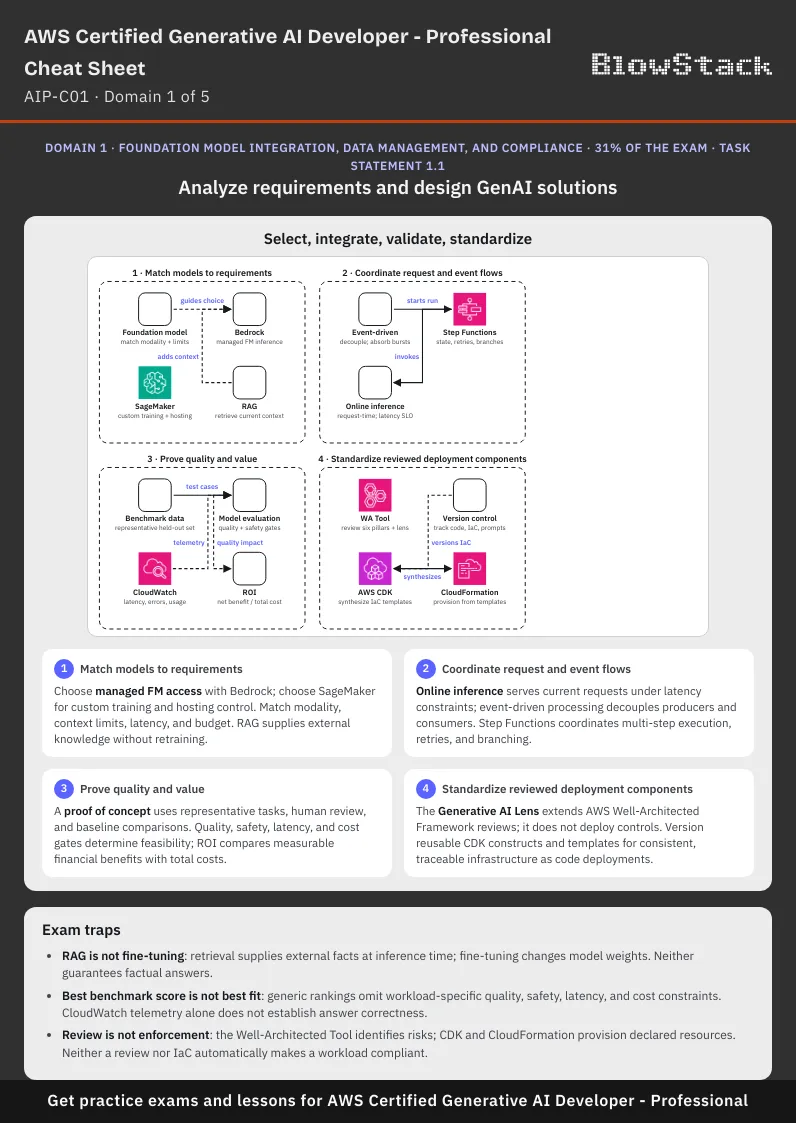
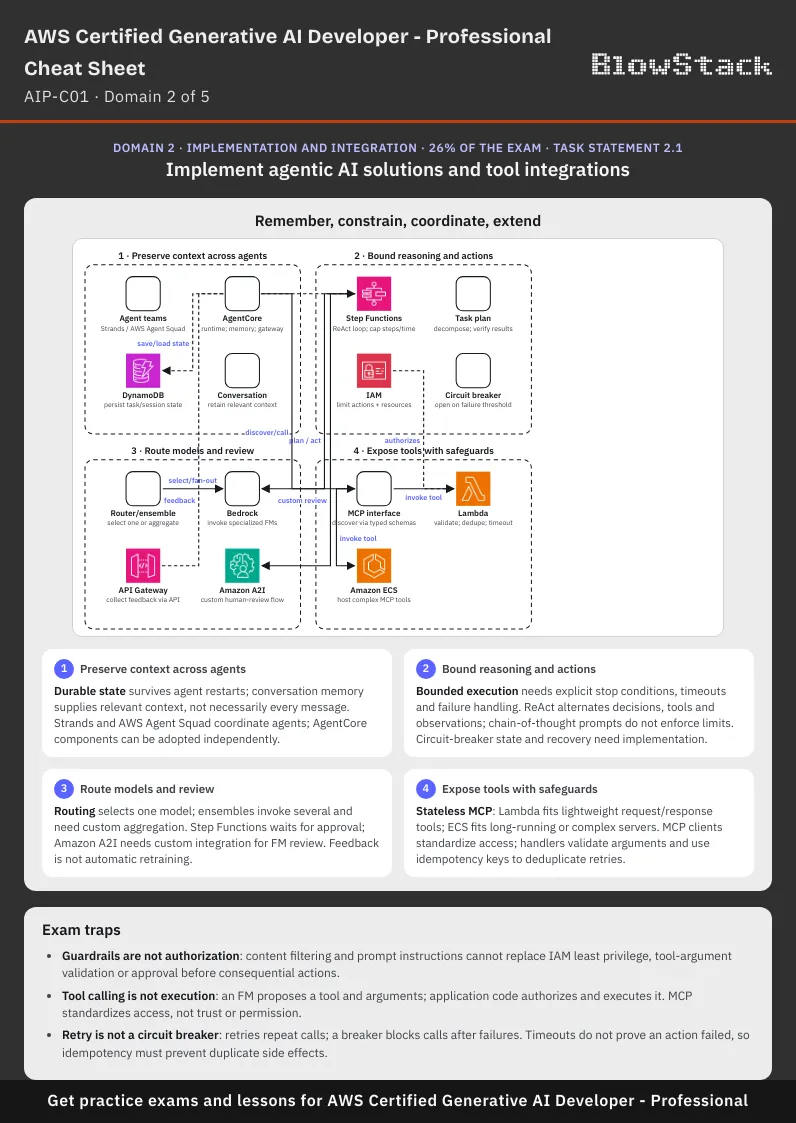
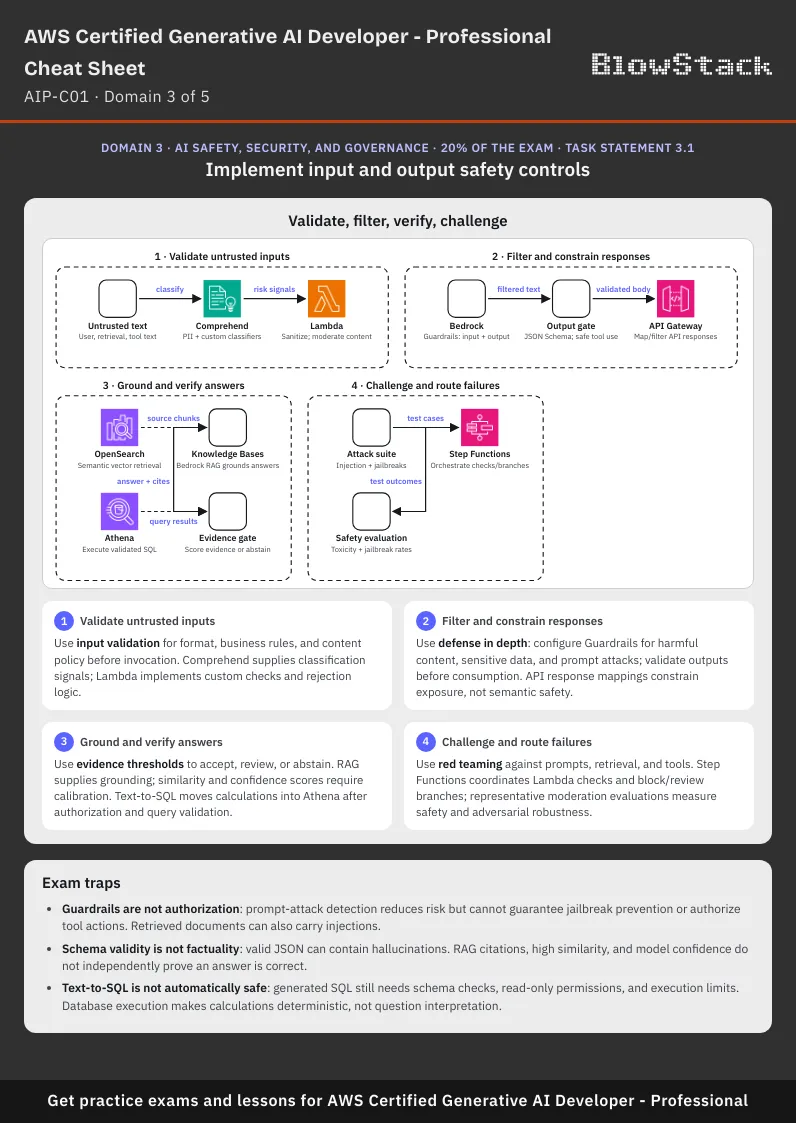
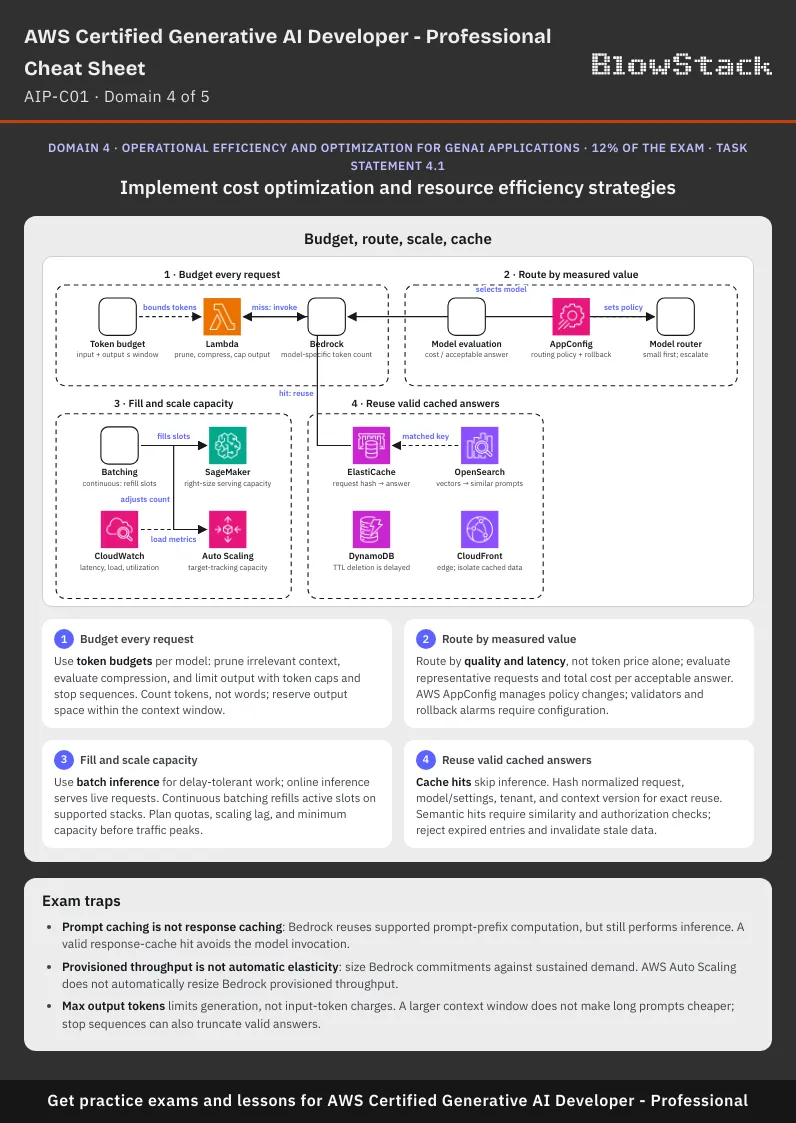
One PDF per exam domain: the domain's task statements, each drawn with its services and exam traps, then the concepts and core services to remember.
- Domain 1Foundation Model Integration, Data Management, and ComplianceView PDFDownload
- Domain 2Implementation and IntegrationView PDFDownload
- Domain 3AI Safety, Security, and GovernanceView PDFDownload
- Domain 4Operational Efficiency and Optimization for GenAI ApplicationsView PDFDownload
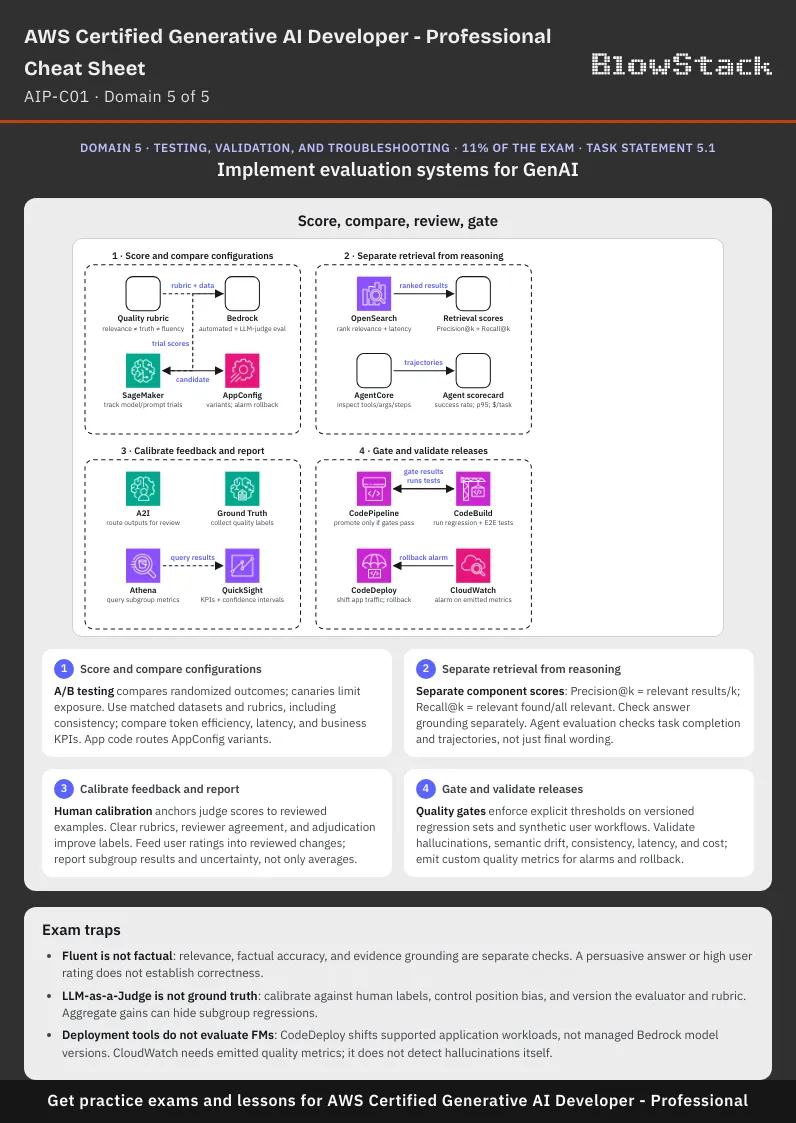
- Domain 5Testing, Validation, and TroubleshootingView PDFDownload
Exam domains
The AIP-C01 questions are grouped into 5 domains divided into 20 tasks.
- Analyze requirements and design GenAI solutions
- Select and configure FMs
- Implement data validation and processing pipelines for FM consumption
- Design and implement vector store solutions
- Design retrieval mechanisms for FM augmentation
- Implement prompt engineering strategies and governance for FM interactions
- Implement agentic AI solutions and tool integrations
- Implement model deployment strategies
- Design and implement enterprise integration architectures
- Implement FM API integrations
- Implement application integration patterns and development tools
- Implement input and output safety controls
- Implement data security and privacy controls
- Implement AI governance and compliance mechanisms
- Implement responsible AI principles
- Implement cost optimization and resource efficiency strategies
- Optimize application performance
- Implement monitoring systems for GenAI applications
- Implement evaluation systems for GenAI
- Troubleshoot GenAI applications
Exam mode and practice mode
| Exam mode | Practice mode | |
|---|---|---|
| Questions count | 75 | 1 - 75 |
| Time limit | 180 minutes | Optional, 10 - 200 minutes |
| Exam scope | 5 domains with the official questions ratio | Selected domains with the official questions ratio |
| Correct answers | After exam submission | After exam submission or after each answer |
| Question types | Single answer and multiple answer | Single answer, multiple answer or all types |
| Question hints | Never | Optional |
| Question domain | Revealed after exam submission | Revealed after submission or during the exam |
| Scoring | 15 of 75 questions do not count towards the result | Official AWS method or mathematical mean |
See all simulator features on the AWS Exam Simulator page.
Technologies and concepts
A/B Testing
A/B testing compares a baseline with an alternative under similar conditions to determine whether a change improves outcomes. For foundation model applications, it helps engineers evaluate changes to models, prompts, or retrieval configurations using real-world task success, human feedback, safety, latency, and cost rather than relying only on benchmark scores.
Adapter Pattern
An adapter isolates differences in request formats, authentication, responses, and errors behind a consistent contract. In generative AI architectures, adapters let applications use different foundation models while configuration controls which supported model or provider handles a request.
Adversarial Robustness
Unlike ordinary reliability testing, adversarial robustness evaluates failures caused by intentional attempts to deceive or misuse a model. It matters because high accuracy on normal data does not establish safety under attack, and defenses must be evaluated alongside usefulness, explainability, latency, and cost.
AI Guardrails
Guardrails help AI applications produce appropriate responses, protect sensitive information, and avoid unauthorized actions. They combine prompt engineering with independently enforced checks, permissions, and operational monitoring because model instructions alone cannot reliably enforce every requirement.
AI Transparency
AI transparency gives users, engineers, reviewers, and auditors appropriate information about how an AI system is developed, operated, and controlled. It supports informed use, accountability, and compliance by documenting system behavior and responsibilities without unnecessarily exposing private data, intellectual property, or security-sensitive details.
Algorithmic Bias
Algorithmic bias can arise from training data, labels, model objectives, prompts, retrieval sources, and the way an AI system is deployed. It matters because a technically accurate system can still discriminate, expose users to harm, create legal risk, and undermine customer trust.
Algorithmic Fairness
Fairness requires choosing context-appropriate criteria for equitable treatment, examining data and model behavior, and addressing harmful disparities throughout the AI lifecycle. It matters because high overall accuracy can conceal systematically worse outcomes for particular populations, especially in consequential decisions such as hiring, lending, and healthcare.
Analytics
Analytics turns raw records, events, and measurements into useful information through querying, aggregation, statistical analysis, and visualization. In the cloud, managed storage and processing services let engineers analyze changing data volumes without building every infrastructure component themselves.
Anomaly Detection
Anomaly detection compares observed activity with an established baseline, statistical model, or expected pattern to identify unusual behavior. In cloud security, it helps engineers detect potentially compromised identities, unexpected network activity, and abnormal resource usage that fixed rules alone might miss. An anomaly is evidence for investigation, not proof of an attack.
Answer Relevance
A relevant answer provides information that helps resolve the actual request without drifting into unrelated material or overlooking essential parts of the question. Evaluating relevance alongside factual accuracy, consistency, and fluency helps engineers detect responses that sound convincing but do not meet user needs.
API Gateway Pattern
An API gateway exposes a stable interface while hiding backend locations, protocols, and implementation changes from clients. It centralizes controls such as authentication, traffic management, and observability; for generative AI workloads, it can also enforce approved model access, data-handling rules, and consumption limits.
API-First Design
API-first design treats APIs as deliberate products for application developers rather than incidental outputs of backend code. Teams agree on operations, data structures, security, and failure behavior early, allowing clients and implementations to evolve independently. For generative AI applications, this creates reusable interfaces that hide model-specific details while supporting web interfaces, automation, and partner integrations.
APIs
An application programming interface defines available operations, accepted inputs, responses, and error behavior. In the cloud, APIs enable applications and automation tools to provision resources, configure services, and process data, making them the foundation of programmatic access.
Application integration
Application integration allows systems with different technologies, ownership, and deployment schedules to work together without becoming a single application. In the cloud, APIs, messaging, event routing, connectors, and workflow orchestration help engineers connect services while controlling coupling, failures, security, and operational complexity.
Approximate Nearest Neighbor Search
Approximate nearest neighbor (ANN) search retrieves likely nearest matches from large vector collections without guaranteeing that every true nearest neighbor is returned. It enables scalable semantic retrieval for foundation models, recommendation systems, and similarity applications, but requires measuring and tuning recall, latency, memory consumption, and cost.
Asynchronous Communication
Applications exchange messages, events, or job requests and obtain results separately through polling, callbacks, or notifications. This decouples components and helps absorb traffic bursts, but requires explicit handling of delivery failures, duplicate processing, and delayed results.
Audit Logging
Audit logging creates an evidence trail showing who or what performed an action, when it occurred, which resource was affected, and what the outcome was. In cloud environments, effective auditing requires selecting complementary log sources and protecting their delivery, retention, and accessibility across accounts, Regions, and workloads.
AWS Well-Architected Framework
The framework helps engineers evaluate operational excellence, security, reliability, performance efficiency, cost optimization, and sustainability through documented questions and best practices. For security governance, it connects architectural decisions to risk reduction and improvement plans, but it does not replace automated resource checks, compliance evidence, or regulatory audits.
Batch Inference
Batch inference processes accumulated inputs on a schedule or when data becomes available, then stores the results for later use. It is useful when throughput and cost efficiency matter more than immediate responses, such as nightly customer scoring, document classification, or generating recommendations in advance.
Benchmark Datasets
A benchmark dataset provides a consistent basis for evaluating foundation models using test inputs, reference answers where appropriate, and a defined scoring procedure. It helps engineers compare candidate models, detect regressions, and assess suitability for an application, but its value depends on how well the test cases represent real workloads.
Cache Invalidation
Caches reduce latency, backend load, and cost, but cached copies can become outdated when source data, application logic, or access permissions change. Invalidation defines when those copies must expire, be removed, or be replaced so that performance improvements do not violate freshness, correctness, or security requirements.
Caching
A cache serves repeated requests without always accessing the original data source or recomputing a result. In cloud architectures, caching can reduce latency, origin load, and data transfer, but it requires deliberate decisions about freshness, capacity, security, and failure behavior.
Canary Testing
A canary runs alongside the current production configuration so engineers can compare behavior under real workloads while limiting exposure to regressions. For generative AI applications, it helps validate changes to foundation models, prompts, retrieval settings, and inference parameters against quality, safety, latency, cost, and business criteria.
Capacity Planning
Capacity planning translates expected traffic, data growth, and processing requirements into measurable resource needs. In the cloud, it combines forecasting, benchmarking, scaling policies, service quota management, and failure testing because elastic infrastructure is neither unlimited nor instantaneous.
Chain-of-Thought Prompting
The technique encourages a model to break a multistep problem into smaller reasoning steps, either through instructions or worked examples. It can improve performance on tasks such as arithmetic and constraint-based decisions, but its effectiveness depends on the model and task, and generated explanations do not guarantee correct results.
Change Data Capture
Change Data Capture (CDC) lets systems process incremental changes instead of repeatedly copying an entire dataset. It supports low-downtime migrations, continuously updated analytics, and current search or vector indexes, while requiring careful handling of ordering, retries, deletions, and recovery.
Chunked Transfer Encoding
A server can begin transmitting a response while it is still generating the remaining content, rather than buffering the entire body first. This supports incremental delivery for applications such as generative AI assistants, although low-latency streaming also depends on application flushing, intermediary behavior, and client processing.
CI/CD
Continuous integration validates frequently merged code changes through automated builds and tests, while continuous delivery or continuous deployment automates the path toward production. Together, these practices shorten feedback cycles, make releases more repeatable, and reduce the risks associated with large, manually executed changes.
Circuit Breaker
A circuit breaker tracks dependency failures and stops sending requests when a configured threshold is exceeded, preventing repeated failures from exhausting caller resources. It supports fast failure, graceful degradation, and controlled recovery, making it useful for foundation model invocations, agent tools, and other remote services.
Code Refactoring
Refactoring makes applications easier to understand, test, maintain, and extend while preserving their existing contracts. In cloud and generative AI applications, it helps engineers separate model integration from business logic, consolidate repeated code, and improve development workflows with automated tests and AI-assisted tooling.
Conditional Branching
Conditional branching allows a cloud workflow to perform different actions instead of following the same sequence for every request. In foundation model applications, it turns model outputs and policy checks into controlled decisions about which prompt, tool, validation step, or escalation path should run next.
Confidence Intervals
A confidence interval adds uncertainty information to a reported metric, such as a foundation model's task success rate or average response latency. In GenAI evaluation reports, it helps stakeholders distinguish meaningful improvements from sampling noise and decide whether the evidence supports a release or further testing.
Confidence Scoring
Confidence scores help engineers manage uncertain AI outputs by connecting model predictions and supporting evidence to explicit decision thresholds. For generative AI, they can help identify potentially unsupported responses, but they do not prove factual correctness and should complement grounding, output validation, and human review.
Configuration Management
Configuration management makes infrastructure and application settings repeatable, auditable, and easier to recover when changes cause problems. In the cloud, it is a shared responsibility: the provider configures its underlying infrastructure, while customers manage the settings and software within their control.
Connection Pooling
Establishing connections consumes time and resources through network handshakes, authentication, and server-side session creation. A connection pool amortizes those costs across requests and can limit concurrent access to a backend, improving efficiency when its capacity and timeout settings match the workload.
Containers
Containers provide a repeatable way to build, distribute, and run software across development and cloud environments. They improve deployment consistency and resource utilization, but require explicit controls for image security, runtime isolation, networking, identity, and persistent data.
Content-Based Routing
Instead of distributing requests solely by availability or load, content-based routing selects a destination suited to each request’s characteristics. In generative AI applications, it can match tasks to specialized foundation models while balancing quality, latency, cost, and security constraints.
Context Pruning
Context pruning keeps prompts, conversation histories, retrieved passages, and tool results within a useful token budget by discarding irrelevant, redundant, or outdated material. It can reduce input-token charges and inference latency, but effective pruning must preserve instructions, dependencies, and evidence that determine answer quality.
Context Window
The context window limits how much instruction, conversation history, retrieved information, and generated output a model can handle together. Engineers use this limit when selecting foundation models and designing prompts, retrieval pipelines, and conversation management so requests fit without sacrificing relevant information or exceeding cost and latency targets.
Continuous Batching
LLM requests have different prompt lengths and generate different numbers of tokens, so fixed batches can waste accelerator capacity while waiting for their longest-running requests. Continuous batching keeps active inference batches populated as requests complete, improving throughput and resource efficiency while requiring careful control of memory, concurrency, and latency.
Conversation Memory
Conversation memory lets a generative AI application carry forward relevant messages, user preferences, decisions, and task progress instead of treating every request as unrelated. It is part of context engineering: selecting and organizing the information a foundation model needs for its next response while controlling cost, privacy, and accuracy.
Cost-Benefit Analysis
For cloud and AI/ML projects, cost-benefit analysis evaluates whether measurable improvements justify development, infrastructure, operational, and error-related costs compared with simpler alternatives. It helps engineers recognize when predictions provide useful business value and when deterministic software, established rules, or human judgment are more appropriate.
Cryptographic Hashing
A cryptographic hash function produces a deterministic fingerprint of data while making it computationally infeasible to reverse the digest or deliberately find different inputs with the same digest. In cloud systems, hashing supports file validation, digital signatures, and tamper detection, but it must be combined with trusted reference values and appropriate access or retention controls.
Data Anonymization
Data anonymization reduces the risk of identifying people from datasets, including through combinations of attributes or linkage with external information. In cloud analytics and AI systems, it helps protect sensitive training data, prompts, retrieved documents, and outputs, but requires more than simply removing names.
Data Loss Prevention
Data Loss Prevention combines data classification, inspection, access restrictions, and enforcement at the points where information is stored, processed, or transmitted. In cloud and generative AI applications, it helps prevent confidential records, credentials, and proprietary content from escaping through prompts, retrieved context, model responses, logs, or external tools.
Data Masking
Data masking reduces unnecessary exposure of confidential information in logs, messages, query results, and nonproduction datasets. It complements encryption and access control by limiting which sensitive values users and downstream systems can actually see.
Data Minimization
Data minimization reduces privacy exposure by limiting the amount, sensitivity, and detail of information used throughout a system’s lifecycle. In cloud and AI architectures, it helps engineers preserve useful functionality while reducing unnecessary disclosure, storage, and downstream use of personal or confidential information.
Data Profiling
Data profiling establishes what data actually contains before engineers transform, integrate, or use it for analytics, machine learning, or foundation model applications. Its findings guide cleansing decisions, validation rules, and monitoring thresholds, reducing the risk that inconsistent or unsuitable data reaches downstream consumers.
Data Provenance
Data provenance connects a dataset to its sources, collection conditions, permissions, processing steps, and downstream uses. In AI systems, it helps engineers assess whether training and evaluation data are appropriate, investigate quality or bias issues, reproduce results, and explain the evidence behind model development.
Data Quality
Data quality determines whether engineers can rely on data for analytics, application behavior, and AI training or inference. In secure data engineering, quality assessments work alongside privacy protections, access controls, and integrity checks to reduce unreliable outputs, unauthorized changes, and inappropriate use of sensitive information.
Data Residency
Data residency connects the physical location of data to legal, contractual, and organizational requirements. Cloud architectures must account for primary databases, replicas, backups, logs, and downstream systems because choosing a deployment Region alone does not establish compliance.
Data Retention
Retention policies balance business needs, recovery requirements, legal obligations, privacy, and storage cost. In the cloud, engineers implement them through lifecycle rules, backup schedules, retention periods, deletion controls, and exceptions such as legal holds.
Data Sovereignty
In cloud architecture, data sovereignty influences where data can be stored and processed, who can access it, and whether it can cross jurisdictional boundaries. Engineers translate these obligations into Region selection, access controls, replication policies, and operational procedures rather than assuming that a particular hosting location guarantees compliance.
Data Synchronization
Enterprise systems often maintain separate representations of the same information, such as customer records, documents, and search indexes. Data synchronization keeps those representations appropriately aligned so applications and foundation model integrations can use current, authorized information without requiring every system to share one database.
Declarative Programming
Instead of prescribing each operation in order, engineers define resources, relationships, constraints, or interface states that a tool interprets. This approach supports repeatable infrastructure provisioning, reusable application components, API contracts, and visual AI workflows, but still requires testing, security controls, and lifecycle management.
Deduplication
Duplicates arise when sources overlap, ingestion jobs replay data, producers retry delivery, or documents appear in multiple formats. Deduplication improves analytical accuracy and foundation model input quality while reducing unnecessary storage, processing, embedding, and retrieval work. Its correctness depends on distinguishing redundant copies from legitimate repeated events or meaningful versions.
Defense in Depth
Defense in Depth combines preventive, detective, and response controls across network boundaries, identities, applications, hosts, and data. It reduces dependence on any single safeguard and limits the impact of successful attacks, configuration mistakes, and compromised credentials.
Deployment Rollback
Rollback limits the impact of a faulty release by returning workloads to a known-good deployment state. It depends on preserved artifacts, compatible dependencies and data, reliable failure signals, and a tested recovery procedure rather than simply undoing a source-code change.
Developer tools
Developer tools support the software development lifecycle, from local coding and version control to automated builds and production releases. In cloud environments, they connect development workflows to programmable infrastructure, managed execution environments, and identity controls so teams can deliver changes consistently and trace failures.
Differential Testing
Instead of evaluating a system only in isolation, differential testing compares its results with a baseline or another implementation under controlled conditions. For generative AI applications, it helps engineers detect changes in factual accuracy, response consistency, tool use, safety behavior, latency, and cost when models or application components change.
Distributed Tracing
A distributed trace connects individual operations across services into a single view of a request's execution. It helps engineers troubleshoot cloud applications whose behavior cannot be understood from one server's logs or metrics alone.
Elasticity
Elasticity aligns available capacity with actual demand, adding resources during busy periods and releasing them when demand falls. In the cloud, automated provisioning and usage-based pricing can reduce idle capacity and avoid purchasing infrastructure for occasional peaks, while helping applications maintain performance.
Embeddings
An embedding model maps inputs such as text or images into a vector space where related inputs are intended to have similar representations. Embeddings support semantic search, recommendations, clustering, and retrieval-augmented generation by helping applications find relevant information beyond exact keyword matches.
End-to-End Testing
End-to-end testing checks whether an application achieves the intended user outcome when its components work together under realistic conditions. For foundation model applications, it evaluates the combined behavior of prompts, retrieval, models, tools, safeguards, and workflows rather than relying on model benchmarks alone.
Ensemble Learning
An ensemble uses complementary models and an aggregation strategy to improve predictive accuracy, robustness, or coverage across tasks. In cloud applications, engineers balance those benefits against inference cost, latency, and operational complexity, sometimes combining ensembles with selective routing or escalation to larger models.
Event Correlation
Individual logs and alerts often describe only fragments of an incident or operational failure. Event correlation combines those fragments into a contextual sequence, helping engineers detect suspicious behavior, investigate causes, and reduce duplicate or low-value alerts.
Event-Driven Architecture
An event records something that has happened, such as an order being placed, a file being uploaded, or a monitoring threshold being crossed. By separating event producers from consumers, this architecture lets cloud applications process work independently, absorb traffic spikes, and deliver notifications without requiring every component to respond at the same time.
Evidence Integrity
Reliable incident response depends on logs and other artifacts remaining authentic, traceable, and protected throughout collection, storage, transfer, and analysis. Evidence integrity combines tamper detection, preservation controls, and documented handling so engineers can reconstruct events and support defensible conclusions.
Experiment Tracking
Experiment tracking connects each model result to the data, code, parameters, and execution environment that produced it. It supports repeatable development, informed model selection, and traceability as models move toward production and are later retrained.
Exponential Backoff
Exponential backoff gives an overloaded or temporarily unavailable dependency time to recover instead of receiving immediate repeated requests. In cloud systems, it is typically combined with randomized delays, retry limits, and safe request semantics to handle throttling and transient failures without amplifying an outage.
Extract, Transform, Load
ETL turns data from databases, files, APIs, and document repositories into consistent, usable datasets. In the cloud, it supports analytics, operational integration, and generative AI retrieval pipelines by separating source access, transformation logic, and destination loading.
Factual Accuracy
For generative AI applications, factual accuracy measures whether generated statements are correct, rather than merely plausible, fluent, or relevant. Engineers evaluate it using authoritative references, claim-level checks, automated scoring, and human review because incorrect outputs can cause operational, financial, or safety consequences.
Feedback Loops
In responsible AI, feedback loops connect model decisions and explanations with the people affected by them, allowing users to question results, report problems, and request review. They support human-centered design by turning those signals into evaluated changes to models, explanations, interfaces, or operating policies.
Fine-Tuning
Fine-tuning reuses the capabilities of an existing model rather than learning everything from scratch. It can improve task accuracy, response style, and output consistency, but introduces training, evaluation, deployment, and maintenance costs that must be compared with prompting and retrieval-based approaches.
Fixed-Size Chunking
Fixed-size chunking creates predictable retrieval units for embedding, indexing, and retrieval-augmented generation (RAG). Chunk size and overlap influence whether retrieved passages contain enough context, how precisely they match questions, and how much storage and model processing the pipeline requires.
Fluency
Fluency measures the linguistic quality of foundation model outputs rather than whether their claims are true or their answers address the task. Evaluating it alongside relevance, factual accuracy, and consistency helps engineers detect responses that are difficult to understand without mistaking polished language for reliable information.
Foundation Models
Foundation models provide reusable capabilities for working with language, images, audio, and other data through prompting, retrieval, or additional training. Choosing between a foundation model and traditional task-specific machine learning depends on the workload, available data, explainability requirements, regulatory obligations, and operational constraints.
Graceful Degradation
Instead of allowing a failed dependency or overloaded component to make an entire application unavailable, graceful degradation provides a predefined, safe reduced-service mode. In AI applications, this can mean switching to an approved alternative model, returning authorized cached information, or offering search results without generating an answer.
Hallucinations
Generative AI can produce convincing answers without establishing that their claims are true or supported by the supplied evidence. Engineers must account for this limitation because fabricated facts, citations, instructions, or commitments can cause operational failures, legal exposure, and loss of customer trust.
Hierarchical Chunking
Hierarchical chunking organizes document segments at multiple levels of detail, such as sections containing smaller passages. In retrieval-augmented generation, this separates the unit used to find relevant information from the unit supplied as context, helping preserve definitions, qualifications, and surrounding explanations.
Hierarchical Indexing
Instead of treating every vector or document as part of one undifferentiated search space, hierarchical indexing uses relationships between levels to guide retrieval. For foundation-model applications, this can reduce search work and improve contextual relevance, but overly restrictive routing can exclude relevant evidence.
Human-in-the-Loop
Human-in-the-Loop combines AI’s ability to process information at scale with people’s ability to interpret context, resolve ambiguity, and exercise judgment. It supports assisted decision-making and responsible automation by giving people meaningful opportunities to correct outputs, challenge decisions, and improve system behavior.
Human-in-the-Loop Evaluation
Human-in-the-loop evaluation combines structured human judgment with repeatable testing to measure how well foundation models meet application requirements. It complements automated metrics by assessing qualities such as usefulness, factual correctness, safety, and appropriateness that a single numerical benchmark may not adequately capture.
Hybrid Search
Keyword search finds explicit terms, identifiers, and phrases, while vector search finds content with similar meaning even when wording differs. Combining these signals can improve retrieval for enterprise search and retrieval-augmented generation, especially when queries mix exact technical details with natural-language intent.
Idempotency
Idempotency makes retries safe when requests time out, events arrive more than once, or automation restarts after a failure. In incident response, it prevents repeated remediation attempts from creating duplicate resources, reversing containment, or causing additional disruption.
Identity Federation
Federation separates where an identity is authenticated from where that identity accesses resources, using established trust and verifiable identity assertions or tokens. It enables centralized sign-in for employees, customers, and workloads while letting each application or cloud account retain control over authorization.
Incremental Processing
Incremental processing preserves useful results from previous runs and applies subsequent changes using tracked processing state. It reduces repeated scanning, transformation, and embedding work, but requires reliable change detection, replay-safe writes, and explicit handling of updates and deletions.
Inference Latency
Inference latency determines how quickly an AI-powered application responds and whether it meets user expectations or processing deadlines. For generative AI, input length, generated output length, model choice, and available serving capacity affect latency, while token-based pricing links much of that work to inference cost.
Infrastructure as code (IaC)
IaC turns infrastructure definitions into repeatable deployment processes that can be reviewed, tested, and automated. It helps engineers create consistent environments, reduce manual errors, and apply security standards across accounts while maintaining a traceable history of changes.
Input Sanitization
Input sanitization reduces the risk that user submissions, retrieved documents, or tool responses introduce malicious instructions or executable payloads into an application. In generative AI systems, it works alongside validation, prompt-injection detection, content filters, and authorization controls rather than making arbitrary text inherently safe.
Input Validation
Input validation establishes whether data is acceptable for a particular operation, including whether it has the correct format, satisfies business constraints, and complies with content policies. In cloud and generative AI applications, it helps prevent malformed requests, harmful prompts, unsafe tool calls, and unintended downstream actions.
Instruction Hierarchy
Foundation model applications distinguish higher-priority application rules from lower-priority user requests and external content. This distinction helps preserve intended behavior when prompts conflict, but its effectiveness depends on the model, API, and application design rather than on wording alone.
Intent Classification
Intent classification helps interactive systems distinguish requests such as checking an order, requesting a refund, or asking for clarification. In foundation model applications, it supports reliable routing, context-aware conversations, and controlled workflow execution instead of treating every message as an unrestricted generation request.
IP Routing
IP routing determines how traffic moves between subnets, private networks, and the internet. In cloud environments, understanding routes, subnet associations, and gateways is essential for designing connectivity and diagnosing why a workload can or cannot reach a destination.
Iterative Prompt Refinement
A prompt is treated as a testable application component rather than a one-time question. Engineers examine outputs, identify failure patterns, and make targeted revisions to improve accuracy, relevance, consistency, and safety without necessarily changing model weights.
Jailbreaking
Jailbreaking attempts use adversarial inputs to make a model produce responses or take actions that its safeguards are intended to prevent. For cloud applications, it is a prompt-engineering risk that requires layered controls because carefully written instructions alone cannot guarantee safe behavior.
Key Performance Indicators
A key performance indicator connects a business objective to a defined measurement, target, and review period. For generative AI applications, KPIs help engineers distinguish technical improvements from business value by measuring outcomes such as efficiency, conversion, revenue, accuracy, and return on investment.
KV Caching
During LLM inference, KV caching exchanges additional memory consumption for less repeated computation and faster token generation. Cloud deployments must budget this growing per-request state alongside model weights, because context length and concurrent requests can exhaust accelerator memory even when the model itself fits.
Label Quality
Labels define expected outcomes for supervised learning, human-preference training, and many AI evaluations. Incorrect, ambiguous, outdated, or systematically biased labels can teach models the wrong behavior and make evaluation results misleading, even when the underlying data and training pipeline are technically sound.
Lazy Loading
Instead of initializing every resource at startup, lazy loading loads a resource when a request or operation first requires it. In cloud deployments, this can reduce startup work and unused memory consumption, but it shifts loading latency and potential failures into the request path.
Least privilege
Least privilege reduces the damage that compromised credentials, software defects, and operational mistakes can cause. In cloud environments, it applies to identity permissions, workload roles, administrative access, network connectivity, and organizational guardrails, and requires ongoing review as requirements change.
LLM-as-a-Judge
An evaluator LLM receives a task, a candidate response, and a scoring rubric, optionally with reference answers or supporting evidence, and returns a score, label, or preference. This approach helps engineers evaluate qualities such as relevance, groundedness, and instruction following at scale, but its judgments require calibration and human oversight.
Log Retention
Log retention determines how long operational, security, and audit records remain available for monitoring, investigation, and compliance. An effective policy balances required history and retrieval speed against storage cost, privacy obligations, and protection from unauthorized alteration or deletion.
Loose Coupling
Loosely coupled components communicate through explicit contracts rather than depending on each other's internal implementation, deployment, or execution timing. This supports independent scaling and fault isolation, but requires deliberate handling of message delivery, data consistency, interface evolution, and operational visibility.
Low-Rank Adaptation
Low-Rank Adaptation, commonly called LoRA, represents changes to selected model weight matrices using pairs of smaller trainable matrices. This reduces trainable parameter counts, optimizer memory, and customization artifact sizes compared with full fine-tuning, making domain-specific model development and deployment more manageable.
Management and governance
Management handles activities such as provisioning, monitoring, configuration, and remediation, while governance defines who may act, which standards apply, and how compliance is demonstrated. Together, they help organizations give engineers useful autonomy without losing accountability, cost visibility, or control over risk.
Message Queuing
A message queue buffers work between applications so that producers and consumers do not need to run at the same speed or be available simultaneously. This helps absorb traffic spikes and isolate failures, but requires careful handling of retries, duplicate messages, processing delays, and retention limits.
Metadata Filtering
Metadata filtering combines relevance-based retrieval with explicit conditions such as publication date, author, domain, tenant, or document status. In retrieval-augmented generation, it helps foundation models receive context that is not only semantically relevant but also appropriate for the user's scope and requirements.
Metadata Schemas
A metadata schema turns descriptive attributes such as authorship, timestamps, domain, and access classification into a predictable contract for applications. In vector search and retrieval-augmented generation, this contract helps systems retrieve relevant, authorized, and contextually appropriate information rather than relying on embedding similarity alone.
Microservices and component delivery
Microservices divide an application into services organized around business capabilities, while component delivery provides the processes and automation needed to release those services safely. This approach supports independent team ownership and targeted scaling, but introduces distributed-system complexity and requires disciplined interface design, observability, and deployment practices.
Model Cards
A model card helps engineers and reviewers decide whether a specific model version is appropriate for a particular application. It connects technical evidence with responsible AI requirements, making risks, unsupported uses, and required safeguards visible before deployment and during operation.
Model Cascading
A model cascade combines models so that each stage either completes a task, filters candidates, or passes work to another stage. It can reduce inference cost and resource consumption while preserving required quality, but its benefits depend on reliable escalation rules and the proportion of requests that need additional processing.
Model Context Protocol
MCP provides a common interface between an AI application's integration layer and external systems, reducing the need for custom connectors for every application–tool combination. In agentic applications, it helps agents discover available capabilities and access relevant information or request actions, while leaving reasoning, orchestration, and authorization enforcement to the surrounding system.
Model Drift
A model learns patterns from historical data, but those patterns may no longer represent the environment in which it operates. Monitoring for drift helps teams identify changing conditions, investigate performance problems, and decide whether to fix data pipelines, adjust the model, or retrain it.
Model Evaluation
Model evaluation uses representative data, defined metrics, and human judgment to determine whether a model meets technical and business requirements. It supports model selection and release decisions throughout the foundation model lifecycle, helping engineers balance output quality, safety, latency, cost, and environmental impact.
Model Routing
A model router applies a selection policy across multiple models rather than sending every request to a single default model. It helps applications combine specialized capabilities and control inference spending while maintaining measurable quality and reliability targets.
Model Transparency
Model transparency makes an AI system understandable enough for stakeholders to evaluate its suitability and hold its operators accountable. It includes documentation and visibility into how the model works, while explainability specifically addresses why it produces particular outputs. These qualities support debugging, informed deployment decisions, and meaningful review of consequential predictions.
Multi-Agent Orchestration
Multiple specialized agents can collaborate on work that requires different responsibilities, data sources, or decision steps. Orchestration defines how tasks are assigned, how agents communicate, and how the application controls state, failures, permissions, and completion.
Multimodal Fusion
Different modalities often provide complementary evidence that a single input type cannot capture. Multimodal fusion makes that evidence usable together, but requires modality-specific preparation, reliable alignment, and a model or application architecture capable of combining the resulting information.
Named Entity Recognition
Named Entity Recognition (NER) converts unstructured text into labeled information that applications can validate, normalize, search, and supply to foundation models. In data-processing pipelines, it helps make model inputs more consistent and explicit, but extracted entities still require validation because recognition can be incomplete or incorrect.
Network Isolation
Network isolation creates controlled communication boundaries between workloads, environments, and external networks. During incident response, it helps contain compromised resources, interrupt attacker communications, and protect unaffected systems while engineers investigate, eradicate threats, and restore trusted workloads.
Nondeterminism
In generative AI, repeated requests can produce different answers because of sampling during generation and variability in the execution environment. This flexibility supports diverse outputs, but it complicates testing, reproducibility, auditing, and business processes that require consistent results.
Nucleus Sampling
Nucleus sampling dynamically limits the next-token choices available to a generative model, balancing response diversity against the exclusion of unlikely continuations. Engineers configure it during inference to influence output variability, usually alongside controls such as temperature and maximum output tokens.
Online Inference
Online inference connects a trained model to a live application so that new inputs can produce timely outputs, such as fraud scores, recommendations, or generated text. It matters when decisions depend on current requests rather than predictions computed in advance, requiring careful management of latency, availability, capacity, and cost.
Output Validation
Generative AI responses must be treated as untrusted data, even when they come from a trusted model endpoint. Output validation helps prevent unsafe content, sensitive-data disclosure, injection attacks, and unauthorized actions by checking responses at the boundaries where applications consume them.
Parallel Execution
Parallel execution replaces unnecessary sequential waiting with overlapping work across available compute resources or remote services. In generative AI applications, it can shorten retrieval, tool-use, and multi-model workflows, but engineers must balance latency improvements against resource consumption, inference costs, quotas, and coordination overhead.
Performance Profiling
Performance profiling connects observed latency, throughput, and resource consumption to the code paths and dependencies responsible for them. For cloud and generative AI applications, it helps engineers distinguish application inefficiencies from model inference delays, network waits, throttling, and infrastructure limits before making changes.
Policy as Code
Policy as Code turns written requirements into executable checks against infrastructure definitions, deployment plans, requests, or running resources. It helps teams apply consistent controls across accounts and environments, detect violations early, and retain reviewable evidence of policy changes and evaluation results.
Precision@k
Precision@k evaluates how much useful information appears within a retrieval system's highest-ranked results. In retrieval-augmented generation (RAG), it helps engineers assess whether the context supplied to a foundation model contains relevant evidence rather than distracting material.
Precomputation
Precomputation moves expensive processing out of the interactive request path and replaces it with retrieval or a smaller amount of remaining work. In generative AI applications, it can improve responsiveness and reduce repeated model inference, but its value depends on reuse, freshness requirements, and the cost of computing results that might never be requested.
Price-Performance Ratio
In cloud systems, price-performance comparisons relate spending to outcomes such as successful requests, processing throughput, or model responses that meet quality and latency requirements. For generative AI applications, this means selecting models and inference patterns by their cost per acceptable result rather than by token price or model capability alone.
Prompt Chaining
Instead of asking a foundation model to complete an entire task in one request, prompt chaining coordinates smaller steps with explicit inputs, outputs, and validation. It helps engineers control complex workflows, reuse prompt components, and isolate failures, while introducing additional latency, cost, and orchestration responsibilities.
Prompt Compression
Prompt compression replaces verbose or redundant model input with a shorter representation that retains task-relevant meaning. It can reduce token-based inference costs, improve context-window utilization, and sometimes lower latency, but it requires evaluation because omitted details can change model behavior or answer quality.
Prompt Context
Context gives a model task-specific facts, conversation history, reference material, or situational details that may not be available from its learned parameters. Selecting relevant, trustworthy context improves response quality, but requires attention to token limits, cost, privacy, and the distinction between supporting information and instructions.
Prompt Injection
Language models process instructions and reference material together, creating opportunities for attackers to disguise malicious commands as ordinary content. In cloud applications, successful injection can manipulate responses, expose sensitive context, or trigger unauthorized tool actions, so defenses must combine model-level guardrails with independently enforced security controls.
Prompt Templates
A prompt template defines the repeatable parts of a model request, such as the task, context boundaries, examples, and expected response format, while leaving placeholders for request-specific data. Templates help engineers standardize application behavior, evaluate changes systematically, and reduce duplicated prompt-building logic without retraining the model.
Quality Gates
A quality gate turns testing, evaluation, and operational requirements into enforceable promotion criteria. In cloud delivery, gates prevent unacceptable application, infrastructure, or generative AI changes from reaching broader environments while providing an auditable explanation for each release decision.
Query Decomposition
Complex questions often contain several information needs that a single retrieval request cannot satisfy reliably. Query decomposition makes those needs explicit, retrieves evidence for each, and supports a grounded final answer while preserving the original question’s constraints.
Query Expansion
Query expansion reduces the vocabulary mismatch between a user's question and the documents that can answer it. In retrieval-augmented generation, it can improve evidence coverage by searching for synonyms, domain terminology, and equivalent questions before selecting context for a foundation model. Its value depends on preserving the user's intent while controlling irrelevant results, latency, and cost.
Query Rewriting
Query rewriting bridges the gap between how users ask questions and how information is indexed and searched. In retrieval-augmented generation, it can resolve conversational references, align terminology, and break complex questions into searchable parts, improving the evidence supplied to a foundation model while introducing additional latency, cost, and validation requirements.
Rate Limiting
Rate limiting protects shared resources by restricting traffic according to a measured request rate, an allowed burst, and an enforcement policy. At the cloud edge, it helps reduce application-layer abuse and backend overload, but effective policies must distinguish legitimate traffic spikes from harmful behavior.
ReAct
ReAct, short for reasoning and acting, lets an agent decide what information or operation it needs next, invoke an appropriate tool, and use the result to guide its next decision. It matters when a task requires multiple dependent steps, current information, calculations, or controlled interactions with external systems rather than a single generated answer.
Recall@k
Recall@k evaluates whether a search or retrieval pipeline finds the evidence needed for a query within a limited result budget. In retrieval-augmented generation (RAG), it helps engineers detect missing context, compare retrieval configurations, and balance evidence coverage against latency and context-window cost.
Red Teaming
For generative AI applications, red teaming tests whether adversarial inputs can bypass safety controls, expose protected information, or cause unauthorized actions. It evaluates the complete application, including prompts, retrieval, models, tools, identity permissions, and monitoring, rather than treating model behavior as the only security boundary.
Regression Testing
Regression testing reruns a maintained set of tests after changes and compares results with approved expectations or a trusted baseline. For generative AI applications, it helps detect unintended changes in answer quality, safety, tool use, latency, and cost when prompts, models, retrieval data, or application code change.
Request Validation
Request validation determines whether incoming data has the required structure, types, values, and application-specific meaning. In cloud systems, it helps reject malformed or unsupported requests early, protect downstream capacity, and give clients predictable feedback without replacing authentication, authorization, or content safety controls.
Reranking
An initial retriever efficiently finds potentially relevant documents, and a reranker evaluates that smaller candidate set more closely against the query. In retrieval-augmented generation, this helps place stronger evidence into a limited context window, but it adds processing cost and cannot recover documents that retrieval missed.
Resiliency
Resiliency combines failure isolation, redundant resources, controlled recovery, and operational testing to limit the impact of failures. In the cloud, it requires deliberate architecture across independent failure domains rather than assuming that provider-managed infrastructure makes an application immune to outages.
Resource Efficiency
Resource efficiency means matching cloud capacity and architecture to useful work rather than provisioning for assumptions or leaving resources idle. It helps engineers improve performance per resource, control costs, and reduce environmental impact while preserving security and reliability requirements.
Resource Utilization
Resource utilization shows how workloads consume CPU, memory, storage, network bandwidth, and other capacity. It informs rightsizing: selecting resource types, sizes, and quantities that meet performance and availability requirements without paying for unnecessary capacity.
Response Streaming
For generative AI applications, response streaming lets users begin reading model output while generation continues. It improves perceived responsiveness, but does not inherently reduce model computation, total completion time, or inference cost.
Retrieval Latency
Retrieval latency determines whether stored data can support interactive requests or must be recovered through a slower, asynchronous process. It is a key storage-selection criterion because lower storage prices can come with longer retrieval delays, additional retrieval charges, or restoration requirements.
Retrieval-Augmented Generation
RAG connects a foundation model to information outside its learned parameters, such as enterprise documents, product catalogs, or operational records. It helps applications answer questions using organization-specific or recently updated information without retraining the model, although accuracy still depends on retrieval quality and how the model uses the evidence.
Return on Investment
ROI helps engineers and business stakeholders determine whether an AI, ML, or cloud initiative produces enough measurable value to justify its costs. Unlike model-quality metrics, ROI connects technical performance to financial outcomes such as reduced operating expenses, increased contribution profit, or avoided losses.
Right-Sizing
Right-sizing uses observed demand and application requirements to choose appropriate compute, memory, storage, and throughput capacity. It reduces waste while preserving performance and reliability, and it requires regular review as workloads change.
Role-Based Access Control
Role-Based Access Control (RBAC) separates permission definitions from individual users or workloads, making access easier to administer and review. In cloud environments, it supports consistent authorization across teams and accounts, but requires carefully scoped roles and controlled assignments to prevent excessive privileges.
Schema Validation
A schema acts as a contract between data producers and consumers, making format expectations testable rather than implicit. Validating that contract at ingestion, transformation, and API boundaries catches incompatible data before it disrupts analytics, machine learning, or foundation model applications, but it does not establish factual accuracy or safety.
Security Quality Gates
A security quality gate turns vulnerability findings and security policy checks into an explicit decision to permit, block, or require approval for a change. In cloud delivery pipelines, it helps prevent vulnerable code, dependencies, container images, and infrastructure configurations from reaching production while preserving an auditable exception process.
Semantic Caching
Unlike exact-match caching, semantic caching can recognize differently worded requests that can safely share an answer. In generative AI applications, it can reduce foundation model invocation costs and response latency, provided that similarity checks are combined with authorization, context, and freshness controls.
Semantic Chunking
Instead of splitting text only at fixed token or character counts, semantic chunking chooses boundaries that preserve related ideas and separate topic changes. In retrieval-augmented generation, this can improve the relevance and completeness of retrieved evidence, although it introduces additional processing cost and requires evaluation against simpler segmentation strategies.
Semantic Search
Semantic search helps users find relevant information even when their queries use different wording from the source material. It commonly uses machine-learning embeddings and relevance models, making it useful for enterprise search, customer support, and retrieving evidence for generative AI applications.
Separation of Duties
The idea is to prevent one identity from initiating, approving, executing, and concealing a sensitive action without independent oversight. In cloud environments, separate administrative roles, account boundaries, approval workflows, and protected audit records reduce the risk of fraud, mistakes, and compromised credentials.
Serialization
Serialization allows applications written in different languages and running on different systems to exchange data through an agreed format. In cloud data pipelines and foundation model integrations, correct serialization preserves data meaning and ensures that consumers receive the structure, types, and encoding they expect.
Server-Sent Events
Server-Sent Events (SSE) lets applications push incremental updates without repeated client polling, using the text/event-stream media type. It is useful for foundation model responses, progress notifications, and live status feeds when updates primarily flow from server to client. Streaming improves perceived responsiveness by displaying available output before the complete operation finishes.
Sharding
Each shard holds part of the data, and a routing mechanism determines which shard should handle a record or query. Sharding can increase storage capacity and aggregate read and write throughput, but its effectiveness depends on balanced distribution, query locality, and the cost of coordinating work across shards.
Small Language Models
Small language models can handle bounded language tasks without the infrastructure or inference expense of much larger models. They help engineers balance output quality, latency, throughput, and cost, either as standalone models or as the first stage of a model cascade that escalates difficult requests.
Source Citation
Source citation connects information to identifiable evidence, such as a dataset version, document passage, or model-development record. In cloud AI systems, it supports verification, reproducibility, and governance by helping engineers establish where information came from, how it changed, and whether its use is appropriate.
Statelessness
A stateless component processes each request using information supplied with that request and, when necessary, state retrieved from external systems. This makes processing instances interchangeable, simplifying horizontal scaling, failure recovery, and deployment without requiring the overall application to stop storing data.
Stop Sequences
Stop sequences define an explicit boundary for generated output, helping applications prevent unwanted continuations and avoid unnecessary output tokens. They complement output-token limits and concise prompting, but require careful delimiter selection and model-specific validation to avoid cutting off useful content.
Strategy Pattern
The pattern separates what an application needs to do from the implementation chosen to do it. For foundation model integrations, it enables configuration-driven selection among supported models or providers while keeping business logic stable and enforcing consistent operational and compliance controls.
Structured Outputs
Instead of accepting arbitrary prose, an application specifies the response’s fields, types, allowed values, and rules for missing information. Combining these specifications with appropriate generation controls, validation, and feedback loops improves integration reliability, although structural correctness does not guarantee factual accuracy or safe actions.
Subgroup Analysis
An AI system can perform well on average while producing less accurate, less reliable, or more harmful results for particular populations or operating conditions. Subgroup analysis compares relevant groups using appropriate quality and fairness metrics, helping engineers detect potential bias, investigate label quality, and monitor whether improvements benefit all affected users.
Task Completion Rate
Task completion rate measures whether an AI application helps users accomplish their intended goals, rather than merely producing plausible responses. It connects foundation model performance to business objectives and should be evaluated alongside user satisfaction, cost per interaction, latency, and safety.
Task Planning
In foundation-model applications, task planning helps an AI agent determine what actions are needed to achieve a business goal rather than merely generate a response. It enables multistep automation, but reliable implementations must constrain tool access, validate results, and require approval for consequential actions.
Temperature Sampling
Lower temperatures favor more probable tokens, while higher temperatures give less probable tokens a greater chance of being selected. This helps engineers balance consistency and variety, but it does not guarantee factual accuracy, enforce an output format, or directly control response length.
Temporary Credentials
Temporary credentials let people and workloads access cloud resources without distributing permanent access keys. They reduce the lifetime of exposed credentials, support federation and role-based access, and shift credential renewal to identity services and supported client libraries.
Text Chunking
Text chunking controls how much information is processed together and which context remains attached to each passage. In generative AI applications, effective chunking helps preserve evidence, improve retrieval relevance, and prevent information loss caused by oversized inputs or poorly chosen boundaries.
Text Embeddings
An embedding model maps text into a vector space where related passages tend to have similar representations. These vectors support semantic search and retrieval augmented generation (RAG), helping applications find relevant external information even when a question and its answer use different wording.
Text Normalization
Text normalization reduces avoidable variation in text, such as inconsistent whitespace, character representations, and domain terminology. In foundation model pipelines, it helps produce more consistent prompts, retrieval results, and responses, but transformations must preserve important distinctions such as negation, units, and identifiers.
Text-to-SQL
Text-to-SQL connects a user's question to database operations by generating SQL grounded in schemas, relationships, and business definitions. It can reduce unsupported numerical answers by moving calculations into a database, but safe use requires query validation, authorization, execution limits, and checks that the SQL actually represents the question.
Token Budgeting
Foundation-model applications consume tokens through instructions, conversation history, retrieved documents, tool interactions, and generated responses. Token budgeting sets limits for these components and tracks actual usage so applications can reduce unnecessary processing without removing information needed for effective answers.
Tokenization
Tokens can represent whole words, word fragments, punctuation, whitespace, or other character sequences, depending on the model’s tokenizer. Tokenization determines how much content fits into a model request and directly affects token-metered inference costs, processing requirements, and response latency.
Tool Calling
Tool calling connects a generative AI model to capabilities such as database queries, calculations, business APIs, and infrastructure operations. It enables agents to use current information and perform actions, while application code remains responsible for execution, authorization, validation, and error handling.
Tool Use
A foundation model can select a tool and generate structured arguments, while the application or managed agent runtime validates and executes the request. This connects language-based reasoning to current data and business systems, enabling AI agents to complete tasks rather than only generate text.
Top-K Sampling
At each generation step, top-K sampling removes candidates outside the K most likely tokens, renormalizes the remaining probabilities, and samples the next token. It helps engineers control output variability, but its usefulness depends on the model, the task, and its interaction with temperature and top-p.
Trajectory Evaluation
A trajectory includes actions such as retrieving documents, selecting tools, supplying arguments, handling results, and deciding when to stop. Evaluating this sequence helps engineers detect unsafe actions, incorrect dependencies, unnecessary work, and intermediate failures that a plausible final response can conceal.
Unit Testing
Unit tests check functions, methods, or small modules against explicit expectations using controlled inputs and dependencies. They provide fast feedback during development and help CI/CD pipelines reject regressions before code reaches deployed data, application, or machine learning workflows.
User Satisfaction
For AI applications, user satisfaction measures whether people find the experience useful, trustworthy, understandable, and responsive. It connects foundation model evaluation to business objectives, but must be assessed alongside task completion, factual correctness, safety, and operating cost.
Vector Search
Embedding models represent text, images, audio, or other data as vectors whose relative positions can reflect meaningful relationships. Vector search uses these representations to find related content even when exact words differ, supporting semantic retrieval, recommendations, and retrieval-augmented generation.
Version Control
Version control creates a traceable history for artifacts such as source code, infrastructure definitions, configuration, and AI prompts. It helps engineers collaborate safely, connect deployed behavior to specific revisions, and recover from changes that introduce errors or regressions.
Webhooks
A webhook lets an event producer send a request to a registered endpoint instead of requiring the consumer to repeatedly poll for changes. Engineers use webhooks to trigger builds and tests, integrate enterprise applications, and start asynchronous AI workflows, while explicitly handling authentication, retries, and duplicate deliveries.
WebSockets
Unlike ordinary HTTP request-response exchanges, a WebSocket connection lets either endpoint send messages without waiting for a new request. This makes it useful for interactive AI applications, live notifications, and collaborative systems where low-latency updates and client commands must flow continuously.
Workflow Orchestration
An orchestrator maintains the execution state of a process and determines which task runs next, including parallel work, waits, retries, and exception paths. In cloud applications, this separates business coordination from individual functions and services, making integrations easier to operate, recover, and audit.
Workload Predictability
Predictability helps engineers decide how much compute usage they can safely commit to and how much should remain flexible. Matching purchasing options to measured demand reduces costs without confusing predictable usage with interruption tolerance or guaranteed capacity.
Services on the exam
The 56 AWS services the AIP-C01 exam covers.
Concepts on the exam
The 194 cloud concepts the AIP-C01 exam covers, each explained with the AWS services that implement it, in the Cloud Concepts Hub .