
AWS Certified Security - Specialty (SCS-C03) Free Practice Exam and Practice Test
864 SCS-C03 practice questions, updated , in an exam simulator that mirrors the real exam: its domains, its question types and its timing, with an explanation for every answer.
SCS-C03 example questions
One example question per domain from the SCS-C03 question bank, with the correct answer and its explanation. Sign in to the simulator to answer them with all answer options.
A company uses the unified CloudWatch agent on Amazon EC2 instances to collect operating system security logs. After a least-privilege IAM policy update, agent metrics continue to arrive, but newly launched instances do not deliver logs to the existing /security/linux log group. The agent reports AccessDeniedException for logs:CreateLogStream.
The agent uses the instance profile role. The role's only statement granting logs:CreateLogStream and logs:PutLogEvents allows both actions with this Resource value:
arn:aws:logs:us-east-1:111122223333:log-group:/security/linux
The configured log group and Region are correct. Network connectivity and local file permissions have been verified, and no other policies restrict these actions. Which change will restore log delivery while maintaining least privilege?
Show answer
CORRECT ANSWERChange the Resource for both actions to arn:aws:logs:us-east-1:111122223333:log-group:/security/linux:log-stream:* in the instance profile role's policy.
CreateLogStream and PutLogEvents authorize access to log-stream resources. The existing ARN identifies only the log group and does not match its log streams. The replacement ARN permits both operations on streams within the intended group without granting access to other groups.
An incident response team stores original system and application log archives in a versioned Amazon S3 evidence bucket. Each object version has a 90-day S3 Object Lock compliance-mode retention period. Lifecycle rules expire current objects and permanently delete eligible noncurrent versions after the approved retention period.
Legal counsel identifies specific object version IDs that must be preserved for litigation. Their retention periods expire tomorrow, but the litigation has no known end date. Unrelated evidence must continue through normal disposal. After counsel authorizes release, the selected versions must become eligible for normal disposal without an additional fixed retention period. Automated cleanup roles can delete object versions but cannot change Object Lock retention settings or legal holds.
Which action meets these requirements?
Show answer
CORRECT ANSWERApply an S3 Object Lock legal hold to each identified object version. Leave the lifecycle rules unchanged, and remove the holds only after counsel authorizes release.
A legal hold protects an individual object version from permanent deletion without requiring an expiration date. Lifecycle processing and cleanup roles cannot permanently delete held versions. Unrelated versions remain subject to normal disposal. Once the holds are removed and the original retention periods have expired, the selected versions become eligible for normal disposal.
A manufacturer uses an Amazon SageMaker AI real-time endpoint to summarize confidential engineering documents. The model must receive the complete documents to produce useful summaries. The endpoint has data capture enabled for requests and responses, and the application also writes request and response bodies to diagnostic logs.
A security review finds confidential document text in both telemetry destinations. Company policy permits processing this text during inference but prohibits storing it in inference-monitoring data or diagnostic logs. Operations engineers must retain request correlation IDs, latency measurements, response status codes, and token counts. They do not require document text or generated summaries.
Which change meets these requirements?
Show answer
CORRECT ANSWERDisable endpoint request and response data capture. Replace application body logging with an allowlist-based telemetry record containing only the required operational fields, and ensure error-handling paths do not log payloads.
This prevents confidential payloads from being persisted through either identified telemetry path while preserving the operational information engineers need. The complete documents can still be sent to the model for inference. Applying the same restriction to error paths prevents exceptions or debugging logic from bypassing the control.
A company uses one shared IAM role for application operators. Each operator session has trusted Project and Environment principal tags that operators cannot change. EC2 instances have corresponding resource tags maintained by a provisioning service. Some legacy instances are missing one or both tags.
Operators must be able to reboot an instance only when BOTH instance tag values match the corresponding principal tag values. Instances missing either tag must remain inaccessible. Operators cannot modify instance tags, assume other roles, or change IAM policies. The role currently has no EC2 permissions, and no other policies grant or restrict the requested access.
A security engineer will scope all new statements to EC2 instance ARNs in the approved account and Region. Which policy configuration meets these requirements?
Show answer
CORRECT ANSWERAdd one Allow statement for ec2:RebootInstances with this condition: {"StringEquals":{"ec2:ResourceTag/Project":"${aws:PrincipalTag/Project}","ec2:ResourceTag/Environment":"${aws:PrincipalTag/Environment}"}}.
Both condition keys must evaluate to true within the same statement. Each resource tag must therefore match its corresponding trusted principal tag. If either resource tag is absent, its StringEquals comparison does not match, and the statement does not grant access.
A company stores sensitive daily exports in an S3 bucket and uses S3 Cross-Region Replication to copy them to a disaster recovery bucket. Both buckets have versioning enabled. Each export uses a unique key and is never overwritten. All replication operations complete successfully before the exports reach their retention limits. Neither bucket uses Object Lock.
The approved retention schedule makes current objects eligible for expiration 365 days after creation and their noncurrent versions eligible for permanent deletion 1 day after becoming noncurrent. The source bucket already has S3 Lifecycle rules implementing this schedule and cleaning up expired object delete markers. The destination bucket has no Lifecycle rules, and an audit finds that old replicas remain there after their source versions have been permanently deleted.
Which change will apply the approved automatic disposal schedule to both existing and future replicas with the least operational overhead?
Show answer
CORRECT ANSWERConfigure destination bucket Lifecycle rules to expire current objects after 365 days, permanently delete noncurrent versions after 1 day, and remove expired object delete markers.
Lifecycle configurations are independent for source and destination buckets. Destination rules apply to existing and future matching replicas. Replicas retain the original objects' creation times for age-based Lifecycle processing. Current-version expiration, noncurrent-version expiration, and expired delete marker cleanup together implement the approved disposal schedule.
A company uses an AWS Control Tower landing zone to govern its AWS accounts. The security team has developed a CloudFormation template that deploys a company-specific AWS Config rule and its supporting resources without modifying Control Tower-managed resources.
Platform operators must be able to select this approved security customization and its version when creating workload accounts through the Control Tower console. The customization must be deployed as part of the account provisioning workflow. The company does not want to modify the Control Tower-managed Account Factory product or maintain a separate post-provisioning automation pipeline.
Which solution meets these requirements?
Show answer
CORRECT ANSWERPublish the template as a versioned AWS Service Catalog product in a blueprint hub account. Configure Account Factory Customization and select the product's blueprint and version when provisioning each workload account.
Account Factory Customization integrates Service Catalog blueprint products into Control Tower account provisioning. A blueprint can deploy custom security resources from a CloudFormation template. Operators can select the approved blueprint and version during account creation without modifying the Control Tower-managed Account Factory product or maintaining a separate deployment pipeline.
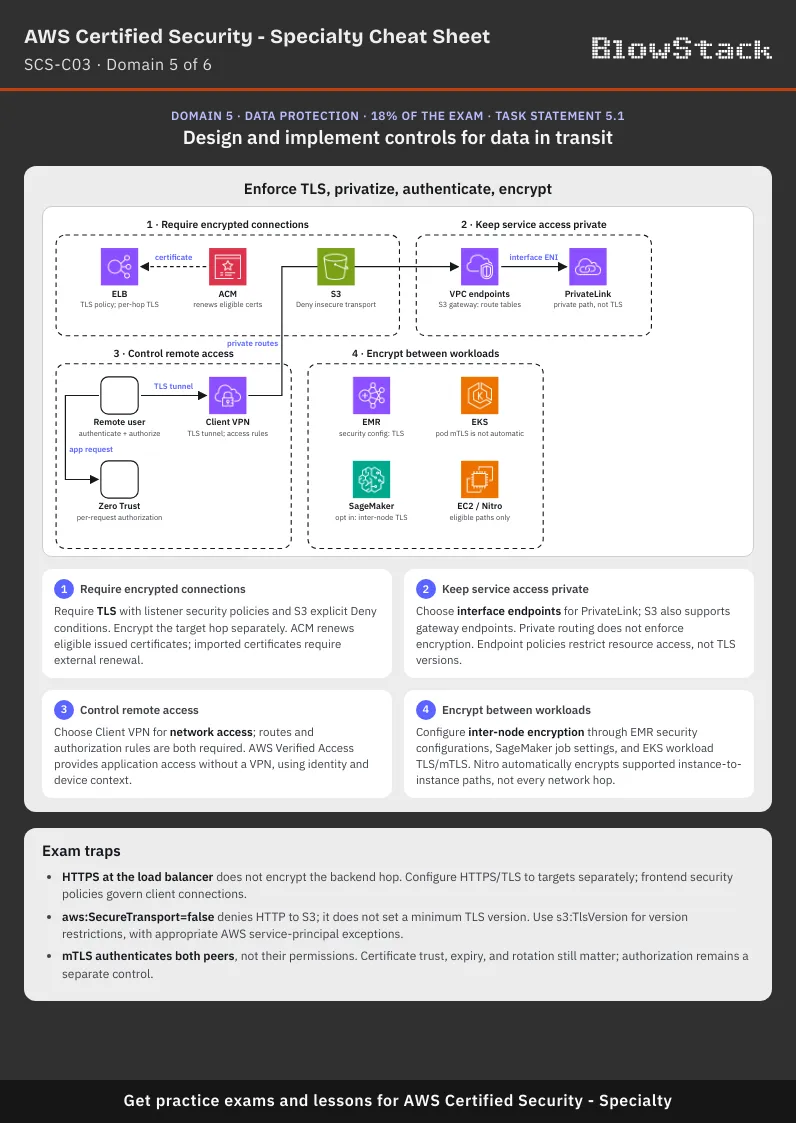
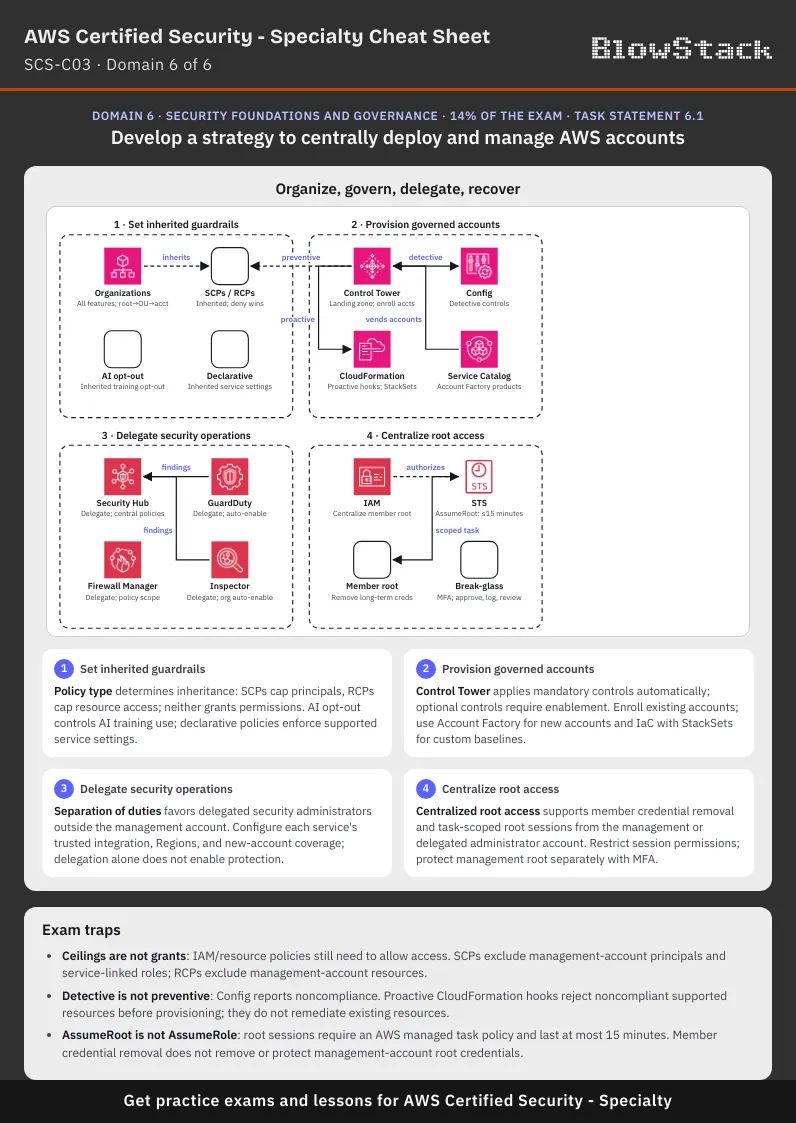
Free SCS-C03 cheat sheets
One PDF per exam domain: the domain's task statements, each drawn with its services and exam traps, then the concepts and core services to remember.
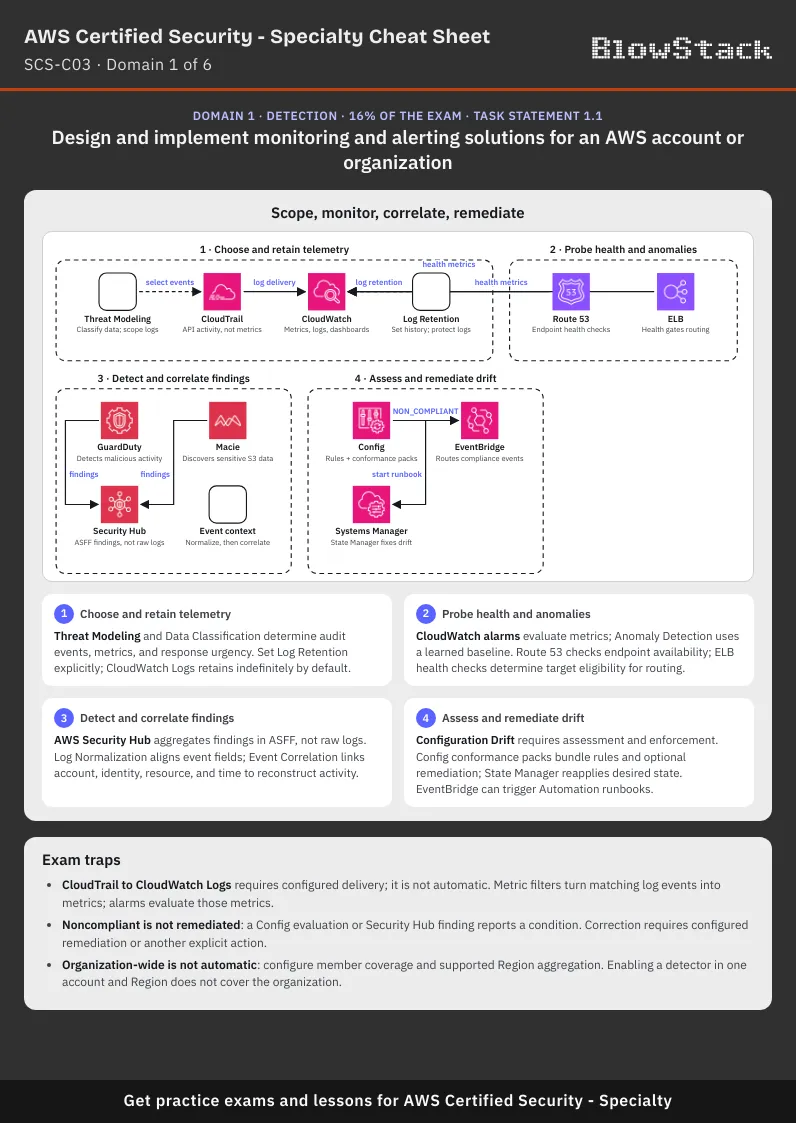
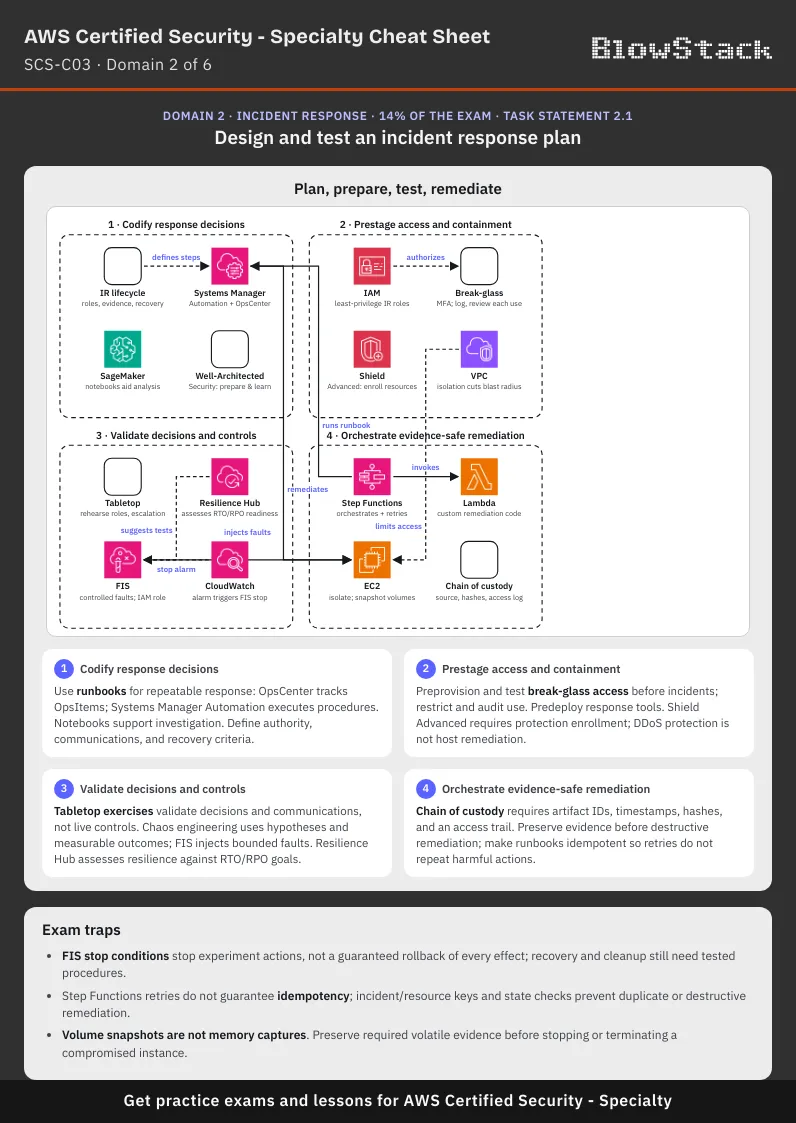
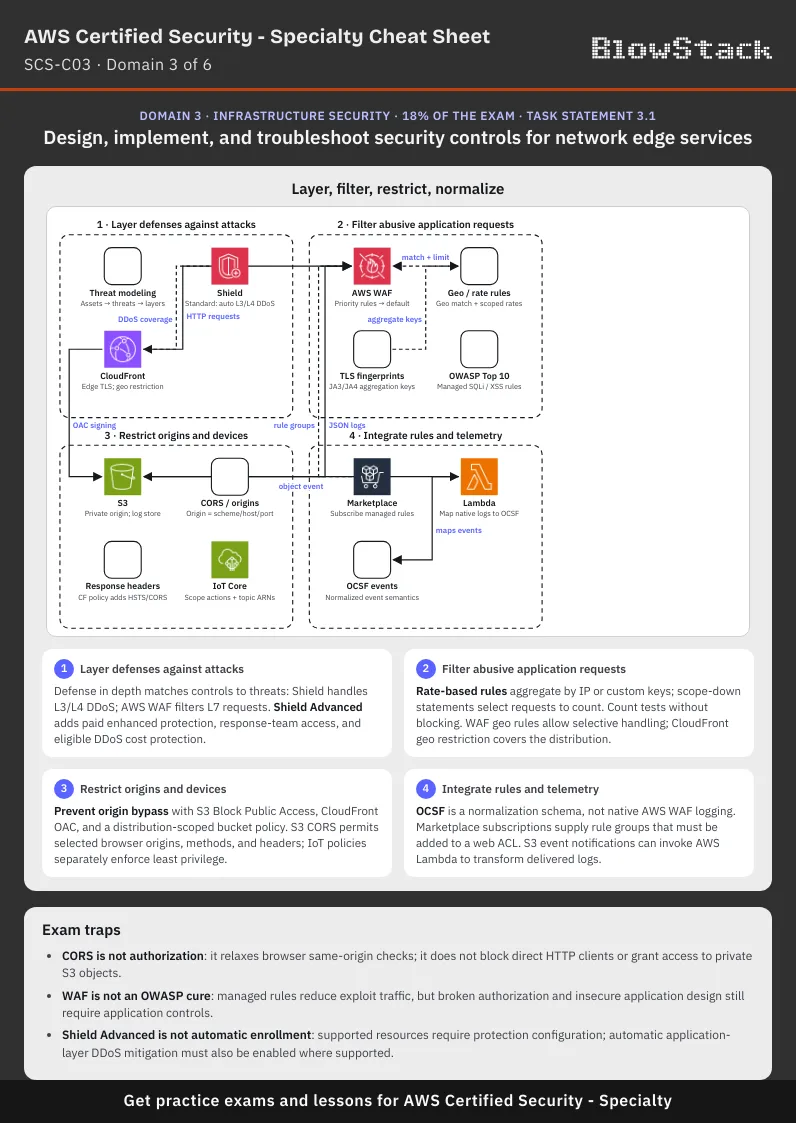
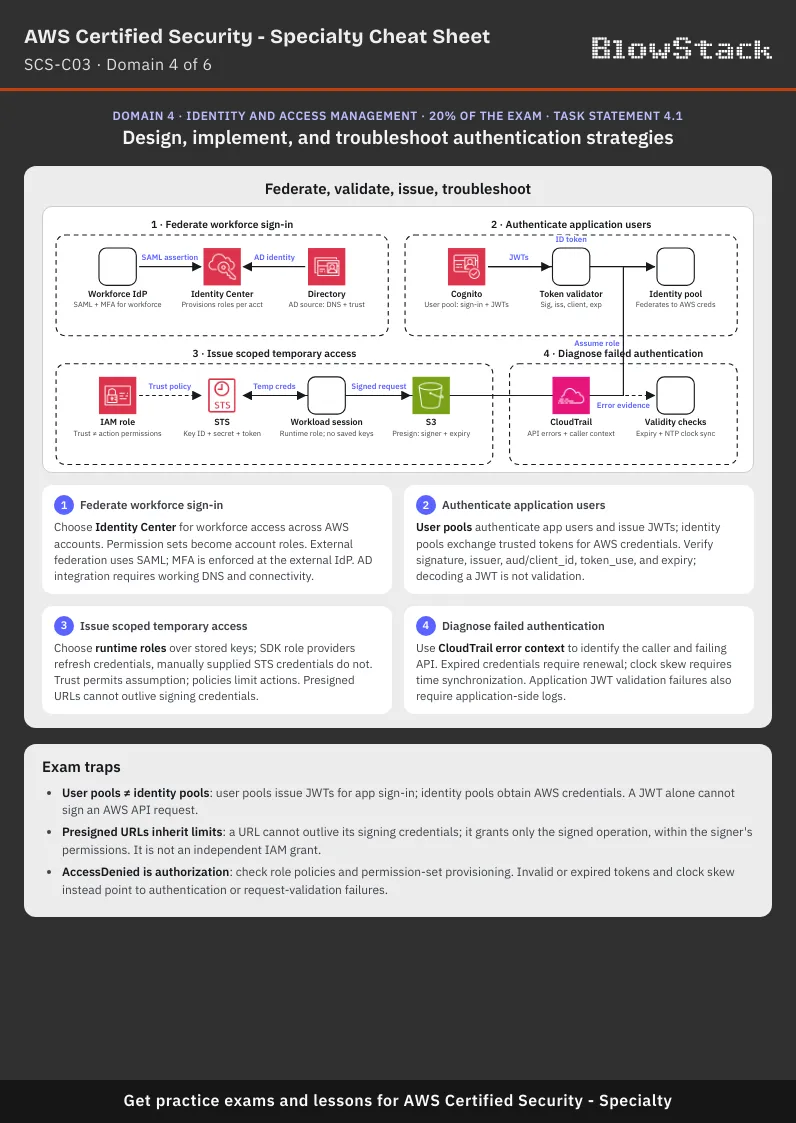
Exam domains
The SCS-C03 questions are grouped into 6 domains divided into 16 tasks.
- Design and implement monitoring and alerting solutions for an AWS account or organization
- Design and implement logging solutions
- Troubleshoot security monitoring, logging, and alerting solutions
- Design and test an incident response plan
- Respond to security events
- Design, implement, and troubleshoot security controls for network edge services
- Design, implement, and troubleshoot security controls for compute workloads
- Design and troubleshoot network security controls
- Design, implement, and troubleshoot authentication strategies
- Design, implement, and troubleshoot authorization strategies
- Design and implement controls for data in transit
- Design and implement controls for data at rest
- Design and implement controls to protect confidential data, credentials, secrets, and cryptographic key materials
- Develop a strategy to centrally deploy and manage AWS accounts
- Implement a secure and consistent deployment strategy for cloud resources
- Evaluate the compliance of AWS resources
Exam mode and practice mode
| Exam mode | Practice mode | |
|---|---|---|
| Questions count | 65 | 1 - 65 |
| Time limit | 170 minutes | Optional, 10 - 200 minutes |
| Exam scope | 6 domains with the official questions ratio | Selected domains with the official questions ratio |
| Correct answers | After exam submission | After exam submission or after each answer |
| Question types | Single answer, multiple answer, ordering, and matching | Single answer, multiple answer or all types |
| Question hints | Never | Optional |
| Question domain | Revealed after exam submission | Revealed after submission or during the exam |
| Scoring | 15 of 65 questions do not count towards the result | Official AWS method or mathematical mean |
See all simulator features on the AWS Exam Simulator page.
Technologies and concepts
Access Control
Access control turns security requirements into enforceable permissions for people, applications, and cloud services. It limits unauthorized activity while preserving legitimate operations, including the ability to deliver logs, run health checks, and investigate incidents.
Anomaly Detection
Anomaly detection compares observed activity with an established baseline, statistical model, or expected pattern to identify unusual behavior. In cloud security, it helps engineers detect potentially compromised identities, unexpected network activity, and abnormal resource usage that fixed rules alone might miss. An anomaly is evidence for investigation, not proof of an attack.
Asymmetric Routing
Routing decisions are made independently in each direction, so a connection does not necessarily return through the devices that handled its outbound packets. This can be harmless in ordinary IP forwarding but can disrupt stateful firewalls, network address translation, and security inspection that depend on seeing both directions of a flow.
Attack Path Analysis
Individual vulnerabilities and alerts rarely explain an entire compromise; attack path analysis connects them into a sequence of access and actions. Engineers use it proactively to break exploitable routes and during incident response to reconstruct events, identify enabling conditions, and determine the scope of compromise.
Attack Surface Reduction
An attack surface includes exposed network services, application interfaces, identities, software components, and administrative access paths. Reducing it means retaining only the capabilities and connectivity required for legitimate operations, which limits opportunities for initial compromise and lateral movement.
Attribute-Based Access Control
ABAC expresses access rules using attributes such as project, department, environment, or data classification instead of maintaining separate permissions for every identity and resource. In cloud environments, trusted identity attributes and resource tags can make permissions scale with changing teams and infrastructure, provided attribute assignment and modification are tightly controlled.
Audit Logging
Audit logging creates an evidence trail showing who or what performed an action, when it occurred, which resource was affected, and what the outcome was. In cloud environments, effective auditing requires selecting complementary log sources and protecting their delivery, retention, and accessibility across accounts, Regions, and workloads.
AWS shared responsibility model
AWS and its customers have distinct responsibilities for protecting systems, data, and operations, with the boundary changing according to the services used. Understanding that boundary helps engineers implement appropriate controls and collect the right evidence instead of assuming that AWS compliance certifications automatically make a workload compliant.
AWS Well-Architected Framework
The framework helps engineers evaluate operational excellence, security, reliability, performance efficiency, cost optimization, and sustainability through documented questions and best practices. For security governance, it connects architectural decisions to risk reduction and improvement plans, but it does not replace automated resource checks, compliance evidence, or regulatory audits.
Backup Isolation
Backup isolation creates independent security and failure boundaries around backup data, retention settings, administrative identities, and encryption keys. It matters because ransomware, stolen credentials, accidental deletion, and infrastructure failures can otherwise affect both live data and the copies needed to recover it.
Blast Radius
Blast radius describes both the potential reach of an incident and the impact actually observed during investigation. Cloud architectures reduce it through isolation, restricted permissions, and controlled dependencies, while incident responders use evidence to determine which boundaries an event has crossed.
Break-Glass Access
It allows authorized responders to regain control, contain damage, or perform exceptional recovery tasks without depending entirely on the systems that may have failed. A sound design balances rapid access with strong authentication, limited privileges, monitoring, and mandatory review after every use.
Bring Your Own Key
Bring Your Own Key (BYOK) gives an organization control over the origin of encryption keys and responsibility for important parts of their lifecycle. It supports requirements for independently generated keys, custody evidence, and revocation, but importing a key does not mean the key remains outside the cloud provider.
Certificate management
It covers certificate issuance, validation, deployment, renewal, revocation, and retirement, together with protection of the keys and trust chains that make certificates useful. In cloud environments, effective certificate management prevents outages from expired certificates and supports authenticated, encrypted communication across public endpoints, internal services, accounts, and Regions.
Chain of Custody
In cloud incident response, chain of custody connects forensic artifacts to their sources and records every authorized person or automated process that handles them. It helps investigators establish that evidence is authentic and unchanged, supports defensible findings, and reduces the risk that remediation destroys information needed to understand an incident.
Chaos Engineering
Chaos engineering uses explicit hypotheses, realistic faults, and measurable outcomes to uncover weaknesses before an unplanned incident exposes them. In cloud environments, it validates both technical resilience and incident response procedures, including detection, escalation, containment, recovery, and communication.
Client Fingerprinting
Client fingerprinting helps distinguish traffic patterns that IP addresses and user-agent strings alone cannot reliably separate. Cloud edge security controls use these signatures alongside request rates, geographic signals, and application context to detect automation and apply targeted restrictions without treating every shared address as one client.
Client-Side Encryption
The receiving service stores ciphertext rather than the original plaintext, and authorized clients decrypt the data when they retrieve it. This separates access to stored data from access to its plaintext, but requires deliberate choices about key custody, application security, and recovery.
Clock Skew
Distributed systems use timestamps to decide whether requests, credentials, and authentication assertions are valid. When participating systems disagree about the current time, legitimate authentication can fail, audit timelines can become misleading, and poorly configured validation tolerances can weaken replay protection.
Configuration Drift
Configuration drift occurs when running infrastructure, operating systems, or applications no longer match their intended configuration, often because of manual changes, competing automation, or incomplete deployments. Detecting and managing drift helps engineers preserve security controls, reproduce environments, and investigate unexpected changes before they cause incidents.
Confused Deputy Problem
A service or application can authenticate a request correctly yet misuse its own permissions because it fails to verify whose authority the request should exercise. Cloud defenses bind delegated access to the intended customer, source resource, and operation rather than trusting the intermediary’s identity alone.
Containers
Containers provide a repeatable way to build, distribute, and run software across development and cloud environments. They improve deployment consistency and resource utilization, but require explicit controls for image security, runtime isolation, networking, identity, and persistent data.
Credential Revocation
Credential revocation contains unauthorized access after a secret, key, token, or identity is compromised or no longer trusted. Effective revocation addresses both the original credential and any sessions or downstream credentials created from it, while allowing legitimate workloads to recover safely.
Credential Rotation
Passwords, access keys, tokens, and application secrets can be exposed through compromised systems, accidental disclosure, or excessive distribution. Rotation limits how long a persistent credential remains usable, but it must coordinate changes across the identity system, secret storage, and consuming applications to avoid outages.
Cross-Account Access
Cloud accounts create administrative and security boundaries, but shared services, deployment pipelines, and operational teams often need controlled access across them. Cross-account access establishes that authorization without requiring shared credentials or moving resources into the same account.
Cryptographic Hashing
A cryptographic hash function produces a deterministic fingerprint of data while making it computationally infeasible to reverse the digest or deliberately find different inputs with the same digest. In cloud systems, hashing supports file validation, digital signatures, and tamper detection, but it must be combined with trusted reference values and appropriate access or retention controls.
Data Classification
Classification connects the value and risk of information to decisions about access, storage, monitoring, retention, and disposal. In cloud workloads, it helps engineers determine which activities require audit records, which changes should trigger alerts, and how quickly security teams must respond.
Data Lakes
Data lakes retain data in its original form and in prepared formats so different teams can reuse it for reporting, exploration, and machine learning. In the cloud, object storage commonly provides the storage foundation, while separate services handle ingestion, cataloging, governance, and computation.
Data Loss Prevention
Data Loss Prevention combines data classification, inspection, access restrictions, and enforcement at the points where information is stored, processed, or transmitted. In cloud and generative AI applications, it helps prevent confidential records, credentials, and proprietary content from escaping through prompts, retrieved context, model responses, logs, or external tools.
Data Masking
Data masking reduces unnecessary exposure of confidential information in logs, messages, query results, and nonproduction datasets. It complements encryption and access control by limiting which sensitive values users and downstream systems can actually see.
Data Residency
Data residency connects the physical location of data to legal, contractual, and organizational requirements. Cloud architectures must account for primary databases, replicas, backups, logs, and downstream systems because choosing a deployment Region alone does not establish compliance.
Data Retention
Retention policies balance business needs, recovery requirements, legal obligations, privacy, and storage cost. In the cloud, engineers implement them through lifecycle rules, backup schedules, retention periods, deletion controls, and exceptions such as legal holds.
DDoS Mitigation
Distributed denial-of-service attacks use many sources to exhaust network bandwidth, connection capacity, or application resources. Mitigation matches defenses to the threatened layer, rejects malicious traffic before it reaches constrained resources, and preserves access for legitimate users.
Defense in Depth
Defense in Depth combines preventive, detective, and response controls across network boundaries, identities, applications, hosts, and data. It reduces dependence on any single safeguard and limits the impact of successful attacks, configuration mistakes, and compromised credentials.
Digital Signatures
A digital signature allows a recipient to detect changes to signed data and verify that the signature was produced by the holder of a particular private key. In cloud environments, signatures help validate software releases, stored files, and audit records, provided that verifiers trust the signing key and enforce verification.
Disaster recovery
Disaster recovery combines recoverable data, replacement infrastructure, documented procedures, and testing to restore technology services after failures, attacks, or operational mistakes. In the cloud, it uses capabilities such as backups, replication, automated provisioning, and geographically separate deployments to balance recovery requirements against cost and complexity.
DNS Tunneling
DNS tunneling repurposes DNS as a transport for application traffic, including unauthorized command-and-control communication and data exfiltration. Detecting it requires visibility into DNS names and query behavior, because network connection metadata alone usually cannot distinguish a tunnel from ordinary name resolution.
Effective Permissions
Assigned permissions do not necessarily equal usable access: authorization combines grants with organizational controls, resource policies, session restrictions, and request context. Understanding the resulting permissions helps engineers design least-privilege access and diagnose why an apparently allowed operation fails.
Encryption in Transit
Encryption in transit prevents observers on a network path from reading protected data and, with correctly configured secure protocols, helps detect tampering and authenticate communicating endpoints. In cloud architectures, it applies to internet traffic, internal service communication, and hybrid or multi-cloud connections, independently of encryption at rest.
Envelope Encryption
Envelope encryption separates bulk data encryption from the protection and management of encryption keys. It combines efficient local encryption with centralized key controls, allowing cloud systems to protect large datasets without sending every byte through a key management service.
Event Correlation
Individual logs and alerts often describe only fragments of an incident or operational failure. Event correlation combines those fragments into a contextual sequence, helping engineers detect suspicious behavior, investigate causes, and reduce duplicate or low-value alerts.
Evidence Integrity
Reliable incident response depends on logs and other artifacts remaining authentic, traceable, and protected throughout collection, storage, transfer, and analysis. Evidence integrity combines tamper detection, preservation controls, and documented handling so engineers can reconstruct events and support defensible conclusions.
Explicit Deny Precedence
In a deny-overrides authorization model, a request fails whenever an applicable policy explicitly denies it, even if another policy allows it. This enables enforceable security guardrails, but troubleshooting requires identifying the denying statement and its evaluation context rather than simply adding permissions.
False Positives
Security tools identify patterns and conditions that require validation, not automatic acceptance as confirmed incidents. Distinguishing false positives from genuine threats and accurately detected but authorized activity helps responders assess scope and impact without wasting investigation time or disrupting legitimate workloads.
Geofencing
At a cloud network edge, geofencing usually means allowing, blocking, or applying additional controls to requests based on the estimated geographic location of their source IP address. It helps enforce geographic access requirements and reduce unwanted traffic, but location is an imperfect signal and must complement authentication, authorization, and other security controls.
Idempotency
Idempotency makes retries safe when requests time out, events arrive more than once, or automation restarts after a failure. In incident response, it prevents repeated remediation attempts from creating duplicate resources, reversing containment, or causing additional disruption.
Identity Federation
Federation separates where an identity is authenticated from where that identity accesses resources, using established trust and verifiable identity assertions or tokens. It enables centralized sign-in for employees, customers, and workloads while letting each application or cloud account retain control over authorization.
Immutable Backups
Backup immutability preserves recovery points even when production systems or administrative credentials are compromised. It helps defend against ransomware and accidental deletion, but must be combined with isolated administration, protected encryption keys, and tested recovery procedures.
Immutable Infrastructure
Changes to operating systems, application dependencies, and security configuration are built into tested machine or container images and deployed as replacements. This reduces configuration drift and makes recovery more repeatable, provided that persistent data, secrets, and incident evidence are managed separately.
Immutable Storage
Immutable storage uses storage-enforced controls to protect retained records from accidental changes, malicious deletion, and unauthorized replacement. For security logging, it preserves evidence for investigations and compliance, while separate controls must ensure that logs are collected completely, remain readable, and can be analyzed safely.
Incident Response Lifecycle
It connects technical response actions with decision authority, communications, evidence handling, and recovery criteria. In cloud environments, the lifecycle helps teams coordinate across accounts and managed services while limiting attacker activity, preserving evidence, and restoring trusted operations.
Infrastructure as code (IaC)
IaC turns infrastructure definitions into repeatable deployment processes that can be reviewed, tested, and automated. It helps engineers create consistent environments, reduce manual errors, and apply security standards across accounts while maintaining a traceable history of changes.
Key Custody
Key custody separates possession of cryptographic material from permission to administer or use a key. It matters because key generation, storage, backup, revocation, and recovery choices determine both the confidentiality and the availability of encrypted data.
Key Management
Encryption depends on keeping cryptographic keys protected while making them available to authorized systems. Key management defines who controls those keys, how applications use them, and how access is audited and recovered, supporting both encryption at rest and encryption in transit.
Key Rotation
Key rotation limits how long a cryptographic key is used to protect new data and supports security policies, compliance requirements, and incident response. A safe rotation process directs new operations to fresh key material, retains older material when necessary for decryption or verification, and retires it only after its dependencies are resolved.
Lateral Movement
After compromising a workload or identity, an attacker can exploit connectivity, credentials, and trust relationships to reach additional targets. Detecting this progression requires correlating network, DNS, identity, and workload activity rather than monitoring only traffic entering or leaving the environment.
Least privilege
Least privilege reduces the damage that compromised credentials, software defects, and operational mistakes can cause. In cloud environments, it applies to identity permissions, workload roles, administrative access, network connectivity, and organizational guardrails, and requires ongoing review as requirements change.
Legal Holds
A legal hold preserves information needed for litigation, investigations, or other legal obligations, usually without a predetermined expiration date. In cloud environments, engineers translate that obligation into enforceable storage and backup controls, supported by access restrictions, audit records, and reliable retrieval procedures.
Link-Layer Encryption
Link-layer encryption provides confidentiality and, with protocols such as MACsec, integrity and data-origin authentication for traffic crossing a network link. It matters in hybrid and multi-cloud connectivity because a private circuit is not automatically encrypted, and protection ends wherever the encrypted link terminates.
Log Normalization
Applications, operating systems, network devices, and cloud services describe events using different field names, formats, and meanings. Log normalization reconciles those differences so centralized detection rules and incident-response queries can operate across sources without repeatedly implementing source-specific logic.
Log Retention
Log retention determines how long operational, security, and audit records remain available for monitoring, investigation, and compliance. An effective policy balances required history and retrieval speed against storage cost, privacy obligations, and protection from unauthorized alteration or deletion.
Multi-Factor Authentication
Multi-factor authentication (MFA) combines factors such as something a person knows, possesses, or is, reducing the risk that a stolen password alone will allow unauthorized access. In cloud environments, it is especially important for privileged human access, root accounts, and sensitive operations, but it must be paired with appropriate authorization, session controls, and recovery procedures.
Mutual TLS
Ordinary HTTPS typically authenticates only the server, whereas mutual TLS also requires the client to prove its identity using a certificate and its corresponding private key. This helps cloud workloads reject untrusted peers, but it requires certificate lifecycle management and separate authorization policies.
Network Isolation
Network isolation creates controlled communication boundaries between workloads, environments, and external networks. During incident response, it helps contain compromised resources, interrupt attacker communications, and protect unaffected systems while engineers investigate, eradicate threats, and restore trusted workloads.
Network Segmentation
Network segmentation separates workloads by trust level, function, environment, or data sensitivity, then permits only the traffic required between them. It reduces exposure and limits lateral movement after a compromise, but effective segmentation requires enforced traffic controls rather than merely separate address ranges.
Open Cybersecurity Schema Framework (OCSF)
OCSF standardizes how security tools describe events, entities, activities, and findings so that data from different sources can be analyzed consistently. In cloud environments, it reduces source-specific parsing and helps integrate edge-service telemetry, third-party security products, and centralized analytics without tying the data model to one provider.
OS Hardening
OS hardening turns a general-purpose operating system into a controlled baseline suited to a specific workload. It combines minimal software, restricted privileges, secure configuration, patching, and monitoring so that compute instances and container workloads expose fewer opportunities for attack.
Output Validation
Generative AI responses must be treated as untrusted data, even when they come from a trusted model endpoint. Output validation helps prevent unsafe content, sensitive-data disclosure, injection attacks, and unauthorized actions by checking responses at the boundaries where applications consume them.
OWASP Top 10
It gives engineering teams a shared vocabulary for recognizing application weaknesses and prioritizing preventive, detective, and corrective controls. In cloud architectures, it helps distinguish attacks that edge filtering can reduce from vulnerabilities that require changes to application code, identity controls, configuration, or operating practices.
Patch Management
Patch management keeps operating systems, applications, and dependencies updated through repeatable policies and deployment workflows. In cloud environments, responsibility depends on the service model: providers patch infrastructure they operate, while customers patch the software layers they control. Effective patching combines automation with risk-based prioritization, availability safeguards, and continuous validation.
Policy as Code
Policy as Code turns written requirements into executable checks against infrastructure definitions, deployment plans, requests, or running resources. It helps teams apply consistent controls across accounts and environments, detect violations early, and retain reviewable evidence of policy changes and evaluation results.
Policy Inheritance
Cloud platforms use policy inheritance to apply common governance requirements across organizational hierarchies without configuring every account, project, or resource separately. The effective result depends on the policy type: some policies impose permission ceilings, while others merge configuration settings or allow controlled overrides.
Privilege Escalation
In cloud environments, an identity can gain unintended access without exploiting a software vulnerability: legitimate administrative APIs can become escalation paths when permissions are combined incorrectly. Preventing and investigating escalation requires evaluating effective authorization, identifying indirect paths to privileged identities, and correcting the permissions or trust relationships that enable them.
Prompt Injection
Language models process instructions and reference material together, creating opportunities for attackers to disguise malicious commands as ordinary content. In cloud applications, successful injection can manipulate responses, expose sensitive context, or trigger unauthorized tool actions, so defenses must combine model-level guardrails with independently enforced security controls.
Public Key Infrastructure
Public Key Infrastructure (PKI) allows systems to verify that a public key belongs to the expected server, user, device, or organization. In cloud environments, it supports authenticated TLS connections, mutual TLS, and digital signatures while requiring careful protection of private keys and management of certificate lifecycles.
Rate Limiting
Rate limiting protects shared resources by restricting traffic according to a measured request rate, an allowed burst, and an enforcement policy. At the cloud edge, it helps reduce application-layer abuse and backend overload, but effective policies must distinguish legitimate traffic spikes from harmful behavior.
Resource Tagging
Tags describe business and operational attributes such as ownership, department, cost center, application, and environment without changing a resource’s function. A consistent tagging strategy supports cost allocation and resource management, while policy controls help prevent missing, misleading, or unauthorized tags.
Role-Based Access Control
Role-Based Access Control (RBAC) separates permission definitions from individual users or workloads, making access easier to administer and review. In cloud environments, it supports consistent authorization across teams and accounts, but requires carefully scoped roles and controlled assignments to prevent excessive privileges.
Runtime Threat Detection
Runtime threat detection looks for signs of compromise in active compute workloads, such as unexpected process execution, suspicious network connections, or attempts to access sensitive files. It complements vulnerability scanning by identifying attack behavior rather than merely identifying software weaknesses that could be exploited.
Same-Origin Policy
An origin is defined by its URL scheme, hostname, and effective port, so two applications can share a domain name yet still have different origins. The policy limits cross-origin data access in browsers, while mechanisms such as Cross-Origin Resource Sharing (CORS) let servers explicitly permit selected access without replacing authentication or authorization.
Secure remote access
Secure remote access combines identity verification, authorization, protected transport, and monitoring to make resources accessible without granting unnecessary network exposure. In cloud environments, it applies to employee application access, administrative sessions, private service access, and connectivity between on-premises networks and cloud workloads.
Security Quality Gates
A security quality gate turns vulnerability findings and security policy checks into an explicit decision to permit, block, or require approval for a change. In cloud delivery pipelines, it helps prevent vulnerable code, dependencies, container images, and infrastructure configurations from reaching production while preserving an auditable exception process.
Separation of Duties
The idea is to prevent one identity from initiating, approving, executing, and concealing a sensitive action without independent oversight. In cloud environments, separate administrative roles, account boundaries, approval workflows, and protected audit records reduce the risk of fraud, mistakes, and compromised credentials.
Server-Side Encryption
Server-side encryption protects stored data while allowing applications to use normal storage and database operations. Its security depends on the service’s encryption boundary, access controls, and key-management configuration, not merely on whether encryption is enabled.
Shift-Left Security
Instead of waiting until deployment or production to discover weaknesses, teams evaluate security while designing systems, writing code, and building artifacts. This shortens feedback loops and helps prevent vulnerable code, dependencies, container images, and infrastructure configurations from reaching cloud workloads.
Stateful and Stateless Filtering
Stateful filters remember permitted traffic flows and use that context to recognize return traffic, while stateless filters evaluate each packet without remembering earlier exchanges. This distinction determines how engineers configure bidirectional access, troubleshoot blocked responses, and combine workload-level controls with subnet boundaries and inspection firewalls.
Static Analysis
Static analysis evaluates artifacts against language rules, resource schemas, security checks, and organizational policies before changes reach production. In cloud engineering, it helps teams detect unsafe infrastructure definitions early and apply consistent deployment standards across accounts, although it cannot establish that deployed resources will behave securely in every environment.
Static Application Security Testing
Static Application Security Testing (SAST) identifies potentially vulnerable code paths, insecure programming patterns, and other implementation weaknesses before deployment. Integrating it into development environments and delivery pipelines helps engineers remediate problems early and prevent changes that violate security policy from reaching production.
Tabletop Exercises
Participants work through a realistic incident scenario, explain their decisions, and identify gaps in responsibilities, communications, access, and response procedures. These exercises validate organizational readiness at relatively low operational risk, but they must be complemented by technical tests to establish whether controls and recovery mechanisms actually work.
Temporal Correlation
Temporal correlation helps engineers reconstruct activity across application, identity, network, and cloud-service logs. During incident response, it reveals event sequences that isolated records cannot show, while requiring careful handling of clock differences, delivery delays, and incomplete evidence.
Temporary Credentials
Temporary credentials let people and workloads access cloud resources without distributing permanent access keys. They reduce the lifetime of exposed credentials, support federation and role-based access, and shift credential renewal to identity services and supported client libraries.
Threat Modeling
Threat modeling connects a workload’s architecture, valuable assets, trust boundaries, and likely attackers to concrete security requirements. It helps engineers prioritize preventive controls, collect useful telemetry, and design alerts around plausible attack scenarios rather than enabling security features indiscriminately.
Timeline Reconstruction
A reconstructed timeline connects security alerts, identity activity, configuration changes, network traffic, and workload events into an evidence-backed incident narrative. It supports root cause analysis by distinguishing the initial compromise and enabling conditions from later attacker actions, symptoms, and response activity.
Token Validation
Cloud applications and identity systems validate tokens before trusting the identities or claims they contain. Correct validation prevents forged, expired, misdirected, or inappropriate tokens from being accepted, while separating authentication failures from authorization problems.
Transport Layer Security
TLS protects data while it moves between clients, load balancers, applications, and other resources. Effective protection requires more than enabling an encrypted listener: engineers must enforce acceptable protocol versions, validate identities, and protect every required network hop.
Vulnerability Assessment
A vulnerability assessment determines which weaknesses exist, which resources they affect, and how urgently they need attention. In cloud environments, recurring assessments help engineers address vulnerable dependencies, exposed workloads, and insecure configurations as deployments and threat information change.
Workload Identity
Workload identity lets software prove who it is and receive permissions appropriate to its function and execution environment. Cloud implementations commonly combine runtime identity, federation, and short-lived credentials to reduce reliance on stored secrets while supporting least privilege and auditable access.
Write Once, Read Many (WORM) Storage
WORM storage protects retained records from modification and deletion, helping preserve evidence, meet retention obligations, and resist destructive attacks. In cloud systems, its guarantees depend on the retention mechanism, administrative bypass rules, and protection of supporting resources such as encryption keys.
Zero Trust
Zero Trust treats internal and external networks as potentially hostile and requires authentication, authorization, and appropriate protection for each resource interaction. It reduces the impact of stolen credentials and compromised devices by combining least-privilege access, workload identity, segmentation, encryption, and ongoing evaluation of security signals.
Services on the exam
The 74 AWS services the SCS-C03 exam covers.
Concepts on the exam
The 99 cloud concepts the SCS-C03 exam covers, each explained with the AWS services that implement it, in the Cloud Concepts Hub .