
AWS Certified Solutions Architect - Associate (SAA-C03) Free Practice Exam and Practice Test
1203 SAA-C03 practice questions, updated , in an exam simulator that mirrors the real exam: its domains, its question types and its timing, with an explanation for every answer.
SAA-C03 example questions
One example question per domain from the SAA-C03 question bank, with the correct answer and its explanation. Sign in to the simulator to answer them with all answer options.
A company uses a customer managed symmetric AWS KMS key to encrypt sensitive application records. An application uses an IAM role to call the KMS Decrypt API directly. The role's identity-based policy allows kms:Decrypt on the key, but requests fail with AccessDeniedException.
The key policy grants a security administrator role permission to manage the key. It does not grant cryptographic permissions, enable IAM policies to authorize key access, or name the application role. No KMS grants or explicit denies apply.
The company must allow the application to decrypt records without allowing it to administer the key or allowing the security administrator to decrypt records. Which change meets these requirements?
Show answer
CORRECT ANSWERAdd a statement to the key policy that allows the application role to perform kms:Decrypt, leaving the administrator's existing permissions unchanged.
A KMS key policy can directly authorize an IAM role in the same account to use the key. Granting only kms:Decrypt to the application role enables the required operation while preserving the separation between key administration and cryptographic use.
An engineering company receives diagnostic bundles that contain 5–20 MiB of already-compressed data. An ingestion service must acknowledge each submission after durably accepting it, without waiting for analysis. A fleet of workers analyzes bundles independently and can be unavailable for up to 72 hours. Accepted bundles must remain available for at least 7 days, and unfinished analysis must be retried if a worker crashes. Workers already handle duplicate jobs safely, and processing order is not important.
Which solution meets these requirements with the least operational overhead?
Show answer
CORRECT ANSWERStore each bundle in Amazon S3 and send its object reference and job ID to an Amazon SQS standard queue with a 7-day retention period. Acknowledge the submission after both operations succeed. Retain the object for at least 7 days, and have workers delete the message only after successful analysis, maintaining visibility while processing.
S3 stores the large payload while SQS durably buffers a small work message. This decouples ingestion from worker availability. Retaining both the object and message supports the outage requirement. Deleting the message only after success allows an unfinished job to become available again if its worker crashes.
A company has hundreds of tables in an Amazon S3 data lake cataloged in the AWS Glue Data Catalog. Analysts query the tables through Amazon Athena. The lake already enforces centrally managed permissions, and analysts cannot read the S3 objects directly. No existing grants give analysts access to the tables.
An ingestion workflow assigns each new table a department and a sensitivity classification. Finance analysts must automatically receive query access to tables classified as both department=finance and sensitivity=internal, including tables created in the future. They must not receive access to other tables. Administrators want to avoid maintaining individual table grants.
Which solution meets these requirements with the LEAST ongoing administrative effort?
Show answer
CORRECT ANSWERDefine department and sensitivity as AWS Lake Formation LF-Tags and have the ingestion workflow assign the appropriate values to each table. Grant the finance analyst role SELECT through an LF-Tag expression that requires department=finance AND sensitivity=internal.
Lake Formation tag-based access control grants permissions based on LF-Tag expressions. The expression requires both classifications to match, so it covers eligible existing tables and future tables when the workflow assigns their tags, without individual table grants.
A company is designing the compute tier for an internal reporting application on Amazon EC2. The business requires 99.9% time-based availability during each 30-day month, measured continuously from the user's perspective. Planned maintenance counts as downtime. There is no separate requirement for uninterrupted service during an Availability Zone failure.
The application stores its state outside the instances. Failure testing and operational modeling produce the monthly downtime estimates in the proposed designs below, including maintenance and recovery. The company has approved these estimates for architecture planning. All designs use the same instance type and maintain their stated instance count continuously. Costs outside EC2 compute are identical.
Which design meets the availability objective at the LOWEST EC2 compute cost?
Show answer
CORRECT ANSWERRun one instance in an EC2 Auto Scaling group with desired capacity 1, automatic replacement of unhealthy instances, and automated maintenance. Estimated total downtime is 35 minutes per month.
A 30-day month contains 43,200 minutes. An availability objective of 99.9% permits 43.2 minutes of downtime. The estimated 35 minutes stays within this budget while requiring only one continuously running instance. Additional redundancy is not required by the stated business requirements.
Free SAA-C03 cheat sheets
One PDF per exam domain: the domain's task statements, each drawn with its services and exam traps, then the concepts and core services to remember.
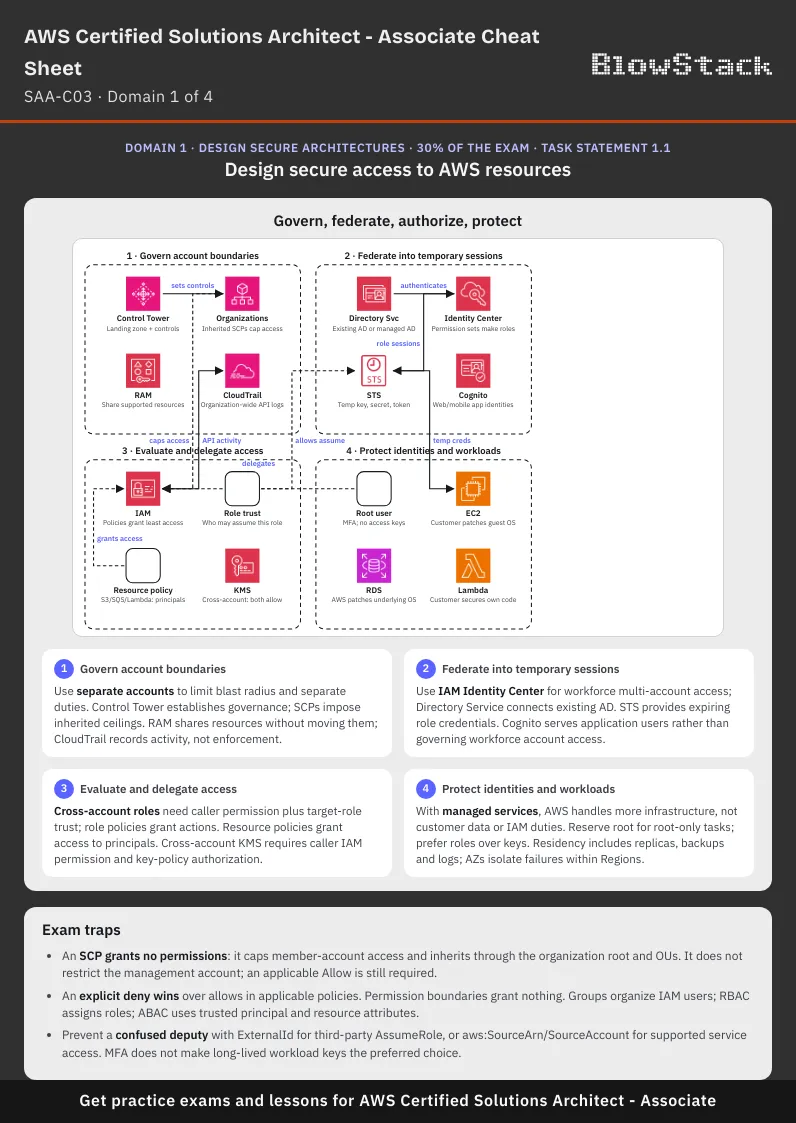
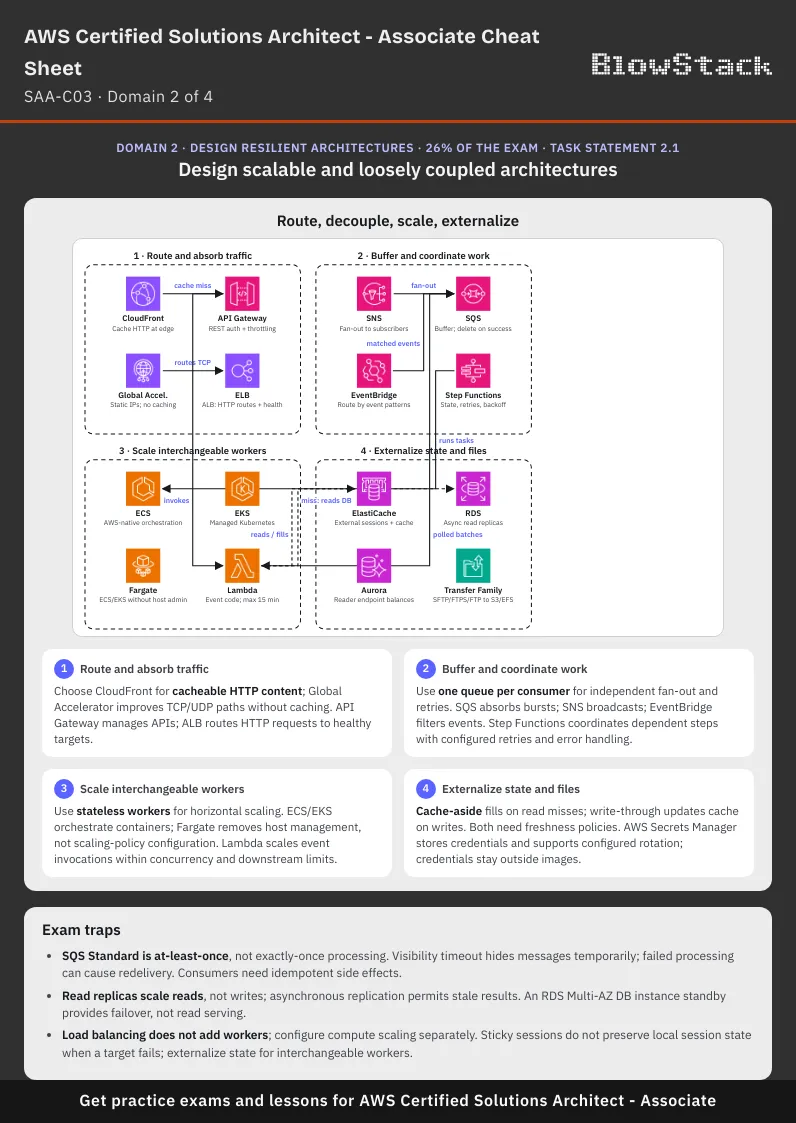
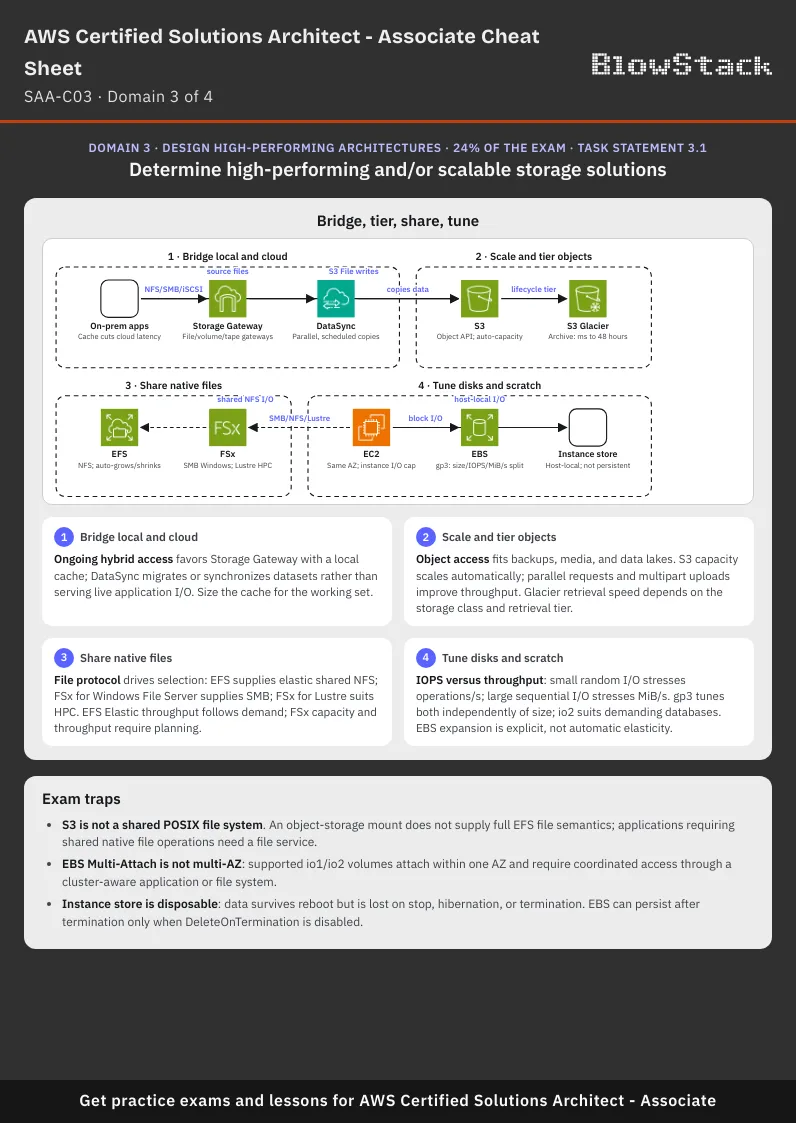
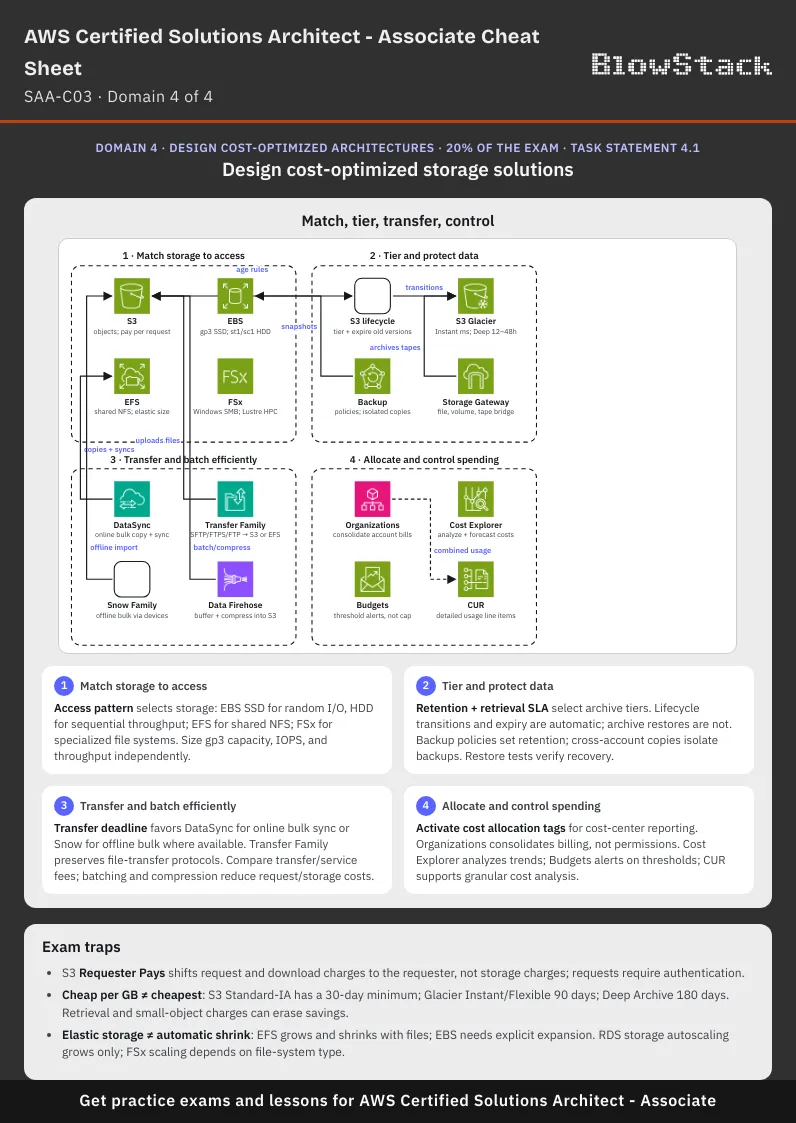
Exam domains
The SAA-C03 questions are grouped into 4 domains divided into 14 tasks.
- Design secure access to AWS resources
- Design secure workloads and applications
- Determine appropriate data security controls
- Design scalable and loosely coupled architectures
- Design highly available and/or fault-tolerant architectures
- Determine high-performing and/or scalable storage solutions
- Design high-performing and elastic compute solutions
- Determine high-performing database solutions
- Determine high-performing and/or scalable network architectures
- Determine high-performing data ingestion and transformation solutions
- Design cost-optimized storage solutions
- Design cost-optimized compute solutions
- Design cost-optimized database solutions
- Design cost-optimized network architectures
Exam mode and practice mode
| Exam mode | Practice mode | |
|---|---|---|
| Questions count | 65 | 1 - 75 |
| Time limit | 130 minutes | Optional, 10 - 200 minutes |
| Exam scope | 4 domains with the official questions ratio | Selected domains with the official questions ratio |
| Correct answers | After exam submission | After exam submission or after each answer |
| Question types | Single answer and multiple answer | Single answer, multiple answer or all types |
| Question hints | Never | Optional |
| Question domain | Revealed after exam submission | Revealed after submission or during the exam |
| Scoring | 15 of 65 questions do not count towards the result | Official AWS method or mathematical mean |
See all simulator features on the AWS Exam Simulator page.
About the SAA-C03 exam
The AWS Certified Solutions Architect - Associate exam's difficulty is significantly influenced by the extensive scope of topics it covers. This wide-ranging content demands a thorough understanding of many AWS services and their integration, which can be daunting, especially for those new to AWS or cloud computing.
The exam covers key areas including compute, storage, databases, networking, security, and application architecture. For compute, you need to understand services like EC2, which involves knowledge of instance types, pricing models, and scaling strategies. You must also be familiar with Lambda, which introduces a serverless paradigm that requires a different approach to architecture and deployment compared to traditional server-based models.
Storage is another critical domain, with services like S3 and EBS. Understanding S3 includes grasping its storage classes, bucket policies, and lifecycle management, while EBS requires knowledge of volume types, performance characteristics, and backup solutions. Databases on AWS span both relational (RDS) and non-relational (DynamoDB) systems, each with its own configuration, scaling, and maintenance considerations.
Networking on AWS involves VPC, subnets, routing tables, and gateways, which are foundational to designing secure and efficient cloud architectures. You must understand how to set up and manage these components to ensure proper isolation, connectivity, and security. Security itself is a vast topic, covering IAM (Identity and Access Management), encryption, and compliance requirements. Mastery of these elements is crucial, as security misconfigurations can lead to vulnerabilities.
The application architecture domain requires knowledge of how to design distributed systems that are highly available, fault-tolerant, and scalable. This involves using load balancers, auto-scaling groups, and designing stateless applications. Moreover, understanding the cost implications of architectural decisions is vital for optimizing performance while managing expenses.
The interrelated nature of these topics adds to the complexity. For instance, designing a fault-tolerant application involves not just compute and storage considerations but also networking and security configurations.
Effective preparation for the exam requires an integrated understanding of how these services work together to build robust, efficient, and secure solutions.
The breadth and depth of knowledge required across these domains, coupled with the need to stay updated with AWS’s frequent service updates and enhancements, contribute significantly to the exam's difficulty.
Technologies and concepts
Access Control
Access control turns security requirements into enforceable permissions for people, applications, and cloud services. It limits unauthorized activity while preserving legitimate operations, including the ability to deliver logs, run health checks, and investigate incidents.
ACID Transactions
ACID properties help applications update shared data correctly despite concurrent requests, processing errors, and infrastructure failures. They apply to relational databases, some NoSQL operations, and transactional lakehouse tables, but their scope and isolation guarantees depend on the implementation.
Active-Active Architecture
Active-active architecture combines availability and scalability by keeping two or more environments actively serving production requests rather than reserving one solely for recovery. Across cloud Regions, it can reduce user latency and support regional disaster recovery, but it requires deliberate traffic management, data consistency, and capacity planning.
Allowlisting
Allowlisting establishes a known set of permitted choices rather than attempting to identify every unsafe choice. In cloud and AI governance, it helps prevent unauthorized access and shadow AI by connecting transparent approval decisions to enforceable access controls, documented usage conditions, and ongoing review.
Amazon EC2 instance types
An instance type represents a resource profile, allowing engineers to match a virtual machine to an application's performance and compatibility requirements. Understanding these profiles helps avoid bottlenecks, reduce unnecessary spending, and distinguish hardware selection from purchasing options such as On-Demand or Spot.
Apache Parquet
Parquet groups values by column, allowing compatible readers to load selected fields and skip irrelevant data rather than scan every record in full. Its typed schema, encodings, and compression make it useful for cloud data lakes and machine learning preparation, especially when workloads repeatedly analyze subsets of large datasets.
APIs
An application programming interface defines available operations, accepted inputs, responses, and error behavior. In the cloud, APIs enable applications and automation tools to provision resources, configure services, and process data, making them the foundation of programmatic access.
Attribute-Based Access Control
ABAC expresses access rules using attributes such as project, department, environment, or data classification instead of maintaining separate permissions for every identity and resource. In cloud environments, trusted identity attributes and resource tags can make permissions scale with changing teams and infrastructure, provided attribute assignment and modification are tightly controlled.
Authentication
Cloud systems use authentication to establish which identity is making a request by validating credentials or other evidence. It is distinct from authorization, which determines what that identity may do, and is essential for protecting administrative access, application data, and service-to-service communication.
AWS Compliance
Compliance in AWS combines AWS-provided infrastructure assurances with customer responsibilities for data, applications, configurations, and operating procedures. Engineers must identify applicable requirements, verify service and geographic scope, implement controls, and retain evidence rather than assume that using AWS makes a workload compliant.
AWS global infrastructure
This infrastructure lets engineers choose where applications run, how they tolerate failures, and how closely they serve users. Understanding its geographic and operational boundaries is essential for designing availability, latency, disaster recovery, and data residency controls.
AWS shared responsibility model
AWS and its customers have distinct responsibilities for protecting systems, data, and operations, with the boundary changing according to the services used. Understanding that boundary helps engineers implement appropriate controls and collect the right evidence instead of assuming that AWS compliance certifications automatically make a workload compliant.
Backpressure
Backpressure keeps data producers from overwhelming consumers, processing stages, or storage systems when incoming work exceeds available capacity. It helps pipelines remain stable during traffic bursts, throttling, and slow transformations, but requires explicit policies for buffering, retries, and overload.
Backup and Restore
Backups preserve earlier states of data so engineers can recover from accidental deletion, application errors, ransomware, or infrastructure failures. Effective protection requires more than creating copies: it also requires suitable retention, protected access, and tested restoration procedures that meet business recovery objectives.
Backup Isolation
Backup isolation creates independent security and failure boundaries around backup data, retention settings, administrative identities, and encryption keys. It matters because ransomware, stolen credentials, accidental deletion, and infrastructure failures can otherwise affect both live data and the copies needed to recover it.
Batch Processing
Batch processing separates data arrival from computation, allowing accumulated records to be ingested, transformed, or analyzed together. It is useful when throughput, efficient resource use, and complete datasets matter more than immediate results, such as hourly log aggregation or nightly financial reconciliation.
Batching
Batching spreads fixed overhead across multiple items instead of handling every item independently. It can reduce request costs and improve ingestion throughput, but introduces buffering delays and requires careful handling of failures, retries, and resource limits.
Blast Radius
Blast radius describes both the potential reach of an incident and the impact actually observed during investigation. Cloud architectures reduce it through isolation, restricted permissions, and controlled dependencies, while incident responders use evidence to determine which boundaries an event has crossed.
Block Storage
Block storage provides disk-like capacity for operating systems, databases, and applications that need direct reads and writes to specific locations. In the cloud, it can be delivered through persistent network-attached volumes or temporary disks attached to a compute host, making durability, performance, and lifecycle behavior important selection criteria.
Blue-Green Deployment
Two independently deployable environments allow engineers to validate a replacement release while the existing release continues serving users. Switching traffic rather than modifying the live environment reduces deployment disruption and can enable fast rollback, provided data and dependencies remain compatible.
Cache Invalidation
Caches reduce latency, backend load, and cost, but cached copies can become outdated when source data, application logic, or access permissions change. Invalidation defines when those copies must expire, be removed, or be replaced so that performance improvements do not violate freshness, correctness, or security requirements.
Cache-Aside
Also called lazy loading, cache-aside stores data in the cache only when an application requests it. It can reduce read latency and database load, but the application must manage cache population, expiration, invalidation, and failure handling.
Caching
A cache serves repeated requests without always accessing the original data source or recomputing a result. In cloud architectures, caching can reduce latency, origin load, and data transfer, but it requires deliberate decisions about freshness, capacity, security, and failure behavior.
Capacity Planning
Capacity planning translates expected traffic, data growth, and processing requirements into measurable resource needs. In the cloud, it combines forecasting, benchmarking, scaling policies, service quota management, and failure testing because elastic infrastructure is neither unlimited nor instantaneous.
Certificate management
It covers certificate issuance, validation, deployment, renewal, revocation, and retirement, together with protection of the keys and trust chains that make certificates useful. In cloud environments, effective certificate management prevents outages from expired certificates and supports authenticated, encrypted communication across public endpoints, internal services, accounts, and Regions.
Change Data Capture
Change Data Capture (CDC) lets systems process incremental changes instead of repeatedly copying an entire dataset. It supports low-downtime migrations, continuously updated analytics, and current search or vector indexes, while requiring careful handling of ordering, retries, deletions, and recovery.
Checkpointing
A checkpoint records enough information to recover a task without restarting all of its work, such as source positions, intermediate calculations, or an agent's workflow state. It reduces recovery time and repeated computation, but reliable recovery also depends on retained inputs, compatible state, and safe handling of repeated side effects.
Classless Inter-Domain Routing (CIDR)
CIDR defines how many leading bits identify an IP network and how many remain for addresses within that network. Engineers use it to size subnets, conserve address space, summarize routes, and prevent overlapping networks from disrupting cloud and hybrid connectivity.
Client-Side Encryption
The receiving service stores ciphertext rather than the original plaintext, and authorized clients decrypt the data when they retrieve it. This separates access to stored data from access to its plaintext, but requires deliberate choices about key custody, application security, and recovery.
Columnar Storage
Columnar storage places values from the same field together, reducing unnecessary data reads when queries inspect a small subset of columns across many records. It underpins analytical databases and file formats such as Apache Parquet and Apache ORC, often improving query performance and lowering storage and scan costs compared with row-oriented representations.
Comma-Separated Values
CSV provides a widely supported way to exchange flat datasets between applications, cloud storage, analytics engines, and machine learning pipelines. Its simplicity makes ingestion and export straightforward, but reliable processing requires explicit agreements about schema, quoting, missing values, and encoding.
Commitment Discounts
Cloud providers offer lower rates when customers commit to eligible resource usage or spending, commonly for one or three years. These discounts can reduce the cost of predictable workloads, but unused commitments can offset or eliminate the savings.
Configuration Drift
Configuration drift occurs when running infrastructure, operating systems, or applications no longer match their intended configuration, often because of manual changes, competing automation, or incomplete deployments. Detecting and managing drift helps engineers preserve security controls, reproduce environments, and investigate unexpected changes before they cause incidents.
Confused Deputy Problem
A service or application can authenticate a request correctly yet misuse its own permissions because it fails to verify whose authority the request should exercise. Cloud defenses bind delegated access to the intended customer, source resource, and operation rather than trusting the intermediary’s identity alone.
Connection Multiplexing
For databases, a proxy can assign an available backend connection to a client for a transaction and then reuse that connection for another client. This reduces connection overhead and helps absorb bursts from serverless functions, containers, and other highly concurrent applications, provided their session behavior permits sharing.
Connection Pooling
Establishing connections consumes time and resources through network handshakes, authentication, and server-side session creation. A connection pool amortizes those costs across requests and can limit concurrent access to a backend, improving efficiency when its capacity and timeout settings match the workload.
Containers
Containers provide a repeatable way to build, distribute, and run software across development and cloud environments. They improve deployment consistency and resource utilization, but require explicit controls for image security, runtime isolation, networking, identity, and persistent data.
Content Delivery Network
A CDN reduces delivery latency and origin workload by serving reusable content from geographically distributed edge locations. It helps applications handle large audiences and traffic spikes, but its effectiveness depends on cache configuration, content freshness requirements, and origin resilience.
Content-Based Routing
Instead of distributing requests solely by availability or load, content-based routing selects a destination suited to each request’s characteristics. In generative AI applications, it can match tasks to specialized foundation models while balancing quality, latency, cost, and security constraints.
Cost Allocation
Cost allocation turns a cloud bill into an accountable view of who consumed resources and which business activities incurred costs. Engineers apply account boundaries, resource metadata, and allocation rules to support budgeting, showback, chargeback, and informed architecture decisions.
CPU Architecture
CPU architecture affects software compatibility, execution performance, and the cost of running workloads in the cloud. Choosing compute resources requires matching the processor architecture, instance family, and instance size to application requirements rather than comparing virtual CPU counts alone.
Credential Management
Credentials include passwords, access keys, session tokens, and other material used to prove an identity. Managing their lifecycle reduces credential theft, limits the impact of compromise, and keeps applications working when credentials change or expire.
Credential Rotation
Passwords, access keys, tokens, and application secrets can be exposed through compromised systems, accidental disclosure, or excessive distribution. Rotation limits how long a persistent credential remains usable, but it must coordinate changes across the identity system, secret storage, and consuming applications to avoid outages.
Cross-Account Access
Cloud accounts create administrative and security boundaries, but shared services, deployment pipelines, and operational teams often need controlled access across them. Cross-account access establishes that authorization without requiring shared credentials or moving resources into the same account.
Cross-Site Scripting
Cross-site scripting occurs when an application treats untrusted content as executable browser code rather than data. It can expose sensitive information, alter pages, or perform actions using a victim's authenticated session, so cloud applications need secure rendering practices alongside application-layer filtering.
Data Archiving
Archiving moves data out of active workflows while preserving its integrity, context, and accessibility for a defined retention period. In the cloud, object storage and archival storage tiers help reduce storage costs, but engineers must balance those savings against retrieval delays, access charges, and retention obligations.
Data Classification
Classification connects the value and risk of information to decisions about access, storage, monitoring, retention, and disposal. In cloud workloads, it helps engineers determine which activities require audit records, which changes should trigger alerts, and how quickly security teams must respond.
Data Compression
Compression reduces the physical size of data by encoding it more efficiently, usually without losing information in engineering and analytics workloads. In cloud architectures, it can lower storage and query costs and improve transfer throughput, but it introduces processing overhead and must match the workload's access patterns.
Data Durability
Durability describes how reliably stored data survives hardware failures, corruption, and other failures covered by the storage system's design. It matters when selecting storage because data can remain safely preserved even when temporarily inaccessible, and different storage options protect against different failure scenarios.
Data Egress
Data egress describes outgoing traffic relative to a specified source; the same transfer is ingress at its destination. Cloud providers often charge for outgoing transfers based on volume, destination, and network path, making data movement an important part of architecture and cost planning.
Data Integrity
Data integrity combines controls that prevent improper changes with checks that detect corruption, invalid transformations, and tampering. In cloud and AI systems, it helps ensure that training data, inference inputs, and outputs remain trustworthy and traceable rather than merely accessible or confidential.
Data Lakes
Data lakes retain data in its original form and in prepared formats so different teams can reuse it for reporting, exploration, and machine learning. In the cloud, object storage commonly provides the storage foundation, while separate services handle ingestion, cataloging, governance, and computation.
Data Locality
In cloud architectures, locality can mean using the same Region, Availability Zone, or processing environment, depending on the workload. It matters because network boundaries affect performance and billing, while replication and geographic distribution introduce trade-offs involving resilience, consistency, and data residency.
Data Partitioning
Partitioning organizes data around access patterns, distribution requirements, and operational boundaries such as dates, tenants, or key ranges. A good strategy reduces unnecessary reads and enables parallel work, while a poor strategy creates skew, excessive metadata, small files, or overloaded database partitions.
Data Replication
Replication helps systems preserve data and continue operating when hardware, servers, or entire locations fail. Its effectiveness depends on where replicas are placed, how changes are acknowledged and synchronized, and whether applications can switch to a usable replica.
Data Residency
Data residency connects the physical location of data to legal, contractual, and organizational requirements. Cloud architectures must account for primary databases, replicas, backups, logs, and downstream systems because choosing a deployment Region alone does not establish compliance.
Data Retention
Retention policies balance business needs, recovery requirements, legal obligations, privacy, and storage cost. In the cloud, engineers implement them through lifecycle rules, backup schedules, retention periods, deletion controls, and exceptions such as legal holds.
Database
Databases give applications controlled access to persistent information, such as customer records, orders, and device readings. Choosing the right database model and operating approach affects correctness, performance, availability, security, and cost.
Database Indexing
An index organizes selected keys and references to records so a database can accelerate lookups, joins, range queries, and sometimes sorting. Effective indexing follows actual access patterns and balances faster reads against additional storage, write overhead, and operational maintenance.
Database Replication
Database replication maintains additional copies of database data by transferring an initial dataset and subsequent changes. In cloud migrations, it lets the source database continue serving applications while a target catches up, reducing the downtime needed to switch environments. Replication also supports resilience and distributed reads, but its consistency, recovery, and cost characteristics depend on the implementation.
DDoS Mitigation
Distributed denial-of-service attacks use many sources to exhaust network bandwidth, connection capacity, or application resources. Mitigation matches defenses to the threatened layer, rejects malicious traffic before it reaches constrained resources, and preserves access for legitimate users.
Defense in Depth
Defense in Depth combines preventive, detective, and response controls across network boundaries, identities, applications, hosts, and data. It reduces dependence on any single safeguard and limits the impact of successful attacks, configuration mistakes, and compromised credentials.
Denormalization
Denormalization shapes stored data around access patterns rather than minimizing duplication across separate entities. It can reduce joins, network requests, and repeated calculations, but increases storage, write amplification, and the effort required to keep duplicated values consistent.
Disaster recovery
Disaster recovery combines recoverable data, replacement infrastructure, documented procedures, and testing to restore technology services after failures, attacks, or operational mistakes. In the cloud, it uses capabilities such as backups, replication, automated provisioning, and geographically separate deployments to balance recovery requirements against cost and complexity.
Distributed Processing
Distributed processing allows workloads to exceed the CPU, memory, storage, or throughput limits of a single machine by partitioning data and executing tasks across multiple workers. It supports large-scale ingestion, transformation, and analytics, but requires careful handling of communication costs, uneven workloads, failures, and result correctness.
Distributed Tracing
A distributed trace connects individual operations across services into a single view of a request's execution. It helps engineers troubleshoot cloud applications whose behavior cannot be understood from one server's logs or metrics alone.
DNS
DNS lets applications and users find resources through stable names instead of hard-coded network addresses. In the cloud, it supports public websites, private service discovery, and endpoint selection while allowing the underlying infrastructure to change.
Document Data Model
The document data model groups related information into records that commonly use JSON or a similar representation, rather than distributing every entity across fixed relational tables. It matters when applications need flexible record structures and efficient access to related data, but it requires deliberate decisions about keys, indexes, duplication, and consistency.
Edge Computing
Edge computing distributes selected application tasks to devices, local gateways, nearby infrastructure, or provider-operated edge locations. It can reduce response latency, network traffic, and centralized processing costs, but introduces distributed infrastructure, security, and operational trade-offs.
Effective Permissions
Assigned permissions do not necessarily equal usable access: authorization combines grants with organizational controls, resource policies, session restrictions, and request context. Understanding the resulting permissions helps engineers design least-privilege access and diagnose why an apparently allowed operation fails.
Elasticity
Elasticity aligns available capacity with actual demand, adding resources during busy periods and releasing them when demand falls. In the cloud, automated provisioning and usage-based pricing can reduce idle capacity and avoid purchasing infrastructure for occasional peaks, while helping applications maintain performance.
Encryption
Encryption helps prevent unauthorized parties from understanding data stored in cloud systems or transmitted over networks. Its effectiveness depends on protecting cryptographic keys, controlling decryption permissions, and applying encryption wherever sensitive data travels or persists.
Encryption at Rest
Encryption at rest protects data stored in objects, disks, databases, snapshots, and backups from disclosure when the underlying storage is accessed without the required keys. In cloud environments, it combines storage encryption with key management and access controls, but it does not replace authorization, backups, or encryption in transit.
Encryption in Transit
Encryption in transit prevents observers on a network path from reading protected data and, with correctly configured secure protocols, helps detect tampering and authenticate communicating endpoints. In cloud architectures, it applies to internet traffic, internal service communication, and hybrid or multi-cloud connections, independently of encryption at rest.
Envelope Encryption
Envelope encryption separates bulk data encryption from the protection and management of encryption keys. It combines efficient local encryption with centralized key controls, allowing cloud systems to protect large datasets without sending every byte through a key management service.
Ephemeral Ports
An operating system usually selects an ephemeral source port so that replies can reach the correct application socket. Understanding these ports is essential when configuring stateless network controls, troubleshooting blocked return traffic, and managing connection capacity.
Ephemeral Storage
Ephemeral storage holds disposable data such as caches, temporary files, and intermediate processing results. Its lifecycle is tied to a resource such as a virtual machine, container, or function execution environment, so applications must keep authoritative data elsewhere or be able to reconstruct it.
Equal-Cost Multipath Routing
Equal-Cost Multipath Routing, commonly called ECMP, allows a router to use several equivalent next hops rather than selecting only one. It can improve aggregate bandwidth utilization and resilience, but it does not normally combine multiple links into a faster path for a single traffic flow.
Event Streaming
Producers append events to a stream, while consumers read and process those events independently, often within seconds or less. This decouples event generation from downstream processing and supports incident detection, operational analytics, and automated responses without requiring producers to know every consumer.
Event-Driven Architecture
An event records something that has happened, such as an order being placed, a file being uploaded, or a monitoring threshold being crossed. By separating event producers from consumers, this architecture lets cloud applications process work independently, absorb traffic spikes, and deliver notifications without requiring every component to respond at the same time.
Eventual Consistency
A successful write does not necessarily become visible immediately through every replica or read path. This model supports asynchronous replication and scalable reads, but engineers must account for stale results, replication lag, and possible data loss when failing over to an asynchronous replica.
Explicit Deny Precedence
In a deny-overrides authorization model, a request fails whenever an applicable policy explicitly denies it, even if another policy allows it. This enables enforceable security guardrails, but troubleshooting requires identifying the denying statement and its evaluation context rather than simply adding permissions.
Exponential Backoff
Exponential backoff gives an overloaded or temporarily unavailable dependency time to recover instead of receiving immediate repeated requests. In cloud systems, it is typically combined with randomized delays, retry limits, and safe request semantics to handle throttling and transient failures without amplifying an outage.
Externalized Configuration
Applications obtain settings from deployment inputs, environment variables, configuration files, or configuration services instead of hard-coding them into business logic. This enables artifact reuse across environments and independent configuration changes, but requires validation, access control, and explicit rules for when applications load updated values.
Extract, Transform, Load
ETL turns data from databases, files, APIs, and document repositories into consistent, usable datasets. In the cloud, it supports analytics, operational integration, and generative AI retrieval pipelines by separating source access, transformation logic, and destination loading.
Failover
Failover uses redundant resources, health detection, and a mechanism for transferring work to reduce interruptions when components fail. In cloud architectures, distributing those resources across multiple Availability Zones helps maintain availability when an instance or an entire zone becomes unavailable.
Fault Isolation
Cloud systems use fault isolation to limit the scope of infrastructure failures, software defects, and resource exhaustion. Separating components into independent failure domains reduces correlated outages, but applications also need healthy alternatives and recovery mechanisms to remain available.
Fault Tolerance
Fault-tolerant systems use redundancy, failure isolation, and automated handling of faults to keep component failures from becoming service failures. In the cloud, this capability also determines which workloads can safely use interruptible compute capacity and which need a more predictable capacity strategy.
Graph Data Model
Graph modeling emphasizes how entities connect, rather than organizing information primarily into rows or independent documents. It is useful for relationship-heavy workloads such as fraud investigation, recommendations, dependency analysis, and knowledge graphs, where questions require following connections across multiple entities.
Health Checks
Health checks turn observations about infrastructure and applications into signals for traffic routing, deployment decisions, and automated recovery. Their value depends on testing the right behavior and connecting failures to appropriate actions without causing unnecessary restarts or cascading outages.
Heterogeneous Migration
Heterogeneous migration changes the database technology as well as moving the data, such as migrating from Oracle Database to PostgreSQL. It can support licensing changes, modernization, and adoption of managed cloud databases, but requires assessment of schema compatibility, application changes, and operational risk.
High availability
High availability reduces service interruptions by combining redundant components, isolated failure domains, health monitoring, and recovery mechanisms. In the cloud, it commonly involves distributing workloads across multiple Availability Zones so that a failure in one location does not stop the entire application.
High performance
High performance depends on how effectively an application uses compute, memory, storage, and networking to deliver useful work. In the cloud, it requires measurable targets, appropriate resource choices, and continuous tuning rather than simply selecting larger instances.
Homogeneous Migration
A homogeneous migration changes where a database runs without changing its underlying engine family. It generally reduces schema conversion and application rewrite work compared with moving between different engines, but still requires compatibility checks, data validation, and a controlled cutover.
Horizontal Scaling
Instead of making one machine larger, horizontal scaling distributes work across multiple resources. It helps applications handle changing demand and can improve resilience, while requiring suitable workload distribution and state management. When automated to match demand, it provides elasticity.
Hub-and-Spoke Topology
The hub provides a common routing point for otherwise separate networks, reducing the number of connections needed compared with a full mesh. In cloud architectures, this simplifies connectivity across accounts, regions, and on-premises environments, but introduces cost, resilience, and performance trade-offs around the shared transit layer.
Hybrid Cloud
Hybrid cloud lets an organization keep some systems in facilities it controls while using public cloud resources for other parts of its environment. It matters when migration constraints, latency requirements, data-handling obligations, or existing investments make an entirely cloud-based deployment unsuitable.
Hybrid Cloud Storage
Hybrid cloud storage combines local access with cloud-based capacity, durability, or data protection. It lets organizations keep applications and frequently accessed data close to users while using cloud storage for larger datasets, backup, or archival needs.
Idempotency
Idempotency makes retries safe when requests time out, events arrive more than once, or automation restarts after a failure. In incident response, it prevents repeated remediation attempts from creating duplicate resources, reversing containment, or causing additional disruption.
Identity Federation
Federation separates where an identity is authenticated from where that identity accesses resources, using established trust and verifiable identity assertions or tokens. It enables centralized sign-in for employees, customers, and workloads while letting each application or cloud account retain control over authorization.
Immutable Infrastructure
Changes to operating systems, application dependencies, and security configuration are built into tested machine or container images and deployed as replacements. This reduces configuration drift and makes recovery more repeatable, provided that persistent data, secrets, and incident evidence are managed separately.
Immutable Storage
Immutable storage uses storage-enforced controls to protect retained records from accidental changes, malicious deletion, and unauthorized replacement. For security logging, it preserves evidence for investigations and compliance, while separate controls must ensure that logs are collected completely, remain readable, and can be analyzed safely.
In-Memory Caching
An in-memory cache keeps reusable copies of data or computation results close to the applications that need them. It reduces response times and backend workload, but engineers must manage data freshness, memory capacity, and behavior when cached entries are unavailable.
In-Memory Databases
In-memory databases reduce storage I/O on the request path by processing data directly in memory. They are useful for latency-sensitive workloads such as session management, leaderboards, and real-time application state, but require deliberate choices about durability, consistency, capacity, and cost.
Incremental Loading
Incremental loading reduces ingestion time, source-system load, data transfer, and processing cost by limiting each run to a defined set of changes. Reliable implementations combine change detection, durable progress tracking, and retry-safe target writes so that failures, updates, and late-arriving data do not produce gaps or duplicates.
Incremental Transfer
Incremental transfer reduces recurring data movement by identifying differences between a source and a previously transferred state. It can shorten synchronization windows, reduce bandwidth consumption, and keep cloud destinations current, but it requires reliable change detection, progress tracking, and recovery handling.
Infrastructure as code (IaC)
IaC turns infrastructure definitions into repeatable deployment processes that can be reviewed, tested, and automated. It helps engineers create consistent environments, reduce manual errors, and apply security standards across accounts while maintaining a traceable history of changes.
IOPS
IOPS describes storage operation rate, not the amount of data transferred or the latency of each request. Engineers use it alongside throughput, latency, and workload characteristics to choose storage configurations that meet application performance requirements without unnecessary cost.
IP Addressing
IP addresses identify network interfaces, while address ranges define how networks are divided and connected. In cloud environments, an addressing plan determines subnet capacity, private and internet connectivity, and whether networks can communicate without overlapping address ranges.
IP Routing
IP routing determines how traffic moves between subnets, private networks, and the internet. In cloud environments, understanding routes, subnet associations, and gateways is essential for designing connectivity and diagnosing why a workload can or cannot reach a destination.
IPsec
IPsec can provide confidentiality, integrity, peer authentication, and protection against replayed packets without requiring changes to individual applications. In cloud architectures, it commonly secures site-to-site VPN connections between on-premises networks and cloud networks, but it does not replace routing, firewall rules, or application-level security.
IPv6
IPv6 provides a much larger address space than IPv4 and enables cloud workloads to communicate over IPv6-only or dual-stack networks. Engineers must coordinate addressing, routing, security, and DNS, especially the AAAA records that publish IPv6 addresses and the PTR records used for reverse lookups.
Key Management
Encryption depends on keeping cryptographic keys protected while making them available to authorized systems. Key management defines who controls those keys, how applications use them, and how access is audited and recovered, supporting both encryption at rest and encryption in transit.
Key Performance Indicators
A key performance indicator connects a business objective to a defined measurement, target, and review period. For generative AI applications, KPIs help engineers distinguish technical improvements from business value by measuring outcomes such as efficiency, conversion, revenue, accuracy, and return on investment.
Key Rotation
Key rotation limits how long a cryptographic key is used to protect new data and supports security policies, compliance requirements, and incident response. A safe rotation process directs new operations to fresh key material, retains older material when necessary for decryption or verification, and retires it only after its dependencies are resolved.
Key-Value Data Model
A key-value model organizes data as associations between identifiers and values rather than primarily as related tables. It is useful for access patterns such as retrieving a session, shopping cart, or user preference by identifier, and it underpins many cloud NoSQL databases and caches.
Latency
Latency measures delay rather than how much work a system completes per second. In cloud data pipelines, it determines how quickly ingested data becomes useful, so architecture and capacity must match business deadlines for processing, delivery, and freshness.
Latency-Based Routing
Latency-based routing selects among multiple application endpoints using measured or estimated network latency rather than geographic distance or fixed traffic percentages. It helps distributed applications reduce connection and response times, but its effectiveness depends on measurement quality, endpoint health, DNS behavior, and the application's data architecture.
Leased Lines
A leased line connects locations through a carrier-managed path rather than relying on ordinary public internet routing. In cloud architectures, these circuits connect enterprise networks to cloud connectivity locations, offering more predictable performance while introducing fixed costs, provisioning lead times, and resilience requirements.
Least privilege
Least privilege reduces the damage that compromised credentials, software defects, and operational mistakes can cause. In cloud environments, it applies to identity permissions, workload roles, administrative access, network connectivity, and organizational guardrails, and requires ongoing review as requirements change.
Legal Holds
A legal hold preserves information needed for litigation, investigations, or other legal obligations, usually without a predetermined expiration date. In cloud environments, engineers translate that obligation into enforceable storage and backup controls, supported by access restrictions, audit records, and reliable retrieval procedures.
Load Balancing
A load balancer provides an entry point that directs traffic to a pool of application instances, containers, or other endpoints according to routing rules and health information. It helps applications handle demand and continue serving users when individual targets fail, but it does not create additional application capacity by itself.
Longest Prefix Match
When several routes cover a packet's destination address, the most specific matching prefix normally determines its next hop. This principle explains how default routes, network summaries, and more-specific exceptions interact across cloud and hybrid networks, independently of the connectivity service carrying the traffic.
Loose Coupling
Loosely coupled components communicate through explicit contracts rather than depending on each other's internal implementation, deployment, or execution timing. This supports independent scaling and fault isolation, but requires deliberate handling of message delivery, data consistency, interface evolution, and operational visibility.
Message Ordering
Message ordering ensures that related events are delivered or processed in the sequence required by an application. It matters when later actions depend on earlier ones, such as applying account transactions, updating inventory, or reconstructing device state from a stream.
Message Queuing
A message queue buffers work between applications so that producers and consumers do not need to run at the same speed or be available simultaneously. This helps absorb traffic spikes and isolate failures, but requires careful handling of retries, duplicate messages, processing delays, and retention limits.
Microservices and component delivery
Microservices divide an application into services organized around business capabilities, while component delivery provides the processes and automation needed to release those services safely. This approach supports independent team ownership and targeted scaling, but introduces distributed-system complexity and requires disciplined interface design, observability, and deployment practices.
Migration and data transfer
Cloud migration combines workload placement, application changes, and data movement to achieve business and technical goals. Engineers must choose an appropriate migration strategy, maintain data consistency, and account for transfer charges that depend on traffic direction, network path, and location.
Multi-Factor Authentication
Multi-factor authentication (MFA) combines factors such as something a person knows, possesses, or is, reducing the risk that a stolen password alone will allow unauthorized access. In cloud environments, it is especially important for privileged human access, root accounts, and sensitive operations, but it must be paired with appropriate authorization, session controls, and recovery procedures.
Multi-Tier Architecture
An application commonly separates presentation, business logic, and data storage into tiers that can be secured, scaled, and operated independently. In cloud environments, this separation guides subnet placement, traffic routing, load balancing, and availability design so that each tier receives the connectivity and capacity it needs.
Mutual TLS
Ordinary HTTPS typically authenticates only the server, whereas mutual TLS also requires the client to prove its identity using a certificate and its corresponding private key. This helps cloud workloads reject untrusted peers, but it requires certificate lifecycle management and separate authorization policies.
Network Address Translation
Network Address Translation allows workloads to communicate using addresses different from those assigned to their network interfaces. Cloud architectures commonly use it to give private workloads outbound IPv4 connectivity, conserve public addresses, or connect networks that require address remapping.
Network Peering
Peering provides direct network-to-network connectivity without combining the networks into a single administrative domain. In cloud architectures, it commonly enables private communication between virtual networks, but its routing limitations, address requirements, and traffic charges influence whether direct peering or a transit topology is the better design.
Network Segmentation
Network segmentation separates workloads by trust level, function, environment, or data sensitivity, then permits only the traffic required between them. It reduces exposure and limits lateral movement after a compromise, but effective segmentation requires enforced traffic controls rather than merely separate address ranges.
Object Storage
Object storage is designed to hold large collections of data without requiring applications to manage disks or traditional file systems. It is commonly used for images, videos, backups, logs, static website assets, and data lakes, with cost and access characteristics determined by the chosen storage class and configuration.
OLTP Versus OLAP
Online transaction processing (OLTP) supports application operations such as placing orders and updating account balances, while online analytical processing (OLAP) supports reporting, aggregation, and historical analysis. Matching the database engine, storage format, and capacity model to the workload reduces cost and prevents analytical queries from disrupting transactional performance.
OSI Model
The Open Systems Interconnection model separates networking responsibilities into layers so engineers can reason about connectivity, traffic handling, and failures. In cloud architecture, it helps distinguish IP routing, transport-level load balancing, and application-aware routing, which is essential when choosing an appropriate and cost-effective load balancer.
Parallel Processing
Parallel processing uses multiple CPU cores, workers, or machines to process independent portions of a workload at the same time. For batch ingestion, its effectiveness depends on partitioning the input, configuring appropriate concurrency, and keeping source systems and destinations within their capacity limits.
Pay-as-You-Go Pricing
Cloud providers meter resources such as compute runtime, stored data, and requests, then charge according to the applicable rates. This helps organizations replace large upfront infrastructure investments with variable operating expenses, while making resource management and cost monitoring essential.
Pilot Light
A pilot light environment maintains the minimum foundation required to rebuild a production workload after a disaster, typically including continuously replicated data and predefined infrastructure. It balances ongoing cost against recovery speed, usually recovering faster than backup and restore but requiring more activation work than warm standby.
Policy Inheritance
Cloud platforms use policy inheritance to apply common governance requirements across organizational hierarchies without configuring every account, project, or resource separately. The effective result depends on the policy type: some policies impose permission ceilings, while others merge configuration settings or allow controlled overrides.
Precomputation
Precomputation moves expensive processing out of the interactive request path and replaces it with retrieval or a smaller amount of remaining work. In generative AI applications, it can improve responsiveness and reduce repeated model inference, but its value depends on reuse, freshness requirements, and the cost of computing results that might never be requested.
Publish-Subscribe Messaging
Publishers do not need to know which applications or people receive their messages, allowing producers and consumers to evolve independently. This pattern supports event distribution, application integration, and operational alerts, especially when one event must reach multiple independent recipients.
Random I/O
Random I/O commonly occurs when applications retrieve individual records, traverse indexes, or update scattered data blocks. Recognizing this pattern helps engineers choose storage based on operations per second, latency, and cost rather than capacity or throughput alone.
Rate Limiting
Rate limiting protects shared resources by restricting traffic according to a measured request rate, an allowed burst, and an enforcement policy. At the cloud edge, it helps reduce application-layer abuse and backend overload, but effective policies must distinguish legitimate traffic spikes from harmful behavior.
Read/Write Splitting
Read/write splitting separates database traffic according to whether an operation changes data or only retrieves it. It helps read-heavy applications increase throughput and isolate reporting workloads, but requires deliberate routing and consistency handling because replicas may lag behind the primary.
Recovery Point Objective
RPO defines how far back in time an organization can tolerate recovering its data after an incident. It guides backup frequency, replication design, and disaster recovery strategy, balancing the business impact of lost changes against protection costs.
Recovery Time Objective
RTO expresses how long a business can tolerate a workload being unavailable before the impact becomes unacceptable. Engineers use it to select recovery architectures, automate recovery procedures, and verify that applications and their dependencies can resume service within the required time.
Relational Data Model
The relational data model provides a structured way to represent entities, their attributes, and their relationships while supporting integrity rules and flexible queries. It is commonly implemented by SQL database systems and is useful when applications need consistent records, joins across entities, and reliable transactional updates.
Resource Tagging
Tags describe business and operational attributes such as ownership, department, cost center, application, and environment without changing a resource’s function. A consistent tagging strategy supports cost allocation and resource management, while policy controls help prevent missing, misleading, or unauthorized tags.
Resource Utilization
Resource utilization shows how workloads consume CPU, memory, storage, network bandwidth, and other capacity. It informs rightsizing: selecting resource types, sizes, and quantities that meet performance and availability requirements without paying for unnecessary capacity.
REST
REST separates clients from server implementations by defining how resources are identified, represented, and manipulated through a consistent interface, commonly using HTTP. In cloud architectures, it supports independently scalable API backends and interoperable clients, but resilience still requires deliberate timeout, retry, caching, and dependency design.
Retrieval Latency
Retrieval latency determines whether stored data can support interactive requests or must be recovered through a slower, asynchronous process. It is a key storage-selection criterion because lower storage prices can come with longer retrieval delays, additional retrieval charges, or restoration requirements.
Reverse Proxy
Clients connect to a reverse proxy rather than directly to the servers providing an application or data service. This separation can centralize routing, security, connection management, and failure handling, but the proxy itself must be designed for availability and sufficient capacity.
Right-Sizing
Right-sizing uses observed demand and application requirements to choose appropriate compute, memory, storage, and throughput capacity. It reduces waste while preserving performance and reliability, and it requires regular review as workloads change.
Role-Based Access Control
Role-Based Access Control (RBAC) separates permission definitions from individual users or workloads, making access easier to administer and review. In cloud environments, it supports consistent authorization across teams and accounts, but requires carefully scoped roles and controlled assignments to prevent excessive privileges.
Row-Level Security
Row-level security allows multiple users or tenants to share tables and dashboards while seeing only the records they are authorized to access. It combines identity or trusted session attributes with data attributes, such as tenant, department, or region, to enforce access without maintaining separate datasets for every audience.
Schema on Read
Data can be stored in its original form and interpreted later using table metadata, parsing rules, and query expressions. This separates ingestion from analytical modeling, enabling flexible exploration while shifting responsibility for type compatibility, validation, and query efficiency to readers and processing pipelines.
Separation of Concerns
Each component focuses on a specific responsibility, such as presentation, business rules, data storage, or message delivery, rather than combining unrelated work. This makes systems easier to change, test, secure, and scale, while reducing the impact that changes or failures in one area have on others.
Separation of Duties
The idea is to prevent one identity from initiating, approving, executing, and concealing a sensitive action without independent oversight. In cloud environments, separate administrative roles, account boundaries, approval workflows, and protected audit records reduce the risk of fraud, mistakes, and compromised credentials.
Sequential I/O
Sequential I/O commonly occurs when applications scan large files, stream media, write logs, or create backups. It typically emphasizes sustained throughput rather than small-operation latency, making it an important factor when selecting cost-effective storage.
Server-Side Encryption
Server-side encryption protects stored data while allowing applications to use normal storage and database operations. Its security depends on the service’s encryption boundary, access controls, and key-management configuration, not merely on whether encryption is enabled.
Serverless
Serverless shifts infrastructure operations to the cloud provider so engineers can focus on application behavior, data, and configuration. It can reduce operational work and align costs with usage, but scaling behavior, billing, execution limits, and customer responsibilities vary by service.
Service Level Indicators
A Service Level Indicator (SLI) measures an aspect of service behavior, such as successful request rate, response latency, or data freshness. Selecting SLIs from business requirements helps engineers evaluate availability, detect user-impacting failures, and determine whether resilient architecture investments deliver the intended results.
Service Level Objectives
A service level objective (SLO) translates business expectations into a measurable target, such as successful request percentage or response time. SLOs guide architecture, monitoring, incident response, and spending by defining how much reliability a workload actually needs.
Session Affinity
Session affinity helps applications that keep session data or useful cached context on individual backend servers. It can simplify support for stateful applications, but it can also create uneven load and does not preserve session data when a backend fails.
Sharding
Each shard holds part of the data, and a routing mechanism determines which shard should handle a record or query. Sharding can increase storage capacity and aggregate read and write throughput, but its effectiveness depends on balanced distribution, query locality, and the cost of coordinating work across shards.
Shared File Systems
A shared file system lets applications on different servers work with the same files through familiar file operations rather than copying data between machines. In the cloud, managed file services support shared application content, user directories, and processing workloads while reducing the work of operating storage servers.
SQL Injection
SQL injection occurs when an application treats attacker-controlled input as SQL instructions rather than data. It can expose or modify records, bypass application authentication, or disrupt database operations, so cloud architectures need both secure query construction and layered controls that reduce exposure and impact.
State Machines
A state machine makes process status, permitted transitions, and completion conditions explicit rather than hiding them in application control flow. In cloud architectures, state machines commonly coordinate distributed tasks, making workflows easier to recover, monitor, and scale independently of the services performing the work.
Stateful and Stateless Filtering
Stateful filters remember permitted traffic flows and use that context to recognize return traffic, while stateless filters evaluate each packet without remembering earlier exchanges. This distinction determines how engineers configure bidirectional access, troubleshoot blocked responses, and combine workload-level controls with subnet boundaries and inspection firewalls.
Statelessness
A stateless component processes each request using information supplied with that request and, when necessary, state retrieved from external systems. This makes processing instances interchangeable, simplifying horizontal scaling, failure recovery, and deployment without requiring the overall application to stop storing data.
Storage Tiering
Storage tiering balances storage cost against access latency, retrieval charges, and retention requirements. Cloud platforms implement it through explicit storage-class selection, lifecycle policies, or automatic movement based on access patterns, helping engineers avoid paying premium storage rates for rarely used data.
Subnetting
Subnetting uses IP prefixes to divide address space into networks sized for particular workloads and operational needs. In cloud environments, it supports scalable network design across accounts, Regions, and virtual networks, while helping engineers avoid address conflicts and establish routing and security boundaries.
Temporary Credentials
Temporary credentials let people and workloads access cloud resources without distributing permanent access keys. They reduce the lifetime of exposed credentials, support federation and role-based access, and shift credential renewal to identity services and supported client libraries.
Throughput
Throughput measures the rate at which storage, networks, applications, and data pipelines deliver results, commonly expressed as bytes, operations, or records per second. It matters when selecting storage configurations, sizing ingestion and transformation workloads, and determining whether a system can meet processing deadlines without accumulating a backlog.
Time to Live
Time to Live (TTL) controls the lifetime of cached responses, DNS records, and other temporary data. Engineers use it to balance freshness, latency, backend load, and storage consumption, but expiration behavior depends on the system implementing it.
Time-Series Data
Time-series workloads commonly record measurements such as sensor readings, application metrics, and market prices, then query them by time range or aggregate them into intervals. Recognizing this access pattern helps engineers choose database engines, storage formats, and retention policies that meet performance requirements without paying for unnecessary capacity.
Token Bucket
Each request or unit of traffic consumes tokens from a bucket that refills at a configured rate up to a maximum capacity. This separates sustained throughput from burst allowance, helping cloud architectures protect downstream capacity and control resource consumption without rejecting every temporary traffic spike.
Total Cost of Ownership
Total Cost of Ownership (TCO) includes direct expenses, such as hardware or cloud usage, and indirect expenses, such as administration, facilities, and migration effort. It helps engineers compare deployment options fairly and determine whether moving a workload to the cloud will reduce overall costs rather than simply change how those costs are billed.
Traffic Shaping
Traffic shaping smooths bursts and controls how applications share constrained network capacity. It helps protect latency-sensitive traffic and avoid downstream congestion, but introduces queueing delay and requires careful measurement to distinguish shaping problems from packet loss, policing, or infrastructure limits.
Transport Layer Security
TLS protects data while it moves between clients, load balancers, applications, and other resources. Effective protection requires more than enabling an encrypted listener: engineers must enforce acceptable protocol versions, validate identities, and protect every required network hop.
Trust Boundaries
A trust boundary marks where a system must reassess whether an interaction is authentic, authorized, and safe rather than inheriting trust from its origin. Identifying these boundaries helps engineers choose network, identity, and application controls that address the threats created by a particular architecture.
Vertical Scaling
Vertical scaling adjusts resources such as CPU and memory to match a workload's requirements while preserving its single-instance execution model. It can improve performance without application redesign, but engineers must account for resizing interruptions, capacity limits, cost, and the fact that a larger instance does not provide redundancy.
Virtual Private Networks
A VPN connects networks or individual users without requiring a dedicated physical circuit between every endpoint. In cloud architectures, VPNs provide hybrid connectivity and remote access, often with lower initial costs than dedicated connections but with performance and availability that depend on the underlying transport.
Virtualization
Virtualization separates the resources applications use from the physical systems that provide them. In cloud computing, it enables providers to offer configurable virtual machines, storage, and networks, while engineers choose resource combinations that balance performance, compatibility, isolation, and cost.
Warm Standby
The recovery environment maintains current application components and replicated data, but normally has less capacity than the primary environment. During a disaster, engineers promote data stores where necessary, increase capacity, and redirect traffic, balancing recovery speed against the cost of keeping duplicate infrastructure running.
Workload Predictability
Predictability helps engineers decide how much compute usage they can safely commit to and how much should remain flexible. Matching purchasing options to measured demand reduces costs without confusing predictable usage with interruption tolerance or guaranteed capacity.
Write-Through Caching
Write-through caching populates or refreshes cached data when that data is written, rather than waiting for a later read miss. It can improve subsequent read performance and reduce database read load, but adds work to the write path and requires explicit handling of failures and concurrent updates.
Services on the exam
The 100 AWS services the SAA-C03 exam covers.
Concepts on the exam
The 189 cloud concepts the SAA-C03 exam covers, each explained with the AWS services that implement it, in the Cloud Concepts Hub .