
AWS Certified CloudOps Engineer - Associate (SOA-C03) Free Practice Exam and Practice Test
862 SOA-C03 practice questions, updated , in an exam simulator that mirrors the real exam: its domains, its question types and its timing, with an explanation for every answer.
SOA-C03 example questions
One example question per domain from the SOA-C03 question bank, with the correct answer and its explanation. Sign in to the simulator to answer them with all answer options.
A company runs applications on an Amazon EKS cluster with Linux managed node groups. A CloudOps engineer must collect node-level and pod-level CPU and memory metrics in CloudWatch and send application container stdout and stderr logs to CloudWatch Logs. The company requires Kubernetes metadata for troubleshooting and does not want to modify application manifests or maintain custom collector deployments. The EKS Pod Identity Agent is already installed, and the cluster has network connectivity to the required AWS endpoints.
Which solution meets these requirements with the least operational overhead?
Show answer
CORRECT ANSWERInstall the Amazon CloudWatch Observability EKS add-on with Container Insights enhanced observability and container log collection enabled. Configure EKS Pod Identity associations that grant the collectors the required CloudWatch permissions.
The add-on manages the CloudWatch agent for Container Insights metrics and Fluent Bit for container logs. It provides Kubernetes-aware node and pod telemetry without application changes or custom collector deployments. EKS Pod Identity supplies the required AWS permissions without stored credentials.
A company uses Amazon Route 53 failover records for an application hosted in two data centers. The primary record has an HTTPS health check configured with the primary server's fixed public IP address, the domain name api.example.com, and the path /ready. The secondary site is healthy.
After a TLS configuration change, Route 53 marks the primary unhealthy, although browser requests to https://api.example.com/ready return HTTP 200 when directed to the primary server. The primary server hosts multiple HTTPS virtual hosts and now rejects TLS connections that do not include the requested hostname in the TLS handshake. Server logs show that Route 53 health check connections are rejected for this reason. Network access is correctly configured.
A CloudOps engineer must restore health checks that verify the primary application's HTTP readiness response without weakening the server's TLS requirements.
Which change meets these requirements?
Show answer
CORRECT ANSWEREnable Server Name Indication (SNI) on the HTTPS health check, retaining the configured IP address, domain name, and path.
Enabling SNI makes Route 53 include the configured domain name in the TLS handshake. The server can select the correct virtual host and complete the handshake, allowing Route 53 to request /ready on the specific primary server.
A CloudOps engineer uses AWS CloudFormation to deploy eight m6i.xlarge On-Demand EC2 instances in us-east-1. Each instance requires 4 vCPUs. Existing workloads in the account consume 48 vCPUs from the same EC2 On-Demand Standard instance quota and must remain running. The deployment fails with a VcpuLimitExceeded error and rolls back completely.
The applied quota is 64 vCPUs in us-east-1 and 128 vCPUs in us-west-2. The new fleet must use the specified instance type in us-east-1. Which solution will allow the deployment to proceed?
Show answer
CORRECT ANSWERRequest an On-Demand Standard instance quota of at least 80 vCPUs in us-east-1 through Service Quotas. Verify that the applied quota has increased before retrying the deployment.
The required total is 48 existing vCPUs plus 32 new vCPUs, or 80 vCPUs. This EC2 quota is Regional, so the increase must apply to us-east-1. The engineer must wait for approval and verify the applied value before retrying; merely submitting a request does not increase the quota.
A company continuously evaluates its AWS accounts against the AWS Foundational Security Best Practices standard in three AWS Regions. The required resource recording and security checks are already operating in every account and Region. A dedicated security account already has administrator access to the member accounts' security findings in each Region.
The operations team must view the findings and control compliance statuses from all three Regions in a single Regional console. Updates to finding workflow statuses must synchronize between this central view and the originating Regions. The company must continue running security checks in all three Regions.
Which solution meets these requirements with the LEAST operational overhead?
Show answer
CORRECT ANSWERConfigure cross-Region aggregation in AWS Security Hub CSPM in the security account. Select an aggregation Region and link the other two Regions, while leaving the service and standards enabled in each Region.
Security Hub CSPM cross-Region aggregation provides a consolidated view of findings and control compliance statuses in the aggregation Region. Finding updates, including workflow status changes, synchronize between the aggregation Region and linked Regions. Checks continue to run in their source Regions.
A company uses a Route 53 public hosted zone for example.com. Its HTTP-only website runs on an on-premises server with a fixed public IPv4 address. During an outage, the company wants new DNS queries, after cached answers expire, to direct visitors to a maintenance page instead. When the server recovers, DNS responses must automatically direct visitors back to it. An S3 bucket named example.com already has static website hosting enabled, and its maintenance page is publicly accessible through the bucket's regional website endpoint. Which Route 53 configuration meets these requirements?
Show answer
CORRECT ANSWERCreate primary and secondary failover A records. Point the primary record to the server's IPv4 address and associate an HTTP health check for the server. Configure the secondary as an alias to the S3 website endpoint with Evaluate Target Health disabled.
Failover routing returns the primary record while its associated health check is healthy and the secondary record when the primary is unhealthy. An A alias can route the zone apex to an S3 website endpoint. S3 website aliases do not support Evaluate Target Health, so it must be disabled. Route 53 resumes returning the primary record when its health check recovers.
Free SOA-C03 cheat sheets
One PDF per exam domain: the domain's task statements, each drawn with its services and exam traps, then the concepts and core services to remember.
- Domain 1Monitoring, Logging, Analysis, Remediation, and Performance OptimizationView PDFDownload
- Domain 2Reliability and Business ContinuityView PDFDownload
- Domain 3Deployment, Provisioning, and AutomationView PDFDownload
- Domain 4Security and ComplianceView PDFDownload
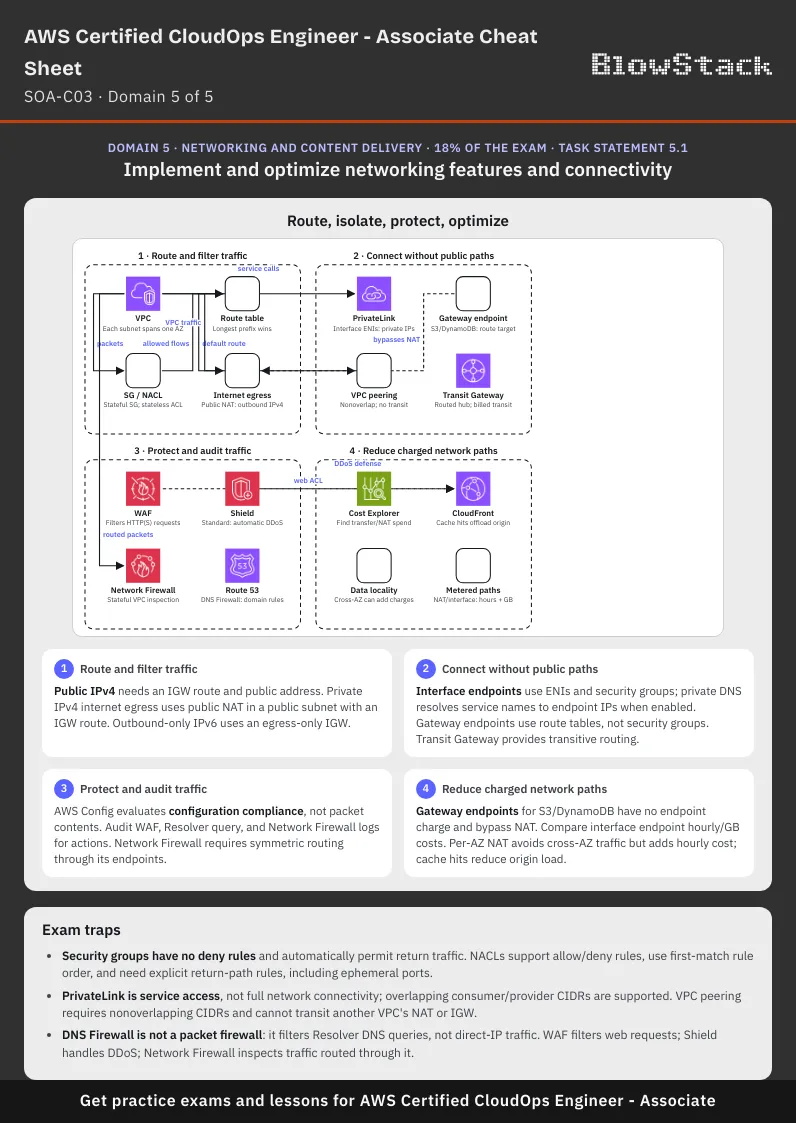
- Domain 5Networking and Content DeliveryView PDFDownload
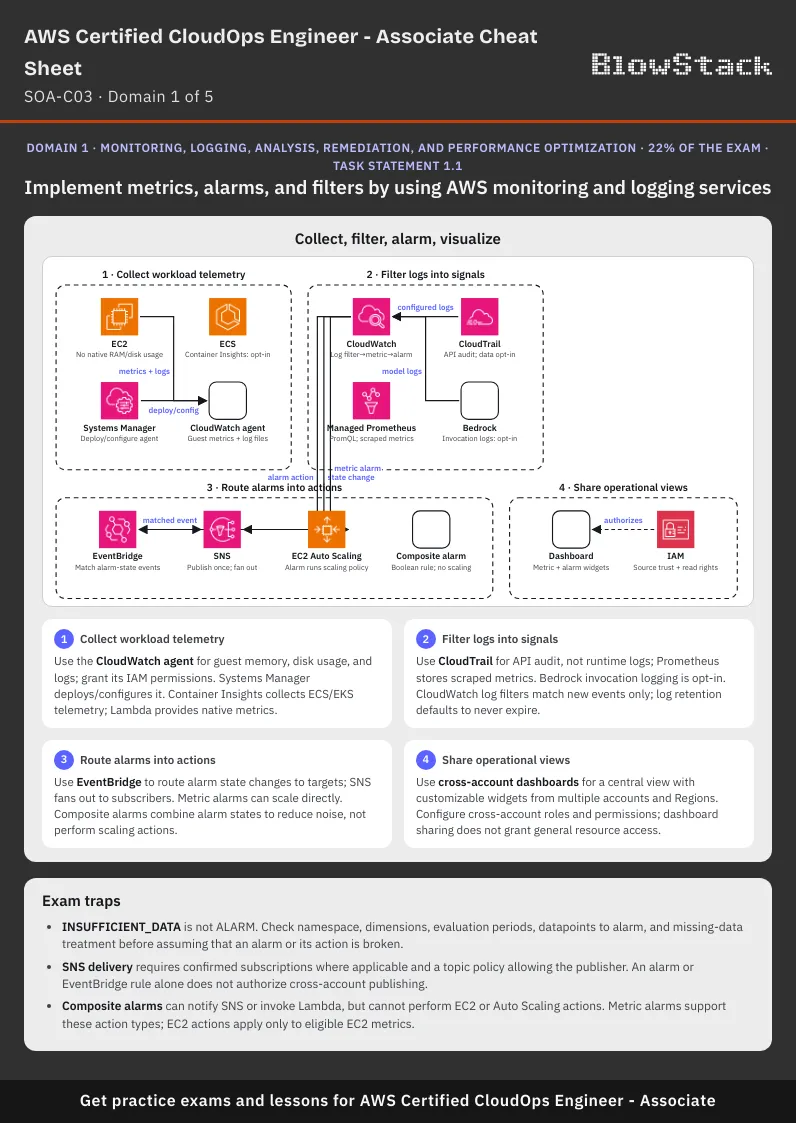
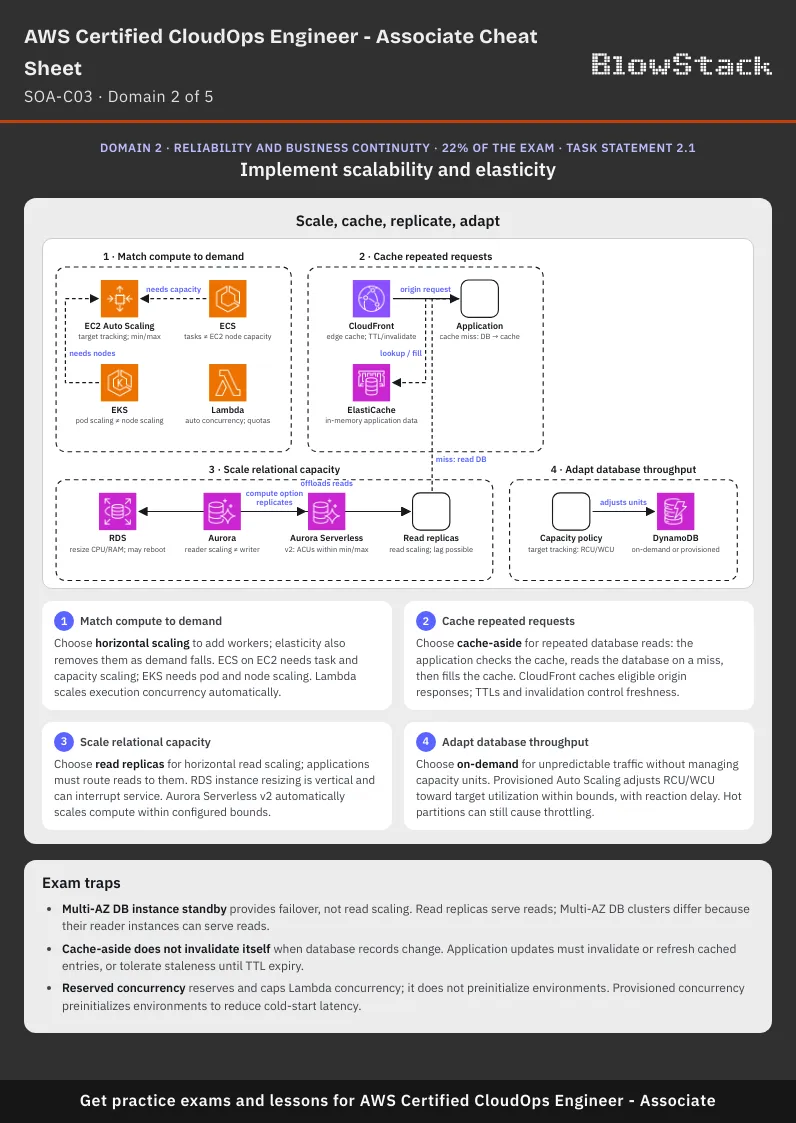
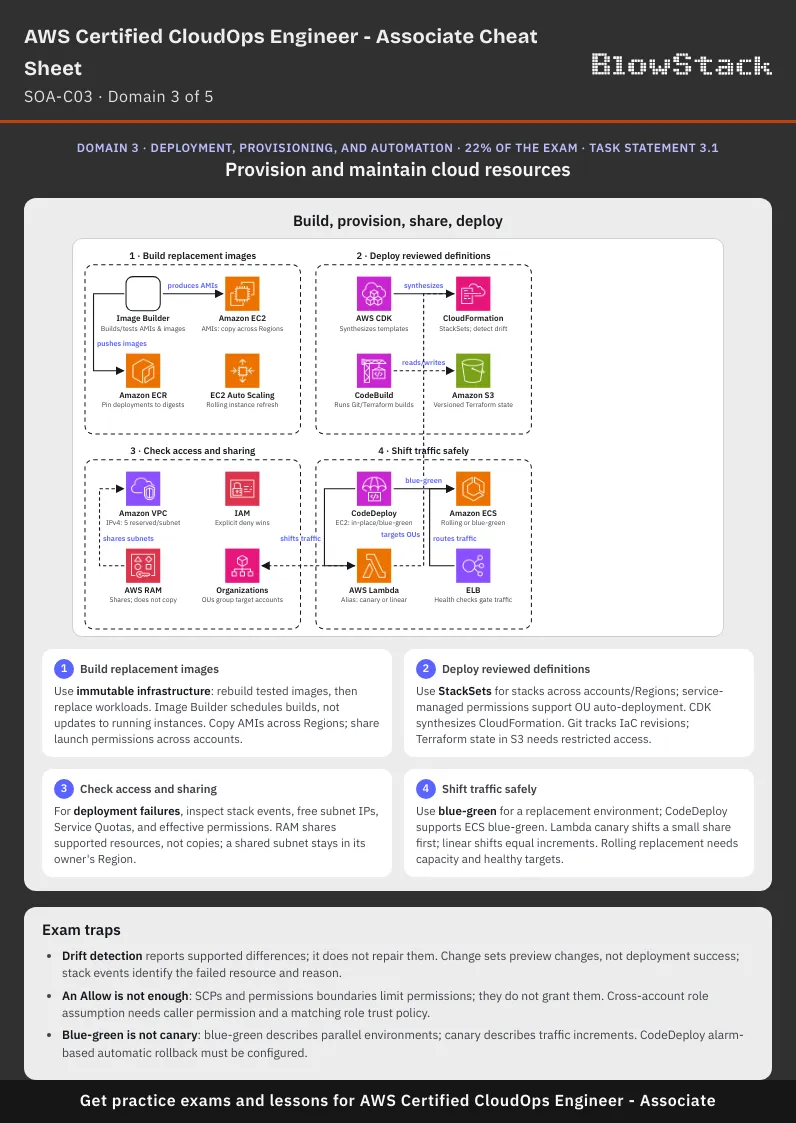
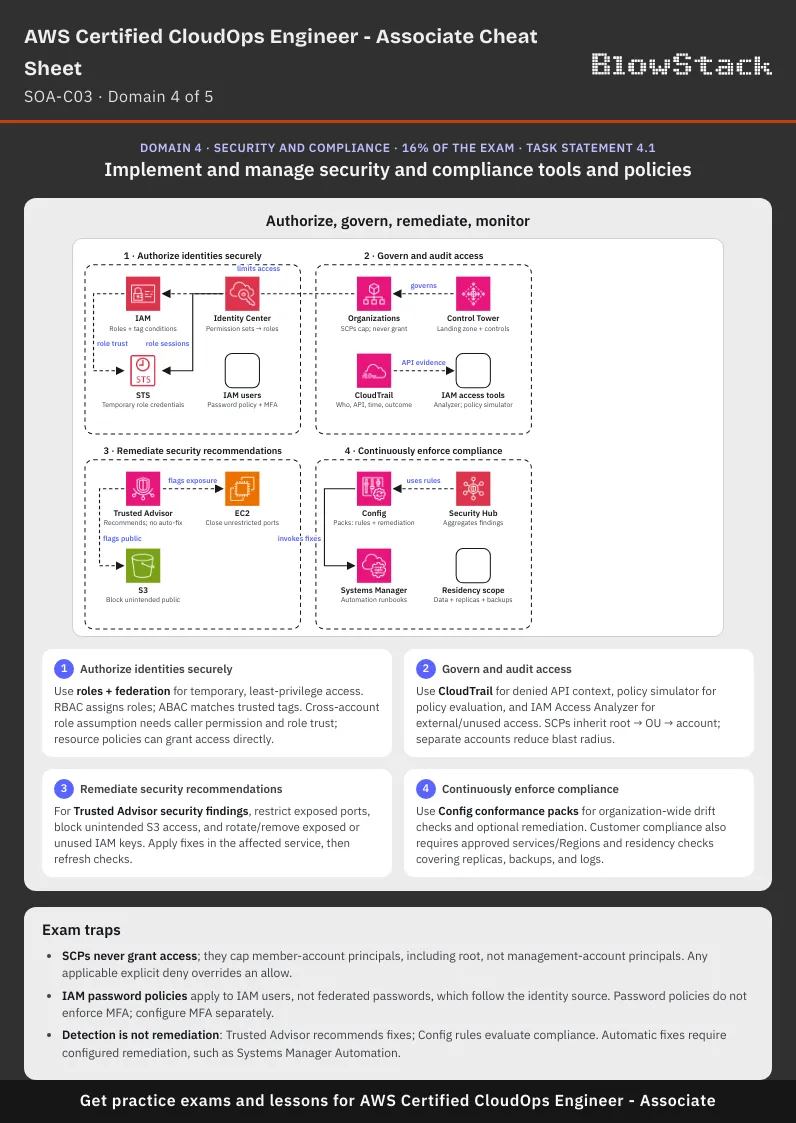
Exam domains
The SOA-C03 questions are grouped into 5 domains divided into 13 tasks.
- Implement metrics, alarms, and filters by using AWS monitoring and logging services
- Identify and remediate issues by using monitoring and availability metrics
- Implement performance optimization strategies for compute, storage, and database resources
- Implement scalability and elasticity
- Implement highly available and resilient environments
- Implement backup and restore strategies
- Provision and maintain cloud resources
- Automate the management of existing resources
- Implement and manage security and compliance tools and policies
- Implement strategies to protect data and infrastructure
- Implement and optimize networking features and connectivity
- Configure domains, DNS services, and content delivery
- Troubleshoot network connectivity issues
Exam mode and practice mode
| Exam mode | Practice mode | |
|---|---|---|
| Questions count | 65 | 1 - 75 |
| Time limit | 130 minutes | Optional, 10 - 200 minutes |
| Exam scope | 5 domains with the official questions ratio | Selected domains with the official questions ratio |
| Correct answers | After exam submission | After exam submission or after each answer |
| Question types | Single answer and multiple answer | Single answer, multiple answer or all types |
| Question hints | Never | Optional |
| Question domain | Revealed after exam submission | Revealed after submission or during the exam |
| Scoring | 15 of 65 questions do not count towards the result | Official AWS method or mathematical mean |
See all simulator features on the AWS Exam Simulator page.
Technologies and concepts
Active-Active Architecture
Active-active architecture combines availability and scalability by keeping two or more environments actively serving production requests rather than reserving one solely for recovery. Across cloud Regions, it can reduce user latency and support regional disaster recovery, but it requires deliberate traffic management, data consistency, and capacity planning.
Anomaly Detection
Anomaly detection compares observed activity with an established baseline, statistical model, or expected pattern to identify unusual behavior. In cloud security, it helps engineers detect potentially compromised identities, unexpected network activity, and abnormal resource usage that fixed rules alone might miss. An anomaly is evidence for investigation, not proof of an attack.
Asymmetric Routing
Routing decisions are made independently in each direction, so a connection does not necessarily return through the devices that handled its outbound packets. This can be harmless in ordinary IP forwarding but can disrupt stateful firewalls, network address translation, and security inspection that depend on seeing both directions of a flow.
Attribute-Based Access Control
ABAC expresses access rules using attributes such as project, department, environment, or data classification instead of maintaining separate permissions for every identity and resource. In cloud environments, trusted identity attributes and resource tags can make permissions scale with changing teams and infrastructure, provided attribute assignment and modification are tightly controlled.
Audit Logging
Audit logging creates an evidence trail showing who or what performed an action, when it occurred, which resource was affected, and what the outcome was. In cloud environments, effective auditing requires selecting complementary log sources and protecting their delivery, retention, and accessibility across accounts, Regions, and workloads.
AWS Compliance
Compliance in AWS combines AWS-provided infrastructure assurances with customer responsibilities for data, applications, configurations, and operating procedures. Engineers must identify applicable requirements, verify service and geographic scope, implement controls, and retain evidence rather than assume that using AWS makes a workload compliant.
Backup and Restore
Backups preserve earlier states of data so engineers can recover from accidental deletion, application errors, ransomware, or infrastructure failures. Effective protection requires more than creating copies: it also requires suitable retention, protected access, and tested restoration procedures that meet business recovery objectives.
Blast Radius
Blast radius describes both the potential reach of an incident and the impact actually observed during investigation. Cloud architectures reduce it through isolation, restricted permissions, and controlled dependencies, while incident responders use evidence to determine which boundaries an event has crossed.
Blue-Green Deployment
Two independently deployable environments allow engineers to validate a replacement release while the existing release continues serving users. Switching traffic rather than modifying the live environment reduces deployment disruption and can enable fast rollback, provided data and dependencies remain compatible.
Border Gateway Protocol
Border Gateway Protocol (BGP) lets networks advertise IP prefixes, select paths, and withdraw routes when connectivity changes. In cloud environments, it supports dynamic routing across private circuits, VPNs, and routing appliances, making it central to troubleshooting hybrid connectivity and failover.
Cache Invalidation
Caches reduce latency, backend load, and cost, but cached copies can become outdated when source data, application logic, or access permissions change. Invalidation defines when those copies must expire, be removed, or be replaced so that performance improvements do not violate freshness, correctness, or security requirements.
Cache-Aside
Also called lazy loading, cache-aside stores data in the cache only when an application requests it. It can reduce read latency and database load, but the application must manage cache population, expiration, invalidation, and failure handling.
Caching
A cache serves repeated requests without always accessing the original data source or recomputing a result. In cloud architectures, caching can reduce latency, origin load, and data transfer, but it requires deliberate decisions about freshness, capacity, security, and failure behavior.
Canary Deployment
A canary deployment runs the current and candidate versions concurrently, exposing only a limited share of real requests or users to the candidate. Engineers use production metrics and explicit acceptance criteria to decide whether to promote the candidate or redirect traffic to the stable version, reducing the impact of faulty releases.
Configuration Drift
Configuration drift occurs when running infrastructure, operating systems, or applications no longer match their intended configuration, often because of manual changes, competing automation, or incomplete deployments. Detecting and managing drift helps engineers preserve security controls, reproduce environments, and investigate unexpected changes before they cause incidents.
Connection Pooling
Establishing connections consumes time and resources through network handshakes, authentication, and server-side session creation. A connection pool amortizes those costs across requests and can limit concurrent access to a backend, improving efficiency when its capacity and timeout settings match the workload.
Cost management
In the cloud, cost management connects resource consumption and pricing choices to business outcomes. It helps engineers compare deployment options, eliminate waste, and balance spending against performance, availability, security, and operational effort.
Credential Rotation
Passwords, access keys, tokens, and application secrets can be exposed through compromised systems, accidental disclosure, or excessive distribution. Rotation limits how long a persistent credential remains usable, but it must coordinate changes across the identity system, secret storage, and consuming applications to avoid outages.
Cross-Account Access
Cloud accounts create administrative and security boundaries, but shared services, deployment pipelines, and operational teams often need controlled access across them. Cross-account access establishes that authorization without requiring shared credentials or moving resources into the same account.
Data Classification
Classification connects the value and risk of information to decisions about access, storage, monitoring, retention, and disposal. In cloud workloads, it helps engineers determine which activities require audit records, which changes should trigger alerts, and how quickly security teams must respond.
Data Egress
Data egress describes outgoing traffic relative to a specified source; the same transfer is ingress at its destination. Cloud providers often charge for outgoing transfers based on volume, destination, and network path, making data movement an important part of architecture and cost planning.
Data Locality
In cloud architectures, locality can mean using the same Region, Availability Zone, or processing environment, depending on the workload. It matters because network boundaries affect performance and billing, while replication and geographic distribution introduce trade-offs involving resilience, consistency, and data residency.
Data Residency
Data residency connects the physical location of data to legal, contractual, and organizational requirements. Cloud architectures must account for primary databases, replicas, backups, logs, and downstream systems because choosing a deployment Region alone does not establish compliance.
Database Replication
Database replication maintains additional copies of database data by transferring an initial dataset and subsequent changes. In cloud migrations, it lets the source database continue serving applications while a target catches up, reducing the downtime needed to switch environments. Replication also supports resilience and distributed reads, but its consistency, recovery, and cost characteristics depend on the implementation.
Disaster recovery
Disaster recovery combines recoverable data, replacement infrastructure, documented procedures, and testing to restore technology services after failures, attacks, or operational mistakes. In the cloud, it uses capabilities such as backups, replication, automated provisioning, and geographically separate deployments to balance recovery requirements against cost and complexity.
DNS
DNS lets applications and users find resources through stable names instead of hard-coded network addresses. In the cloud, it supports public websites, private service discovery, and endpoint selection while allowing the underlying infrastructure to change.
Effective Permissions
Assigned permissions do not necessarily equal usable access: authorization combines grants with organizational controls, resource policies, session restrictions, and request context. Understanding the resulting permissions helps engineers design least-privilege access and diagnose why an apparently allowed operation fails.
Elasticity
Elasticity aligns available capacity with actual demand, adding resources during busy periods and releasing them when demand falls. In the cloud, automated provisioning and usage-based pricing can reduce idle capacity and avoid purchasing infrastructure for occasional peaks, while helping applications maintain performance.
Encryption at Rest
Encryption at rest protects data stored in objects, disks, databases, snapshots, and backups from disclosure when the underlying storage is accessed without the required keys. In cloud environments, it combines storage encryption with key management and access controls, but it does not replace authorization, backups, or encryption in transit.
Encryption in Transit
Encryption in transit prevents observers on a network path from reading protected data and, with correctly configured secure protocols, helps detect tampering and authenticate communicating endpoints. In cloud architectures, it applies to internet traffic, internal service communication, and hybrid or multi-cloud connections, independently of encryption at rest.
Envelope Encryption
Envelope encryption separates bulk data encryption from the protection and management of encryption keys. It combines efficient local encryption with centralized key controls, allowing cloud systems to protect large datasets without sending every byte through a key management service.
Event-Driven Architecture
An event records something that has happened, such as an order being placed, a file being uploaded, or a monitoring threshold being crossed. By separating event producers from consumers, this architecture lets cloud applications process work independently, absorb traffic spikes, and deliver notifications without requiring every component to respond at the same time.
Explicit Deny Precedence
In a deny-overrides authorization model, a request fails whenever an applicable policy explicitly denies it, even if another policy allows it. This enables enforceable security guardrails, but troubleshooting requires identifying the denying statement and its evaluation context rather than simply adding permissions.
Failover
Failover uses redundant resources, health detection, and a mechanism for transferring work to reduce interruptions when components fail. In cloud architectures, distributing those resources across multiple Availability Zones helps maintain availability when an instance or an entire zone becomes unavailable.
Fault Isolation
Cloud systems use fault isolation to limit the scope of infrastructure failures, software defects, and resource exhaustion. Separating components into independent failure domains reduces correlated outages, but applications also need healthy alternatives and recovery mechanisms to remain available.
Fault Tolerance
Fault-tolerant systems use redundancy, failure isolation, and automated handling of faults to keep component failures from becoming service failures. In the cloud, this capability also determines which workloads can safely use interruptible compute capacity and which need a more predictable capacity strategy.
Horizontal Scaling
Instead of making one machine larger, horizontal scaling distributes work across multiple resources. It helps applications handle changing demand and can improve resilience, while requiring suitable workload distribution and state management. When automated to match demand, it provides elasticity.
Idempotency
Idempotency makes retries safe when requests time out, events arrive more than once, or automation restarts after a failure. In incident response, it prevents repeated remediation attempts from creating duplicate resources, reversing containment, or causing additional disruption.
Identity Federation
Federation separates where an identity is authenticated from where that identity accesses resources, using established trust and verifiable identity assertions or tokens. It enables centralized sign-in for employees, customers, and workloads while letting each application or cloud account retain control over authorization.
Immutable Infrastructure
Changes to operating systems, application dependencies, and security configuration are built into tested machine or container images and deployed as replacements. This reduces configuration drift and makes recovery more repeatable, provided that persistent data, secrets, and incident evidence are managed separately.
Infrastructure as code (IaC)
IaC turns infrastructure definitions into repeatable deployment processes that can be reviewed, tested, and automated. It helps engineers create consistent environments, reduce manual errors, and apply security standards across accounts while maintaining a traceable history of changes.
IP Addressing
IP addresses identify network interfaces, while address ranges define how networks are divided and connected. In cloud environments, an addressing plan determines subnet capacity, private and internet connectivity, and whether networks can communicate without overlapping address ranges.
IP Routing
IP routing determines how traffic moves between subnets, private networks, and the internet. In cloud environments, understanding routes, subnet associations, and gateways is essential for designing connectivity and diagnosing why a workload can or cannot reach a destination.
Key Rotation
Key rotation limits how long a cryptographic key is used to protect new data and supports security policies, compliance requirements, and incident response. A safe rotation process directs new operations to fresh key material, retains older material when necessary for decryption or verification, and retires it only after its dependencies are resolved.
Least privilege
Least privilege reduces the damage that compromised credentials, software defects, and operational mistakes can cause. In cloud environments, it applies to identity permissions, workload roles, administrative access, network connectivity, and organizational guardrails, and requires ongoing review as requirements change.
Log Retention
Log retention determines how long operational, security, and audit records remain available for monitoring, investigation, and compliance. An effective policy balances required history and retrieval speed against storage cost, privacy obligations, and protection from unauthorized alteration or deletion.
Multi-Factor Authentication
Multi-factor authentication (MFA) combines factors such as something a person knows, possesses, or is, reducing the risk that a stolen password alone will allow unauthorized access. In cloud environments, it is especially important for privileged human access, root accounts, and sensitive operations, but it must be paired with appropriate authorization, session controls, and recovery procedures.
Mutual TLS
Ordinary HTTPS typically authenticates only the server, whereas mutual TLS also requires the client to prove its identity using a certificate and its corresponding private key. This helps cloud workloads reject untrusted peers, but it requires certificate lifecycle management and separate authorization policies.
Network Address Translation
Network Address Translation allows workloads to communicate using addresses different from those assigned to their network interfaces. Cloud architectures commonly use it to give private workloads outbound IPv4 connectivity, conserve public addresses, or connect networks that require address remapping.
Network Isolation
Network isolation creates controlled communication boundaries between workloads, environments, and external networks. During incident response, it helps contain compromised resources, interrupt attacker communications, and protect unaffected systems while engineers investigate, eradicate threats, and restore trusted workloads.
Network Segmentation
Network segmentation separates workloads by trust level, function, environment, or data sensitivity, then permits only the traffic required between them. It reduces exposure and limits lateral movement after a compromise, but effective segmentation requires enforced traffic controls rather than merely separate address ranges.
Password Policies
Password policies establish requirements such as minimum length, prohibited passwords, reuse restrictions, and reset procedures to reduce unauthorized access. In cloud environments, their effectiveness depends on applying them to the correct identity source and combining them with multifactor authentication, secure credential storage, and appropriate access permissions.
Pilot Light
A pilot light environment maintains the minimum foundation required to rebuild a production workload after a disaster, typically including continuously replicated data and predefined infrastructure. It balances ongoing cost against recovery speed, usually recovering faster than backup and restore but requiring more activation work than warm standby.
Point-in-Time Recovery
Point-in-Time Recovery (PITR) uses retained backups and change history to recover data to a chosen moment, rather than only to the time of a scheduled backup. It helps engineers recover from accidental changes or corruption while balancing acceptable data loss, restoration time, and protection costs.
Policy Inheritance
Cloud platforms use policy inheritance to apply common governance requirements across organizational hierarchies without configuring every account, project, or resource separately. The effective result depends on the policy type: some policies impose permission ceilings, while others merge configuration settings or allow controlled overrides.
Publish-Subscribe Messaging
Publishers do not need to know which applications or people receive their messages, allowing producers and consumers to evolve independently. This pattern supports event distribution, application integration, and operational alerts, especially when one event must reach multiple independent recipients.
Recovery Time Objective
RTO expresses how long a business can tolerate a workload being unavailable before the impact becomes unacceptable. Engineers use it to select recovery architectures, automate recovery procedures, and verify that applications and their dependencies can resume service within the required time.
Resource Tagging
Tags describe business and operational attributes such as ownership, department, cost center, application, and environment without changing a resource’s function. A consistent tagging strategy supports cost allocation and resource management, while policy controls help prevent missing, misleading, or unauthorized tags.
Resource Utilization
Resource utilization shows how workloads consume CPU, memory, storage, network bandwidth, and other capacity. It informs rightsizing: selecting resource types, sizes, and quantities that meet performance and availability requirements without paying for unnecessary capacity.
Right-Sizing
Right-sizing uses observed demand and application requirements to choose appropriate compute, memory, storage, and throughput capacity. It reduces waste while preserving performance and reliability, and it requires regular review as workloads change.
Role-Based Access Control
Role-Based Access Control (RBAC) separates permission definitions from individual users or workloads, making access easier to administer and review. In cloud environments, it supports consistent authorization across teams and accounts, but requires carefully scoped roles and controlled assignments to prevent excessive privileges.
Rolling Deployment
A rolling deployment gradually updates or replaces running instances, tasks, or pods instead of changing the entire fleet at once. It limits simultaneous disruption and can avoid maintaining a complete second environment, but requires sufficient capacity, reliable health checks, and compatibility between application versions.
Shared File Systems
A shared file system lets applications on different servers work with the same files through familiar file operations rather than copying data between machines. In the cloud, managed file services support shared application content, user directories, and processing workloads while reducing the work of operating storage servers.
Split-Horizon DNS
Split-horizon DNS maintains separate views of a shared namespace, commonly returning private addresses to internal clients and public endpoints to internet clients. It lets applications use consistent names across environments while controlling which endpoints each audience discovers, but requires careful resolver configuration and coordination between DNS views.
Stateful and Stateless Filtering
Stateful filters remember permitted traffic flows and use that context to recognize return traffic, while stateless filters evaluate each packet without remembering earlier exchanges. This distinction determines how engineers configure bidirectional access, troubleshoot blocked responses, and combine workload-level controls with subnet boundaries and inspection firewalls.
Storage Tiering
Storage tiering balances storage cost against access latency, retrieval charges, and retention requirements. Cloud platforms implement it through explicit storage-class selection, lifecycle policies, or automatic movement based on access patterns, helping engineers avoid paying premium storage rates for rarely used data.
Temporal Correlation
Temporal correlation helps engineers reconstruct activity across application, identity, network, and cloud-service logs. During incident response, it reveals event sequences that isolated records cannot show, while requiring careful handling of clock differences, delivery delays, and incomplete evidence.
Time to Live
Time to Live (TTL) controls the lifetime of cached responses, DNS records, and other temporary data. Engineers use it to balance freshness, latency, backend load, and storage consumption, but expiration behavior depends on the system implementing it.
Transport Layer Security
TLS protects data while it moves between clients, load balancers, applications, and other resources. Effective protection requires more than enabling an encrypted listener: engineers must enforce acceptable protocol versions, validate identities, and protect every required network hop.
Version Control
Version control creates a traceable history for artifacts such as source code, infrastructure definitions, configuration, and AI prompts. It helps engineers collaborate safely, connect deployed behavior to specific revisions, and recover from changes that introduce errors or regressions.
Vertical Scaling
Vertical scaling adjusts resources such as CPU and memory to match a workload's requirements while preserving its single-instance execution model. It can improve performance without application redesign, but engineers must account for resizing interruptions, capacity limits, cost, and the fact that a larger instance does not provide redundancy.
Warm Standby
The recovery environment maintains current application components and replicated data, but normally has less capacity than the primary environment. During a disaster, engineers promote data stores where necessary, increase capacity, and redirect traffic, balancing recovery speed against the cost of keeping duplicate infrastructure running.
Services on the exam
The 68 AWS services the SOA-C03 exam covers.
Concepts on the exam
The 72 cloud concepts the SOA-C03 exam covers, each explained with the AWS services that implement it, in the Cloud Concepts Hub .