
AWS Certified Advanced Networking - Specialty (ANS-C01) Free Practice Exam and Practice Test
681 ANS-C01 practice questions, updated , in an exam simulator that mirrors the real exam: its domains, its question types and its timing, with an explanation for every answer.
ANS-C01 example questions
One example question per domain from the ANS-C01 question bank, with the correct answer and its explanation. Sign in to the simulator to answer them with all answer options.
A company runs an HTTPS application behind internet-facing Application Load Balancers (ALBs) in two AWS Regions. Route 53 latency alias records point to the ALBs, with Evaluate Target Health enabled. Each ALB has multiple listener rules that forward requests to separate production target groups. The company requires Route 53 to exclude a Region from new DNS responses if any production target group in that Region has no healthy targets, provided the other Region remains healthy.
After a deployment, Route 53 stops returning one Region's ALB even though every production target group in that Region has healthy targets. Engineers discover that an obsolete preview listener rule on that ALB still references a target group with no registered targets. The preview service is permanently retired.
Which change will restore latency-based routing to both Regions while preserving the required health-based exclusion behavior?
Show answer
CORRECT ANSWERRemove the obsolete preview listener rule and delete its unused target group. Keep Evaluate Target Health enabled on both latency alias records.
With Evaluate Target Health enabled, Route 53 considers an ALB healthy only when every associated target group has at least one healthy target. An associated target group with no registered targets is unhealthy. Removing the retired service's association eliminates the false regional failure while preserving health evaluation for every production target group.
A company connects its data center to an AWS Transit Gateway through AWS Site-to-Site VPN. A transit gateway VPC attachment provides access to an application on an EC2 instance. After a network change, an on-premises client cannot establish TCP connections to the instance on port 443. Transit Gateway Network Manager Route Analyzer reports that the VPN attachment can reach the VPC attachment in both directions.
Before authorizing live test traffic, a network engineer must check whether the VPC configuration permits the client's inbound connection and identify any blocking configuration. Which approach best meets these requirements?
Show answer
CORRECT ANSWERUse VPC Reachability Analyzer to model the inbound path from the VPC's transit gateway attachment to the instance's network interface. Specify TCP destination port 443 and the on-premises client's source IP address, and inspect the analysis for blocking VPC components.
Reachability Analyzer performs configuration-based analysis without sending packets. Modeling the inbound AWS-side path with the client's source address and destination port can identify blocking security groups, network ACLs, and route configuration. This complements Route Analyzer's attachment-level results; it does not independently validate the on-premises network or live VPN data plane.
A financial analytics application transfers data between two Amazon EC2 instances in the same Availability Zone by using a single long-lived TCP connection. Each instance supports 100 Gbps networking and ENA Express, but the connection currently achieves approximately 5 Gbps. Testing confirms that CPU, memory, storage, and TCP window sizes are not bottlenecks. The company needs at least 15 Gbps for this single connection and lower tail latency during network congestion. The application cannot be modified to use a different networking library or multiple connections. Which change best meets these requirements without increasing the instance sizes?
Show answer
CORRECT ANSWEREnable ENA Express on the network interfaces used by both instances for the connection.
ENA Express uses AWS Scalable Reliable Datagram (SRD) transparently for supported TCP and UDP traffic between eligible instances in the same Availability Zone. It supports single-flow bandwidth of up to 25 Gbps and reduces tail latency under congestion without requiring application changes. Both communicating interfaces must have ENA Express enabled.
A company connects workload VPCs in multiple AWS accounts through a centrally managed AWS Transit Gateway. Compliance requires all inter-VPC traffic to pass through stateful firewall appliances in an inspection VPC. The inspection VPC has a transit gateway attachment subnet and a firewall appliance in each of two Availability Zones. VPC routing directs traffic from each attachment subnet through the firewall in that Availability Zone.
The transit gateway route tables send traffic from workload attachments to the inspection attachment and send inspected traffic to the destination workload attachment. No direct workload-to-workload routes bypass inspection. During testing, some connections between workloads in different Availability Zones fail. Packet captures show that the forward and return packets traverse different firewall appliances, which drop packets because connection state is not shared. Security groups and network ACLs permit the required traffic.
Which change will resolve the failures while retaining stateful inspection and the two-Availability-Zone architecture?
Show answer
CORRECT ANSWEREnable appliance mode on the inspection VPC's transit gateway attachment and retain the existing inspection routing.
Transit Gateway appliance mode maintains flow affinity to the same Availability Zone in the inspection VPC attachment for the lifetime of a flow, including return traffic. With the existing per-AZ routing through the firewalls, both directions traverse the same stateful appliance. Both Availability Zones can remain available for inspection.
Free ANS-C01 cheat sheets
One PDF per exam domain: the domain's task statements, each drawn with its services and exam traps, then the concepts and core services to remember.
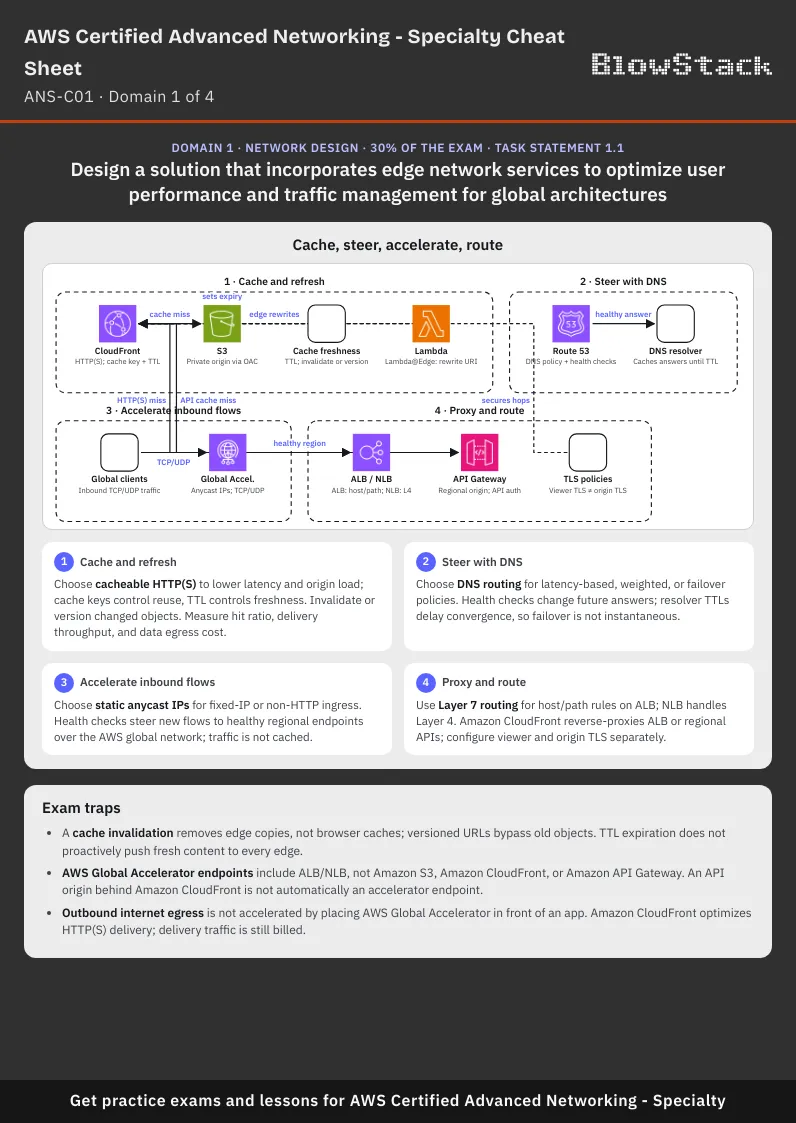
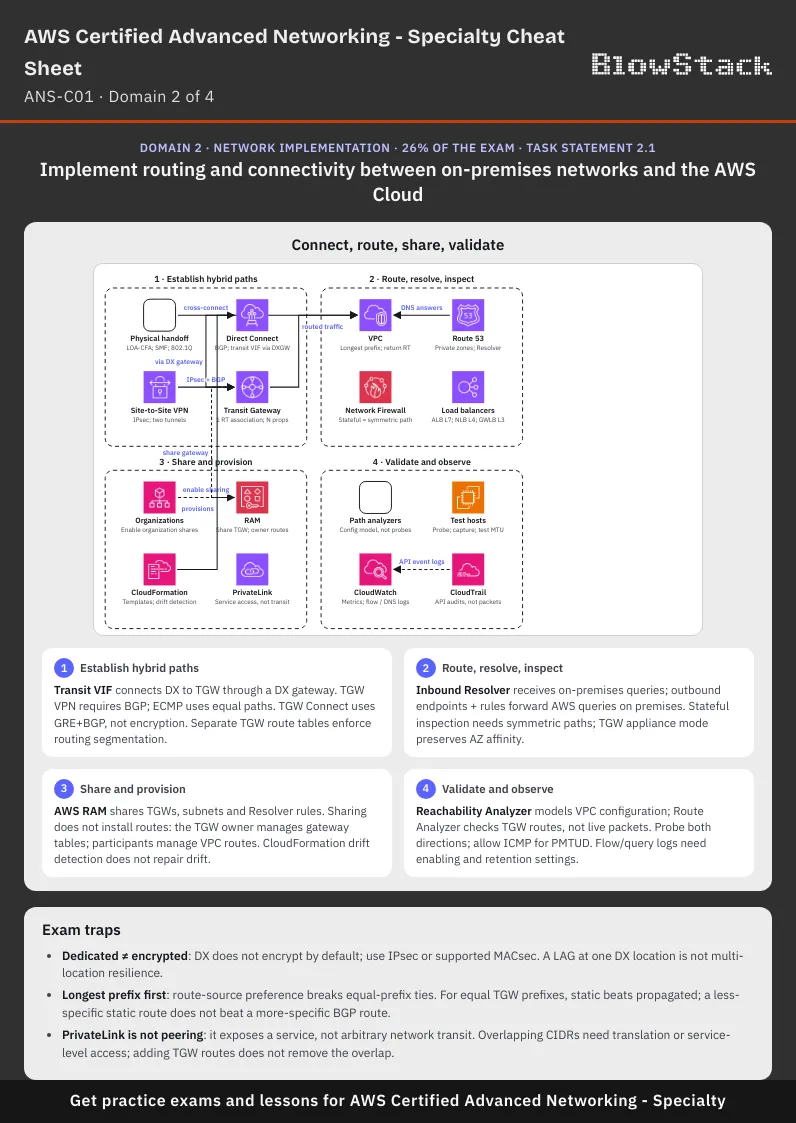
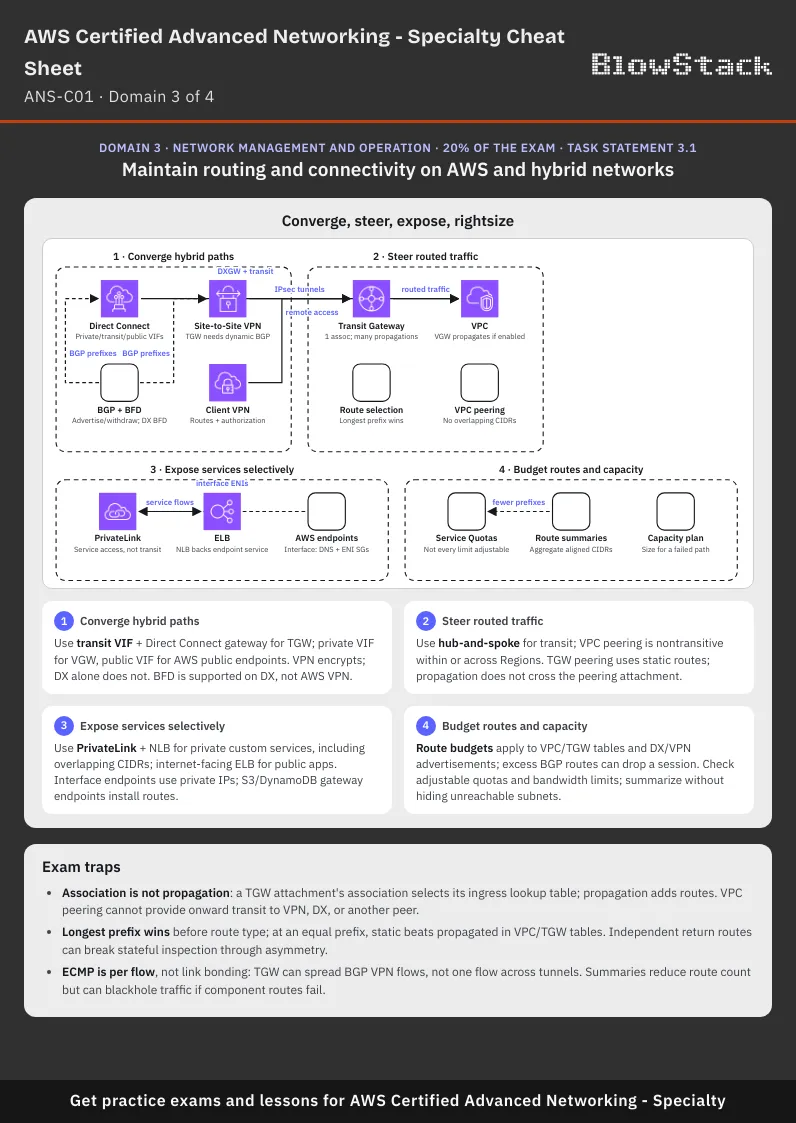
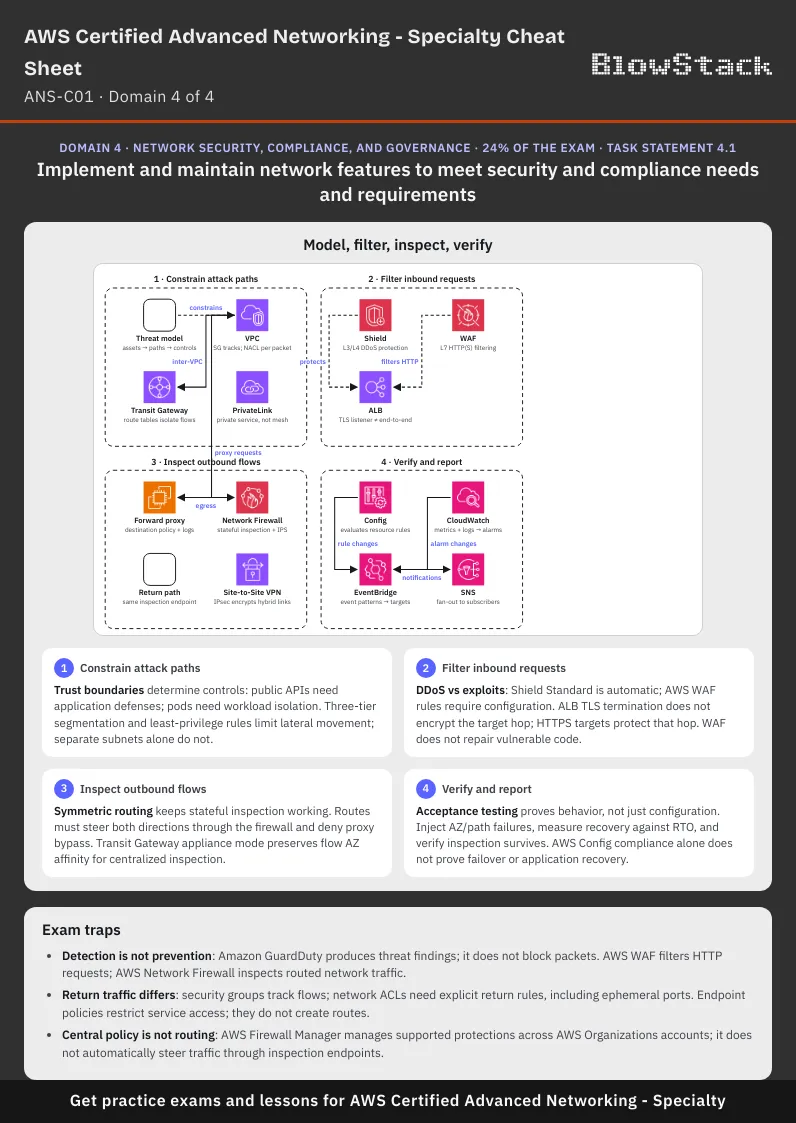
Exam domains
The ANS-C01 questions are grouped into 4 domains divided into 16 tasks.
- Design a solution that incorporates edge network services to optimize user performance and traffic management for global architectures
- Design DNS solutions that meet public, private, and hybrid requirements
- Design solutions that integrate load balancing to meet high availability, scalability, and security requirements
- Define logging and monitoring requirements across AWS and hybrid networks
- Design a routing strategy and connectivity architecture between on-premises networks and the AWS Cloud
- Design a routing strategy and connectivity architecture that include multiple AWS accounts, AWS Regions, and VPCs to support different connectivity patterns
- Implement routing and connectivity between on-premises networks and the AWS Cloud
- Implement routing and connectivity across multiple AWS accounts, Regions, and VPCs to support different connectivity patterns
- Implement complex hybrid and multi-account DNS architectures
- Automate and configure network infrastructure
- Maintain routing and connectivity on AWS and hybrid networks
- Monitor and analyze network traffic to troubleshoot and optimize connectivity patterns
- Optimize AWS networks for performance, reliability, and cost-effectiveness
- Implement and maintain network features to meet security and compliance needs and requirements
- Validate and audit security by using network monitoring and logging services
- Implement and maintain confidentiality of data and communications of the network
Exam mode and practice mode
| Exam mode | Practice mode | |
|---|---|---|
| Questions count | 65 | 1 - 75 |
| Time limit | 170 minutes | Optional, 1 - 200 minutes |
| Exam scope | 4 domains with the official questions ratio | Selected domains with the official questions ratio |
| Correct answers | After exam submission | After exam submission or after each answer |
| Question types | Single answer, multiple answer, and matching | Single answer, multiple answer or all types |
| Question hints | Never | Optional |
| Question domain | Revealed after exam submission | Revealed after submission or during the exam |
| Scoring | 15 of 65 questions do not count towards the result | Official AWS method or mathematical mean |
See all simulator features on the AWS Exam Simulator page.
About the ANS-C01 exam
The AWS Certified Advanced Networking - Specialty (ANS-C01) certification is a highly specialized credential aimed at professionals with advanced networking skills and extensive experience in designing and implementing AWS and hybrid IT network architectures at scale. The exam tests a deep understanding of a broad range of AWS networking services and concepts, along with the ability to design, develop, and deploy complex cloud-based solutions using the Amazon Web Services platform.
A significant portion of the exam focuses on networking fundamentals and concepts, requiring candidates to have a strong grasp of the OSI model and how various networking protocols map to it. Understanding IP addressing, particularly in IPv4 and IPv6, is crucial, including subnetting, CIDR (Classless Inter-Domain Routing), and the differences between these IP versions. Additionally, knowledge of routing and switching is vital, with an emphasis on static and dynamic routing protocols such as RIP, OSPF, and BGP, as well as concepts like route tables, network address translation (NAT), and switching mechanisms.
The exam extensively covers AWS networking services, beginning with Amazon VPC (Virtual Private Cloud), a core service that allows the creation of isolated networks within AWS. Candidates are expected to understand VPC components, including subnets, route tables, security groups, and Network ACLs (NACLs). Additionally, the exam delves into more advanced VPC features like VPC Peering, Transit Gateway, and VPC endpoints. AWS Direct Connect is another critical service, providing a dedicated network connection from an on-premises environment to AWS, and the exam assesses knowledge of its setup, configuration, and use cases.
AWS VPN is also a key service, with the exam focusing on both Site-to-Site VPN and Client VPN, including setup, encryption standards, and integration with VPCs and on-premises networks. Elastic Load Balancing (ELB) is another important topic, where candidates must have detailed knowledge of application, network, and gateway load balancers, including their use cases and configuration. The exam also evaluates understanding of AWS Global Accelerator, which is used to improve global application performance by leveraging AWS’s global network infrastructure.
Amazon Route 53, AWS’s DNS service, plays a significant role in the exam, with candidates needing to demonstrate knowledge of routing policies such as latency-based, geolocation, and failover, as well as domain registration and health checks. AWS Transit Gateway, which allows the interconnection of VPCs and on-premises networks via a central hub, is another critical topic, including concepts like route propagation, attachments, and segmentation. Amazon CloudFront, a content delivery network (CDN) service, is also covered, with a focus on edge locations, distribution types, and caching strategies.
Security is a major theme in the exam, with an emphasis on securing AWS networking components using security groups, NACLs, AWS Web Application Firewall (WAF), and Shield (DDoS protection). Candidates must also understand encryption, both in-transit and at-rest, as well as AWS compliance frameworks like PCI DSS, HIPAA, and GDPR, and how they impact network design. Disaster recovery and high availability strategies are also tested, including Multi-AZ and Multi-Region architectures, failover mechanisms, and data replication to ensure network resilience and data redundancy.
The exam also tests knowledge of network automation and monitoring. Candidates need to be proficient in using AWS CloudFormation, AWS CLI, and SDKs for automating network deployments, as well as third-party automation tools like Terraform. Monitoring and troubleshooting are equally important, with expertise in using Amazon CloudWatch, VPC Flow Logs, AWS Config, and AWS CloudTrail to monitor, troubleshoot, and audit network activity. The exam may present scenarios requiring the identification and resolution of network performance issues.
Hybrid networking and multi-account environments are also key areas of focus. Candidates must understand hybrid cloud architectures, including connecting on-premises networks with AWS using services like AWS Direct Connect and VPN. The exam also includes scenarios involving multiple AWS accounts, VPC peering, and shared services, and requires knowledge of AWS Organizations and best practices for managing networking across multiple AWS accounts, including the use of centralized logging and monitoring, shared VPCs, and resource access management.
The AWS Certified Advanced Networking - Specialty (ANS-C01) exam is known for its difficulty. It requires a deep understanding of AWS networking services and the ability to apply this knowledge to complex, real-world scenarios. The depth of knowledge required is significant, with the exam testing advanced networking concepts that go beyond basic AWS networking. The questions are often scenario-based, requiring candidates to design or troubleshoot a network architecture, which tests both knowledge and problem-solving skills. The breadth of services covered is also extensive, requiring candidates to understand how different AWS services integrate with each other, adding to the challenge. Additionally, the time pressure of the exam, with its detailed and time-consuming questions, makes effective time management crucial.
Overall, the AWS Certified Advanced Networking - Specialty (ANS-C01) certification is an excellent credential for professionals seeking to demonstrate their expertise in AWS networking. It validates a candidate’s ability to design, deploy, and maintain complex network architectures on AWS, making it a valuable certification for network engineers, architects, and systems administrators. However, due to its difficulty, it requires thorough preparation and substantial practical experience with AWS networking services.
Technologies and concepts
Acceptance Testing
Acceptance testing evaluates observable system behavior against requirements that stakeholders consider necessary for release or delivery. In CI/CD pipelines, automated acceptance tests provide a repeatable release gate, complementing lower-level technical tests and any required human acceptance decisions.
Access Control
Access control turns security requirements into enforceable permissions for people, applications, and cloud services. It limits unauthorized activity while preserving legitimate operations, including the ability to deliver logs, run health checks, and investigate incidents.
Active-Active Architecture
Active-active architecture combines availability and scalability by keeping two or more environments actively serving production requests rather than reserving one solely for recovery. Across cloud Regions, it can reduce user latency and support regional disaster recovery, but it requires deliberate traffic management, data consistency, and capacity planning.
Anomaly Detection
Anomaly detection compares observed activity with an established baseline, statistical model, or expected pattern to identify unusual behavior. In cloud security, it helps engineers detect potentially compromised identities, unexpected network activity, and abnormal resource usage that fixed rules alone might miss. An anomaly is evidence for investigation, not proof of an attack.
Anycast
Anycast gives a distributed service a shared network identity, allowing clients to reach an ingress location selected by network routing rather than by choosing a location-specific address. It supports global performance and resilience, but the selected location depends on routing policy and topology—not necessarily geographic distance or measured application latency.
APIs
An application programming interface defines available operations, accepted inputs, responses, and error behavior. In the cloud, APIs enable applications and automation tools to provision resources, configure services, and process data, making them the foundation of programmatic access.
Asymmetric Routing
Routing decisions are made independently in each direction, so a connection does not necessarily return through the devices that handled its outbound packets. This can be harmless in ordinary IP forwarding but can disrupt stateful firewalls, network address translation, and security inspection that depend on seeing both directions of a flow.
At-Least-Once Delivery
At-least-once delivery uses retries, acknowledgments, and durable buffering to favor delivery reliability over duplicate avoidance. It is common in real-time log ingestion, where consumers must tolerate repeated records without inflating metrics, duplicating alerts, or corrupting downstream state.
Attack Path Analysis
Individual vulnerabilities and alerts rarely explain an entire compromise; attack path analysis connects them into a sequence of access and actions. Engineers use it proactively to break exploitable routes and during incident response to reconstruct events, identify enabling conditions, and determine the scope of compromise.
Attack Surface Reduction
An attack surface includes exposed network services, application interfaces, identities, software components, and administrative access paths. Reducing it means retaining only the capabilities and connectivity required for legitimate operations, which limits opportunities for initial compromise and lateral movement.
Audit Logging
Audit logging creates an evidence trail showing who or what performed an action, when it occurred, which resource was affected, and what the outcome was. In cloud environments, effective auditing requires selecting complementary log sources and protecting their delivery, retention, and accessibility across accounts, Regions, and workloads.
Authentication
Cloud systems use authentication to establish which identity is making a request by validating credentials or other evidence. It is distinct from authorization, which determines what that identity may do, and is essential for protecting administrative access, application data, and service-to-service communication.
AWS shared responsibility model
AWS and its customers have distinct responsibilities for protecting systems, data, and operations, with the boundary changing according to the services used. Understanding that boundary helps engineers implement appropriate controls and collect the right evidence instead of assuming that AWS compliance certifications automatically make a workload compliant.
Bidirectional Forwarding Detection
Bidirectional Forwarding Detection (BFD) checks whether two peers can continue exchanging packets, independently of routing-protocol keepalive timers. In cloud and hybrid networks, it can help BGP react to failed paths sooner, reducing traffic loss when a usable alternative route exists.
Blast Radius
Blast radius describes both the potential reach of an incident and the impact actually observed during investigation. Cloud architectures reduce it through isolation, restricted permissions, and controlled dependencies, while incident responders use evidence to determine which boundaries an event has crossed.
Blue-Green Deployment
Two independently deployable environments allow engineers to validate a replacement release while the existing release continues serving users. Switching traffic rather than modifying the live environment reduces deployment disruption and can enable fast rollback, provided data and dependencies remain compatible.
Border Gateway Protocol
Border Gateway Protocol (BGP) lets networks advertise IP prefixes, select paths, and withdraw routes when connectivity changes. In cloud environments, it supports dynamic routing across private circuits, VPNs, and routing appliances, making it central to troubleshooting hybrid connectivity and failover.
Cache Invalidation
Caches reduce latency, backend load, and cost, but cached copies can become outdated when source data, application logic, or access permissions change. Invalidation defines when those copies must expire, be removed, or be replaced so that performance improvements do not violate freshness, correctness, or security requirements.
Caching
A cache serves repeated requests without always accessing the original data source or recomputing a result. In cloud architectures, caching can reduce latency, origin load, and data transfer, but it requires deliberate decisions about freshness, capacity, security, and failure behavior.
Canary Deployment
A canary deployment runs the current and candidate versions concurrently, exposing only a limited share of real requests or users to the candidate. Engineers use production metrics and explicit acceptance criteria to decide whether to promote the candidate or redirect traffic to the stable version, reducing the impact of faulty releases.
Capacity Planning
Capacity planning translates expected traffic, data growth, and processing requirements into measurable resource needs. In the cloud, it combines forecasting, benchmarking, scaling policies, service quota management, and failure testing because elastic infrastructure is neither unlimited nor instantaneous.
Certificate management
It covers certificate issuance, validation, deployment, renewal, revocation, and retirement, together with protection of the keys and trust chains that make certificates useful. In cloud environments, effective certificate management prevents outages from expired certificates and supports authenticated, encrypted communication across public endpoints, internal services, accounts, and Regions.
Chain of Trust
Trust is established by validating each link back to a trusted starting point rather than accepting an isolated signature or assertion. In DNSSEC, this connects signed DNS answers through parent-zone delegations to a resolver's trust anchor, helping detect forged or modified DNS responses.
Classless Inter-Domain Routing (CIDR)
CIDR defines how many leading bits identify an IP network and how many remain for addresses within that network. Engineers use it to size subnets, conserve address space, summarize routes, and prevent overlapping networks from disrupting cloud and hybrid connectivity.
Conditional DNS Forwarding
Conditional DNS forwarding connects separate DNS namespaces without copying their records into every environment. In hybrid and multicloud networks, it lets cloud workloads resolve corporate names and on-premises clients resolve private cloud names through explicitly configured DNS paths.
Conditional Forwarding
A DNS resolver matches a query name against configured domain suffixes and forwards matching queries to specified upstream servers. This allows cloud and on-premises environments to resolve each other’s private namespaces without publishing private records or copying entire DNS zones.
Configuration Drift
Configuration drift occurs when running infrastructure, operating systems, or applications no longer match their intended configuration, often because of manual changes, competing automation, or incomplete deployments. Detecting and managing drift helps engineers preserve security controls, reproduce environments, and investigate unexpected changes before they cause incidents.
Configuration Management
Configuration management makes infrastructure and application settings repeatable, auditable, and easier to recover when changes cause problems. In the cloud, it is a shared responsibility: the provider configures its underlying infrastructure, while customers manage the settings and software within their control.
Connection Draining
Connection draining separates stopping new work from terminating the resources handling existing work. It reduces interrupted requests during scale-in, deployments, and maintenance, provided the load balancer, application, and resource lifecycle use compatible shutdown behavior.
Content-Based Routing
Instead of distributing requests solely by availability or load, content-based routing selects a destination suited to each request’s characteristics. In generative AI applications, it can match tasks to specialized foundation models while balancing quality, latency, cost, and security constraints.
Cost management
In the cloud, cost management connects resource consumption and pricing choices to business outcomes. It helps engineers compare deployment options, eliminate waste, and balance spending against performance, availability, security, and operational effort.
Cross-Account Access
Cloud accounts create administrative and security boundaries, but shared services, deployment pipelines, and operational teams often need controlled access across them. Cross-account access establishes that authorization without requiring shared credentials or moving resources into the same account.
Cross-Connects
A cross-connect provides the local physical link used by many dedicated hybrid-cloud connections. Correct provisioning requires coordination of authorization documents, facility demarcation points, cabling, and compatible interfaces; routing configuration cannot compensate for an incorrect or incomplete physical connection.
Data Egress
Data egress describes outgoing traffic relative to a specified source; the same transfer is ingress at its destination. Cloud providers often charge for outgoing transfers based on volume, destination, and network path, making data movement an important part of architecture and cost planning.
DDoS Mitigation
Distributed denial-of-service attacks use many sources to exhaust network bandwidth, connection capacity, or application resources. Mitigation matches defenses to the threatened layer, rejects malicious traffic before it reaches constrained resources, and preserves access for legitimate users.
Declarative Programming
Instead of prescribing each operation in order, engineers define resources, relationships, constraints, or interface states that a tool interprets. This approach supports repeatable infrastructure provisioning, reusable application components, API contracts, and visual AI workflows, but still requires testing, security controls, and lifecycle management.
Defense in Depth
Defense in Depth combines preventive, detective, and response controls across network boundaries, identities, applications, hosts, and data. It reduces dependence on any single safeguard and limits the impact of successful attacks, configuration mistakes, and compromised credentials.
DHCP
DHCP reduces manual host configuration by distributing settings such as IP addresses, DNS servers, domain names, and lease durations. In cloud networks, engineers must distinguish configuration delivered to a guest operating system from provider-controlled resources that determine address ownership, routing, and security.
Digital Signatures
A digital signature allows a recipient to detect changes to signed data and verify that the signature was produced by the holder of a particular private key. In cloud environments, signatures help validate software releases, stored files, and audit records, provided that verifiers trust the signing key and enforce verification.
DNS
DNS lets applications and users find resources through stable names instead of hard-coded network addresses. In the cloud, it supports public websites, private service discovery, and endpoint selection while allowing the underlying infrastructure to change.
DNS over HTTPS
DoH uses HTTPS encryption and server authentication to reduce DNS eavesdropping and tampering on the client-to-resolver connection. It is useful across untrusted networks and cloud boundaries, but it does not replace DNSSEC, guarantee resolver privacy, or automatically encrypt every subsequent DNS lookup.
DNS over TLS
DNS over TLS protects DNS traffic from observation and modification between a client and its configured resolver. It helps secure cloud and hybrid DNS communications, but its protection applies only to the encrypted connection and does not replace DNSSEC, resolver access controls, or DNS filtering.
DNSSEC
DNSSEC lets validating resolvers verify that DNS answers originate from the authoritative zone and have not been altered, helping defend against forged responses and cache poisoning. It establishes trust through signed records and parent-to-child delegations, but it does not encrypt DNS queries or responses.
Domain Verification
Cloud services use domain verification to confirm that a requester can authorize activities such as issuing certificates, sending email, or associating a custom domain with an application. Verification commonly requires publishing a service-issued DNS value, making correct record selection, authoritative DNS placement, and public visibility essential.
Elasticity
Elasticity aligns available capacity with actual demand, adding resources during busy periods and releasing them when demand falls. In the cloud, automated provisioning and usage-based pricing can reduce idle capacity and avoid purchasing infrastructure for occasional peaks, while helping applications maintain performance.
Encryption in Transit
Encryption in transit prevents observers on a network path from reading protected data and, with correctly configured secure protocols, helps detect tampering and authenticate communicating endpoints. In cloud architectures, it applies to internet traffic, internal service communication, and hybrid or multi-cloud connections, independently of encryption at rest.
End-to-End Testing
End-to-end testing checks whether an application achieves the intended user outcome when its components work together under realistic conditions. For foundation model applications, it evaluates the combined behavior of prompts, retrieval, models, tools, safeguards, and workflows rather than relying on model benchmarks alone.
Ephemeral Ports
An operating system usually selects an ephemeral source port so that replies can reach the correct application socket. Understanding these ports is essential when configuring stateless network controls, troubleshooting blocked return traffic, and managing connection capacity.
Equal-Cost Multipath Routing
Equal-Cost Multipath Routing, commonly called ECMP, allows a router to use several equivalent next hops rather than selecting only one. It can improve aggregate bandwidth utilization and resilience, but it does not normally combine multiple links into a faster path for a single traffic flow.
Ethernet Switching
An Ethernet switch learns which MAC addresses are reachable through its ports and uses that information to deliver frames within a broadcast domain. Understanding where switching ends and IP routing begins is essential when connecting on-premises networks to cloud environments, especially when configuring VLANs, gateways, and dedicated connectivity.
Event Correlation
Individual logs and alerts often describe only fragments of an incident or operational failure. Event correlation combines those fragments into a contextual sequence, helping engineers detect suspicious behavior, investigate causes, and reduce duplicate or low-value alerts.
Event-Driven Architecture
An event records something that has happened, such as an order being placed, a file being uploaded, or a monitoring threshold being crossed. By separating event producers from consumers, this architecture lets cloud applications process work independently, absorb traffic spikes, and deliver notifications without requiring every component to respond at the same time.
Exponential Backoff
Exponential backoff gives an overloaded or temporarily unavailable dependency time to recover instead of receiving immediate repeated requests. In cloud systems, it is typically combined with randomized delays, retry limits, and safe request semantics to handle throttling and transient failures without amplifying an outage.
Failover
Failover uses redundant resources, health detection, and a mechanism for transferring work to reduce interruptions when components fail. In cloud architectures, distributing those resources across multiple Availability Zones helps maintain availability when an instance or an entire zone becomes unavailable.
Fault Isolation
Cloud systems use fault isolation to limit the scope of infrastructure failures, software defects, and resource exhaustion. Separating components into independent failure domains reduces correlated outages, but applications also need healthy alternatives and recovery mechanisms to remain available.
Fiber Optics
Fiber optics provides the Layer 1 foundation for many data center, carrier, and dedicated cloud connections. Engineers must match optical interfaces, validate signal quality, and design physically diverse paths before VLANs, link aggregation, and routing can operate reliably.
Forward Proxy
A forward proxy provides a controlled point through which clients access external resources, allowing organizations to enforce destination policies, authenticate clients, and record outbound activity. In cloud networks, it helps secure internet-bound traffic, but effective enforcement also requires preventing workloads from bypassing the proxy.
Generic Routing Encapsulation
Generic Routing Encapsulation (GRE) separates the routes carried through a tunnel from the network that transports the tunnel packets. It is useful for overlay networks, virtual routers, and SD-WAN integration, but it provides encapsulation rather than encryption and requires careful routing, MTU, and availability design.
GENEVE
Generic Network Virtualization Encapsulation (GENEVE) separates the traffic being transported from the physical or virtual network carrying it. Clouds use it for network overlays and transparent insertion of appliances such as firewalls, where preserving original packets and carrying processing metadata are important.
Geographic Routing
Geographic routing maps locations such as countries, continents, or geographic areas to selected destinations, commonly through DNS responses. It helps engineers deliver localized applications and control regional traffic distribution, but its accuracy depends on how location is inferred and it does not independently enforce data residency.
Health Checks
Health checks turn observations about infrastructure and applications into signals for traffic routing, deployment decisions, and automated recovery. Their value depends on testing the right behavior and connecting failures to appropriate actions without causing unnecessary restarts or cascading outages.
High availability
High availability reduces service interruptions by combining redundant components, isolated failure domains, health monitoring, and recovery mechanisms. In the cloud, it commonly involves distributing workloads across multiple Availability Zones so that a failure in one location does not stop the entire application.
Horizontal Scaling
Instead of making one machine larger, horizontal scaling distributes work across multiple resources. It helps applications handle changing demand and can improve resilience, while requiring suitable workload distribution and state management. When automated to match demand, it provides elasticity.
Hub-and-Spoke Topology
The hub provides a common routing point for otherwise separate networks, reducing the number of connections needed compared with a full mesh. In cloud architectures, this simplifies connectivity across accounts, regions, and on-premises environments, but introduces cost, resilience, and performance trade-offs around the shared transit layer.
Idempotency
Idempotency makes retries safe when requests time out, events arrive more than once, or automation restarts after a failure. In incident response, it prevents repeated remediation attempts from creating duplicate resources, reversing containment, or causing additional disruption.
Identity Federation
Federation separates where an identity is authenticated from where that identity accesses resources, using established trust and verifiable identity assertions or tokens. It enables centralized sign-in for employees, customers, and workloads while letting each application or cloud account retain control over authorization.
IGMP
The Internet Group Management Protocol lets receivers express interest in multicast traffic so the network can deliver a shared stream to participating hosts. It matters when designing one-to-many applications because successful multicast requires both receiver membership management and a network that explicitly supports multicast forwarding.
Infrastructure as code (IaC)
IaC turns infrastructure definitions into repeatable deployment processes that can be reviewed, tested, and automated. It helps engineers create consistent environments, reduce manual errors, and apply security standards across accounts while maintaining a traceable history of changes.
IP Addressing
IP addresses identify network interfaces, while address ranges define how networks are divided and connected. In cloud environments, an addressing plan determines subnet capacity, private and internet connectivity, and whether networks can communicate without overlapping address ranges.
IP Fragmentation
Fragmentation allows oversized IP datagrams to cross smaller-MTU links, but increases packet-processing overhead and makes delivery more sensitive to loss. Cloud network design generally aims to avoid fragmentation by aligning packet sizes with the complete path, accounting for tunnel overhead, and enabling appropriate path MTU discovery.
IP Routing
IP routing determines how traffic moves between subnets, private networks, and the internet. In cloud environments, understanding routes, subnet associations, and gateways is essential for designing connectivity and diagnosing why a workload can or cannot reach a destination.
IPsec
IPsec can provide confidentiality, integrity, peer authentication, and protection against replayed packets without requiring changes to individual applications. In cloud architectures, it commonly secures site-to-site VPN connections between on-premises networks and cloud networks, but it does not replace routing, firewall rules, or application-level security.
IPv6
IPv6 provides a much larger address space than IPv4 and enables cloud workloads to communicate over IPv6-only or dual-stack networks. Engineers must coordinate addressing, routing, security, and DNS, especially the AAAA records that publish IPv6 addresses and the PTR records used for reverse lookups.
Jumbo Frames
Jumbo frames reduce the number of packets needed to transfer large amounts of data, potentially improving throughput and reducing packet-processing overhead. Their usefulness depends on the maximum transmission unit supported across the entire network path, including hosts, switches, routers, cloud connections, and tunnels.
Kernel Bypass
Kernel bypass moves performance-critical network operations into user space, often using direct access to adapter queues through specialized libraries and drivers. It can reduce latency, jitter, and CPU overhead, but requires compatible hardware, software, and operational practices.
Key Rotation
Key rotation limits how long a cryptographic key is used to protect new data and supports security policies, compliance requirements, and incident response. A safe rotation process directs new operations to fresh key material, retains older material when necessary for decryption or verification, and retires it only after its dependencies are resolved.
Latency
Latency measures delay rather than how much work a system completes per second. In cloud data pipelines, it determines how quickly ingested data becomes useful, so architecture and capacity must match business deadlines for processing, delivery, and freshness.
Latency-Based Routing
Latency-based routing selects among multiple application endpoints using measured or estimated network latency rather than geographic distance or fixed traffic percentages. It helps distributed applications reduce connection and response times, but its effectiveness depends on measurement quality, endpoint health, DNS behavior, and the application's data architecture.
Lateral Movement
After compromising a workload or identity, an attacker can exploit connectivity, credentials, and trust relationships to reach additional targets. Detecting this progression requires correlating network, DNS, identity, and workload activity rather than monitoring only traffic entering or leaving the environment.
Leased Lines
A leased line connects locations through a carrier-managed path rather than relying on ordinary public internet routing. In cloud architectures, these circuits connect enterprise networks to cloud connectivity locations, offering more predictable performance while introducing fixed costs, provisioning lead times, and resilience requirements.
Least privilege
Least privilege reduces the damage that compromised credentials, software defects, and operational mistakes can cause. In cloud environments, it applies to identity permissions, workload roles, administrative access, network connectivity, and organizational guardrails, and requires ongoing review as requirements change.
Least-Connections Load Balancing
This dynamic routing algorithm uses current connection counts rather than a fixed rotation to distribute incoming traffic. It is useful when connections have different lifetimes, but its effectiveness depends on how closely connection count represents actual backend workload.
Link Aggregation
A link aggregation group distributes traffic across compatible physical connections while presenting a single logical interface to higher network layers. It is useful for hybrid cloud interconnects, but its capacity and resilience depend on traffic distribution, member-link configuration, and shared failure domains.
Load Balancing
A load balancer provides an entry point that directs traffic to a pool of application instances, containers, or other endpoints according to routing rules and health information. It helps applications handle demand and continue serving users when individual targets fail, but it does not create additional application capacity by itself.
Load Testing
Load testing applies representative traffic or work to an application and measures whether it meets business performance requirements. In cloud environments, it helps engineers identify bottlenecks, validate automatic scaling, and prevent performance regressions through repeatable CI/CD tests.
Log Normalization
Applications, operating systems, network devices, and cloud services describe events using different field names, formats, and meanings. Log normalization reconciles those differences so centralized detection rules and incident-response queries can operate across sources without repeatedly implementing source-specific logic.
Log Retention
Log retention determines how long operational, security, and audit records remain available for monitoring, investigation, and compliance. An effective policy balances required history and retrieval speed against storage cost, privacy obligations, and protection from unauthorized alteration or deletion.
Longest Prefix Match
When several routes cover a packet's destination address, the most specific matching prefix normally determines its next hop. This principle explains how default routes, network summaries, and more-specific exceptions interact across cloud and hybrid networks, independently of the connectivity service carrying the traffic.
Loose Coupling
Loosely coupled components communicate through explicit contracts rather than depending on each other's internal implementation, deployment, or execution timing. This supports independent scaling and fault isolation, but requires deliberate handling of message delivery, data consistency, interface evolution, and operational visibility.
Maximum Transmission Unit
MTU determines how much data can travel in each packet and whether that packet fits across every segment of a network path. Correct MTU sizing improves transmission efficiency, while mismatches can cause fragmentation, packet loss, or connections that establish successfully but stall during data transfer.
Metric Cardinality
A metric such as request latency becomes many separate time series when it is partitioned by service, environment, endpoint, or instance. Controlling cardinality preserves useful diagnostic detail while limiting ingestion volume, storage costs, query work, and operational complexity.
Multi-Tier Architecture
An application commonly separates presentation, business logic, and data storage into tiers that can be secured, scaled, and operated independently. In cloud environments, this separation guides subnet placement, traffic routing, load balancing, and availability design so that each tier receives the connectivity and capacity it needs.
Multicast
Multicast reduces duplicate traffic when multiple receivers need the same data at approximately the same time. It is useful for live media, market data, and other shared streams, but requires explicit network support, membership management, and application handling of delivery failures.
Multicast Tunneling
Multicast tunneling connects multicast-capable networks or applications across a unicast-only transport, preserving one-to-many delivery at the tunnel endpoints. It is useful for extending applications such as market-data feeds, telemetry distribution, and media delivery between on-premises environments and cloud networks without requiring native multicast support throughout the path.
Multiprotocol Label Switching (MPLS)
MPLS separates packet forwarding from repeated destination-IP lookups in a provider network, supporting applications such as private wide-area networks, traffic engineering, and service isolation. In cloud architectures, it commonly provides the enterprise WAN that reaches a cloud connectivity service, rather than a protocol configured directly on cloud virtual networks.
Mutual TLS
Ordinary HTTPS typically authenticates only the server, whereas mutual TLS also requires the client to prove its identity using a certificate and its corresponding private key. This helps cloud workloads reject untrusted peers, but it requires certificate lifecycle management and separate authorization policies.
Network Address Translation
Network Address Translation allows workloads to communicate using addresses different from those assigned to their network interfaces. Cloud architectures commonly use it to give private workloads outbound IPv4 connectivity, conserve public addresses, or connect networks that require address remapping.
Network Isolation
Network isolation creates controlled communication boundaries between workloads, environments, and external networks. During incident response, it helps contain compromised resources, interrupt attacker communications, and protect unaffected systems while engineers investigate, eradicate threats, and restore trusted workloads.
Network Peering
Peering provides direct network-to-network connectivity without combining the networks into a single administrative domain. In cloud architectures, it commonly enables private communication between virtual networks, but its routing limitations, address requirements, and traffic charges influence whether direct peering or a transit topology is the better design.
Network Segmentation
Network segmentation separates workloads by trust level, function, environment, or data sensitivity, then permits only the traffic required between them. It reduces exposure and limits lateral movement after a compromise, but effective segmentation requires enforced traffic controls rather than merely separate address ranges.
OSI Model
The Open Systems Interconnection model separates networking responsibilities into layers so engineers can reason about connectivity, traffic handling, and failures. In cloud architecture, it helps distinguish IP routing, transport-level load balancing, and application-aware routing, which is essential when choosing an appropriate and cost-effective load balancer.
OWASP Top 10
It gives engineering teams a shared vocabulary for recognizing application weaknesses and prioritizing preventive, detective, and corrective controls. In cloud architectures, it helps distinguish attacks that edge filtering can reduce from vulnerabilities that require changes to application code, identity controls, configuration, or operating practices.
Packet Capture
Packet capture provides packet-level evidence, including headers, timestamps, and any captured payload bytes, rather than only aggregate traffic statistics. In cloud and hybrid networks, it helps engineers validate connectivity, diagnose intermittent failures, and investigate security events, provided the capture point and collection scope match the problem.
Packet Loss
Packet loss reduces network reliability and can cause retransmissions, lower throughput, application timeouts, and degraded real-time communication. Engineers assess it using endpoint measurements, active probes, device counters, and traffic records, distinguishing actual delivery failures from monitoring artifacts or intentional filtering.
Parameterization
Parameterization lets the same infrastructure code provision different environments without editing its underlying resource definitions. For cloud networking, it reduces the deployment failures, configuration inconsistencies, and security mistakes caused by hardcoded CIDR blocks, resource identifiers, account numbers, and Region-specific settings.
Path Diversity
Multiple connections provide meaningful resilience only when they avoid shared failure points such as routers, fiber conduits, carrier facilities, and cloud access locations. In hybrid cloud networks, path diversity combines independent connectivity with routing policies that move traffic onto surviving paths when a failure occurs.
Path MTU Discovery
The path maximum transmission unit is constrained by the smallest supported IP MTU along the route, including any tunnels and intermediate network devices. Discovering and respecting this limit prevents large-packet failures, while allowing workloads to use larger packets where the entire path supports them.
Performance Benchmarking
Performance benchmarking establishes how quickly, reliably, and efficiently an application handles a specified workload. In cloud delivery pipelines, it helps engineers detect performance regressions, validate scaling behavior, and compare deployment options before promoting a release.
Policy as Code
Policy as Code turns written requirements into executable checks against infrastructure definitions, deployment plans, requests, or running resources. It helps teams apply consistent controls across accounts and environments, detect violations early, and retain reviewable evidence of policy changes and evaluation results.
PROXY Protocol
When a load balancer creates a separate connection to a backend, the backend may see the load balancer's address instead of the client's address. PROXY Protocol carries the original connection details ahead of application data, allowing compatible backends to use them for logging, access controls, and troubleshooting.
Public Key Infrastructure
Public Key Infrastructure (PKI) allows systems to verify that a public key belongs to the expected server, user, device, or organization. In cloud environments, it supports authenticated TLS connections, mutual TLS, and digital signatures while requiring careful protection of private keys and management of certificate lifecycles.
Recovery Time Objective
RTO expresses how long a business can tolerate a workload being unavailable before the impact becomes unacceptable. Engineers use it to select recovery architectures, automate recovery procedures, and verify that applications and their dependencies can resume service within the required time.
Regression Testing
Regression testing reruns a maintained set of tests after changes and compares results with approved expectations or a trusted baseline. For generative AI applications, it helps detect unintended changes in answer quality, safety, tool use, latency, and cost when prompts, models, retrieval data, or application code change.
Remote Direct Memory Access
RDMA reduces the processing and copying normally associated with network communication by allowing supported hardware and software to move data directly between application buffers. It is especially useful for tightly coupled high-performance computing and distributed machine learning, where communication latency and CPU overhead can limit scaling.
Resource Efficiency
Resource efficiency means matching cloud capacity and architecture to useful work rather than provisioning for assumptions or leaving resources idle. It helps engineers improve performance per resource, control costs, and reduce environmental impact while preserving security and reliability requirements.
Reverse Proxy
Clients connect to a reverse proxy rather than directly to the servers providing an application or data service. This separation can centralize routing, security, connection management, and failure handling, but the proxy itself must be designed for availability and sufficient capacity.
Right-Sizing
Right-sizing uses observed demand and application requirements to choose appropriate compute, memory, storage, and throughput capacity. It reduces waste while preserving performance and reliability, and it requires regular review as workloads change.
Rolling Deployment
A rolling deployment gradually updates or replaces running instances, tasks, or pods instead of changing the entire fleet at once. It limits simultaneous disruption and can avoid maintaining a complete second environment, but requires sufficient capacity, reliable health checks, and compatibility between application versions.
Round-Robin Scheduling
Round-robin scheduling distributes requests, connections, or processing turns across a resource pool without selecting resources based on their current load. It is simple and predictable, but equal assignment counts do not necessarily produce equal resource utilization or response times.
Route Summarization
Route summarization reduces route-table size and routing advertisements by representing related networks with a common address prefix. It helps cloud and hybrid networks stay within routing quotas and simplify operations, but requires careful address planning, next-hop selection, and failure handling to avoid black holes or unintended connectivity.
SAML 2.0
Security Assertion Markup Language 2.0 enables users to access cloud accounts and applications using an existing organizational identity rather than separate credentials for each destination. It supports centralized authentication and single sign-on, while the receiving service remains responsible for deciding what the user can access.
SD-WAN
SD-WAN separates application-aware traffic policy from individual WAN circuits, allowing branches, data centers, and cloud networks to use transports such as broadband, MPLS, and cellular links together. In cloud architectures, it extends an organization's WAN fabric to virtual network appliances or managed integration points while retaining control over routing, segmentation, and path selection.
Service Level Objectives
A service level objective (SLO) translates business expectations into a measurable target, such as successful request percentage or response time. SLOs guide architecture, monitoring, incident response, and spending by defining how much reliability a workload actually needs.
Session Affinity
Session affinity helps applications that keep session data or useful cached context on individual backend servers. It can simplify support for stateful applications, but it can also create uneven load and does not preserve session data when a backend fails.
Single Root I/O Virtualization (SR-IOV)
SR-IOV moves much of the I/O data path from software-based device emulation into hardware, reducing host CPU overhead and improving throughput, latency, and packet-processing consistency. In cloud networking, it underpins enhanced networking capabilities, but actual performance still depends on instance limits, drivers, workload behavior, and the network path.
Single-Mode Fiber
Single-mode fiber uses a small core to avoid the modal dispersion associated with multimode fiber, making it suitable for carrier networks and dedicated cloud connectivity. Engineers must match the fiber, optical transceivers, connectors, and optical power budget to the cloud provider’s physical handoff requirements before configuring VLANs or routing.
Split-Horizon DNS
Split-horizon DNS maintains separate views of a shared namespace, commonly returning private addresses to internal clients and public endpoints to internet clients. It lets applications use consistent names across environments while controlling which endpoints each audience discovers, but requires careful resolver configuration and coordination between DNS views.
Stateful and Stateless Filtering
Stateful filters remember permitted traffic flows and use that context to recognize return traffic, while stateless filters evaluate each packet without remembering earlier exchanges. This distinction determines how engineers configure bidirectional access, troubleshoot blocked responses, and combine workload-level controls with subnet boundaries and inspection firewalls.
Static Routing
Static routes provide predictable forwarding paths between networks, gateways, and appliances without exchanging routing updates. They work well for stable topologies, but engineers must explicitly manage route changes, return paths, and failure recovery.
Subnetting
Subnetting uses IP prefixes to divide address space into networks sized for particular workloads and operational needs. In cloud environments, it supports scalable network design across accounts, Regions, and virtual networks, while helping engineers avoid address conflicts and establish routing and security boundaries.
TCP Congestion Control
TCP congestion control balances throughput, latency, and network stability by adjusting how much data a sender can keep in flight and, in some implementations, how quickly it sends packets. Understanding its behavior helps engineers distinguish network congestion and traffic-shaping effects from receiver limitations, application delays, and cloud infrastructure limits.
TCP MSS Clamping
A router, firewall, or VPN gateway can reduce the MSS option in TCP SYN and SYN-ACK packets to prevent endpoints from sending TCP segments that are too large for the path. This is especially useful across encrypted tunnels and mixed-MTU cloud networks, where oversized packets can cause stalled connections if Path MTU Discovery fails.
TCP Window Scaling
TCP receivers advertise how much additional data they can accept, which limits how much unacknowledged data a sender can keep in flight. Window scaling expands that advertised receive window, helping individual connections use available bandwidth when the bandwidth-delay product exceeds the original TCP window limit.
Temporal Correlation
Temporal correlation helps engineers reconstruct activity across application, identity, network, and cloud-service logs. During incident response, it reveals event sequences that isolated records cannot show, while requiring careful handling of clock differences, delivery delays, and incomplete evidence.
Threat Modeling
Threat modeling connects a workload’s architecture, valuable assets, trust boundaries, and likely attackers to concrete security requirements. It helps engineers prioritize preventive controls, collect useful telemetry, and design alerts around plausible attack scenarios rather than enabling security features indiscriminately.
Throughput
Throughput measures the rate at which storage, networks, applications, and data pipelines deliver results, commonly expressed as bytes, operations, or records per second. It matters when selecting storage configurations, sizing ingestion and transformation workloads, and determining whether a system can meet processing deadlines without accumulating a backlog.
Time to Live
Time to Live (TTL) controls the lifetime of cached responses, DNS records, and other temporary data. Engineers use it to balance freshness, latency, backend load, and storage consumption, but expiration behavior depends on the system implementing it.
TLS Termination
A load balancer, reverse proxy, or edge service can terminate TLS to centralize certificate management and inspect application traffic. The connection from that intermediary to the backend is a separate design decision: it can use plaintext or a new TLS connection, with different security and operational consequences.
Token Bucket
Each request or unit of traffic consumes tokens from a bucket that refills at a configured rate up to a maximum capacity. This separates sustained throughput from burst allowance, helping cloud architectures protect downstream capacity and control resource consumption without rejecting every temporary traffic spike.
Total Cost of Ownership
Total Cost of Ownership (TCO) includes direct expenses, such as hardware or cloud usage, and indirect expenses, such as administration, facilities, and migration effort. It helps engineers compare deployment options fairly and determine whether moving a workload to the cloud will reduce overall costs rather than simply change how those costs are billed.
Traffic Shaping
Traffic shaping smooths bursts and controls how applications share constrained network capacity. It helps protect latency-sensitive traffic and avoid downstream congestion, but introduces queueing delay and requires careful measurement to distinguish shaping problems from packet loss, policing, or infrastructure limits.
Transitive Routing
Connectivity from network A to B and from B to C does not necessarily allow A to reach C; the intermediate infrastructure must support transit and have the required routes and forwarding policies. This distinction determines whether cloud networks need direct peering connections, a shared routing hub, or another supported transit architecture.
Transmission Control Protocol
TCP uses sequence numbers, acknowledgments, retransmissions, and flow and congestion control to move data between endpoints. In cloud architectures, its connection behavior affects load balancer selection, target registration, firewall rules, application availability, and performance.
Transport Layer Security
TLS protects data while it moves between clients, load balancers, applications, and other resources. Effective protection requires more than enabling an encrypted listener: engineers must enforce acceptable protocol versions, validate identities, and protect every required network hop.
Trust Boundaries
A trust boundary marks where a system must reassess whether an interaction is authentic, authorized, and safe rather than inheriting trust from its origin. Identifying these boundaries helps engineers choose network, identity, and application controls that address the threats created by a particular architecture.
Unicast
Unicast underpins most cloud application traffic, including API requests, database connections, and web downloads. It provides straightforward per-client communication, but delivering identical content separately to many receivers can multiply bandwidth consumption, making multicast or edge caching useful alternatives for suitable workloads.
Virtual LAN (VLAN)
VLANs let engineers divide a physical Ethernet network into separate logical networks, commonly using IEEE 802.1Q tags to identify traffic on shared links. In cloud connectivity, they help separate logical connections over physical interconnects, but IP routing and security policies still determine which networks can communicate.
Virtual Private Networks
A VPN connects networks or individual users without requiring a dedicated physical circuit between every endpoint. In cloud architectures, VPNs provide hybrid connectivity and remote access, often with lower initial costs than dedicated connections but with performance and availability that depend on the underlying transport.
VLAN Tagging
IEEE 802.1Q VLAN tagging lets switches and routers distinguish traffic belonging to different broadcast domains on shared Ethernet infrastructure. In cloud connectivity, it commonly separates logical connections on a private circuit, while IP addressing, gateways, and routing determine which destinations each connection can reach.
VXLAN
Virtual Extensible LAN separates logical network segments from the physical or routed infrastructure that transports their traffic. It enables scalable segmentation and selected Layer 2 connectivity across IP networks, but requires careful planning for tunnel endpoints, routing, packet size, security, and failure handling.
Weighted Routing
Weighted routing lets engineers control the approximate share of traffic sent to each eligible destination, supporting gradual migrations, release testing, and capacity-aware distribution. Its behavior depends on where selection occurs: DNS weighting influences answers to DNS queries, while proxy or load-balancer weighting can select destinations for individual requests or connections.
Workflow Orchestration
An orchestrator maintains the execution state of a process and determines which task runs next, including parallel work, waits, retries, and exception paths. In cloud applications, this separates business coordination from individual functions and services, making integrations easier to operate, recover, and audit.
Services on the exam
The 49 AWS services the ANS-C01 exam covers.
Concepts on the exam
The 152 cloud concepts the ANS-C01 exam covers, each explained with the AWS services that implement it, in the Cloud Concepts Hub .